I already have the boat tail Riviera on the shelf, the strange pointed one from the early seventies. This is the car that came before it, and putting the two together taught me something about how quickly a design idea can go wrong.
The 1964 Riviera is restrained, sharp and almost European. The boat tail is none of those things. Same name, same company, eight years apart.
Buick’s answer to the Thunderbird
The first generation Riviera existed because Ford was selling personal luxury coupes and General Motors wanted in. Buick got the job, and what came out was far better than a reactive product usually turns out to be.
The shape is all straight lines and knife edges. A flat roof, a crisp shoulder line running the length of the body, thin pillars, and a front end with the headlights stacked vertically at the outer corners. There is almost no ornamentation on it.
Designers in Europe noticed. The Riviera got compared to Italian and British coupes at the time, which was not a compliment American cars usually received in the sixties.
What the casting keeps and what it changes
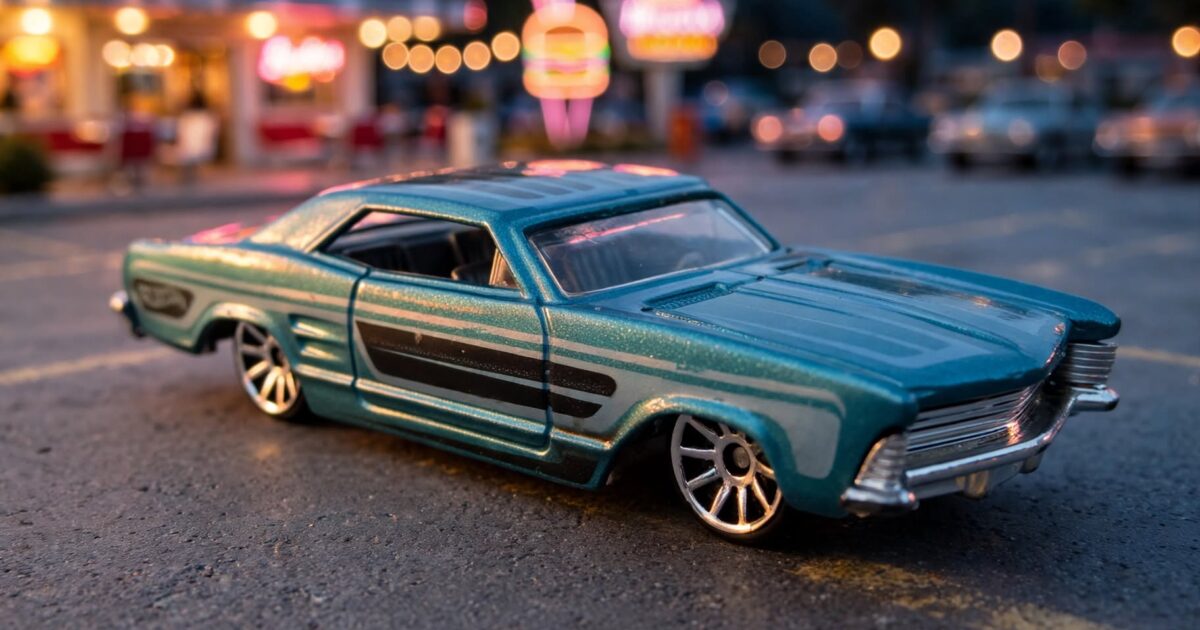
The proportions survive, which is the important part. The roofline is low and flat, the body sides are clean, and the vertical headlight arrangement is moulded into the front corners where it belongs.
What Hot Wheels changed is the attitude. This is not a stock Riviera. It sits low on large chrome wheels with a serious rake, and the whole car has been pushed toward a custom cruiser rather than a showroom coupe.
On this body the treatment works. The real car was already low and wide, so exaggerating those traits follows the design instead of fighting it. I have seen the same approach ruin upright cars from the same era.
Printed louvres and a teal metallic
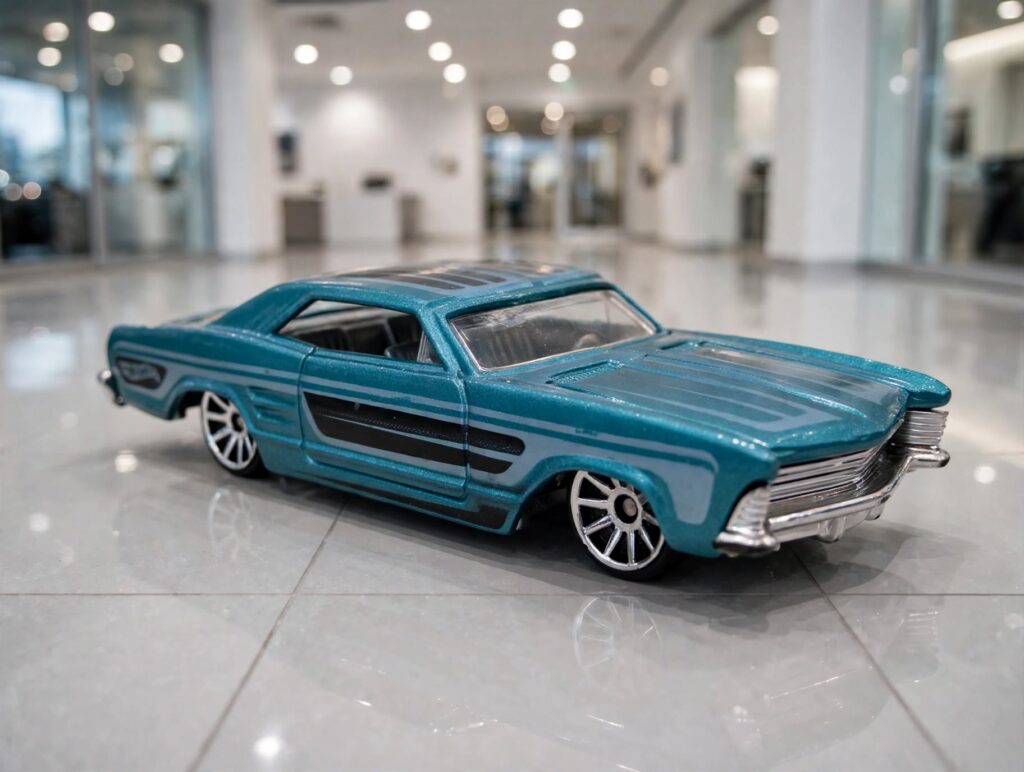
The deco is more interesting than it first appears. The bonnet, the roof and the rear deck carry printed louvre lines in a pale grey, the side panels have black and grey striping, and there is a Hot Wheels logo on the rear quarter.
Printed louvres are a hot rod reference. On real customs, louvres get punched into the sheet metal for cooling and for looks, and a car with louvres across the bonnet is announcing that somebody worked on it.
Doing it in tampo instead of moulding it is the cheap option, and here it is the correct one. Moulded louvres at this size turn into vague ripples. Printed ones stay crisp.
The teal metallic underneath is the real star. It is a period colour, it flatters the shape, and it photographs beautifully under almost any light.
First generation or boat tail: which Riviera?
If you are only buying one, it depends what you want the car to do on your shelf.
This one is the better looking object. Cleaner, sharper, easier to place next to other cars without looking strange.
The boat tail is the better conversation piece. Nobody asks about a handsome coupe. Everybody asks about the one with the pointed tail.
I ended up with both, and side by side they make each other more interesting. The first generation shows you what Buick was capable of when it was being disciplined, and the boat tail shows you what happened when the discipline ran out.
Stock or custom: which Riviera release?
Hot Wheels has run this body in both directions, and the choice matters more here than on most castings.
A custom release, like mine, gives you the lowered stance, big wheels and graphics. It looks like something out of a car show and it fits naturally alongside the rest of a Hot Wheels shelf.
A stock or near stock release gives you the car as Buick designed it, sitting at a realistic height on period wheels. That version shows off the actual design far better, because the 1964 Riviera was a triumph of restraint and a lowered custom treatment argues with that.
My advice depends on the rest of your collection. If everything around it is customised, match it. If you are building a shelf of sixties cars as they were, hold out for a stock version, because this is one of the few bodies where the factory car was already the better looking object.
Buying a loose ’64 Riviera
The printed louvres are the thing to check and most people skip them. They sit on the bonnet, the roof and the deck, all flat upward facing surfaces, which is exactly where handling wear concentrates. Faded louvres take the character out of the car.
Then the chrome. The front bumper and the grille surround are bright chrome and they sit at the furthest forward point of a long nose. Check them straight on.
Teal metallic hides scratches reasonably well and shows chips clearly, so run a light along the shoulder line and check the edges of the wings.
Then the usual roll test. This is a long car and a bent axle shows as a visible sag from the side.
Sixties personal luxury in 1:64
This is an underrated corner of the hobby. Everybody collects muscle cars from the same years, and almost nobody collects the coupes that outsold them.
The advantage is obvious once you start. Nobody is competing with you, the castings sit on shelves, and a row of them looks completely different from the muscle car display everybody else has built.
The Riviera is the best entry point because it is the best looking of the group, and because there are enough releases of this casting to find one in a colour you like.
Final thoughts
A genuinely handsome shape, lowered in a way that suits it, wearing printed louvres that reference hot rod culture without overdoing it. Cheap, common and better looking than most of the muscle cars from the same model year. Check the louvre tampo before you buy.