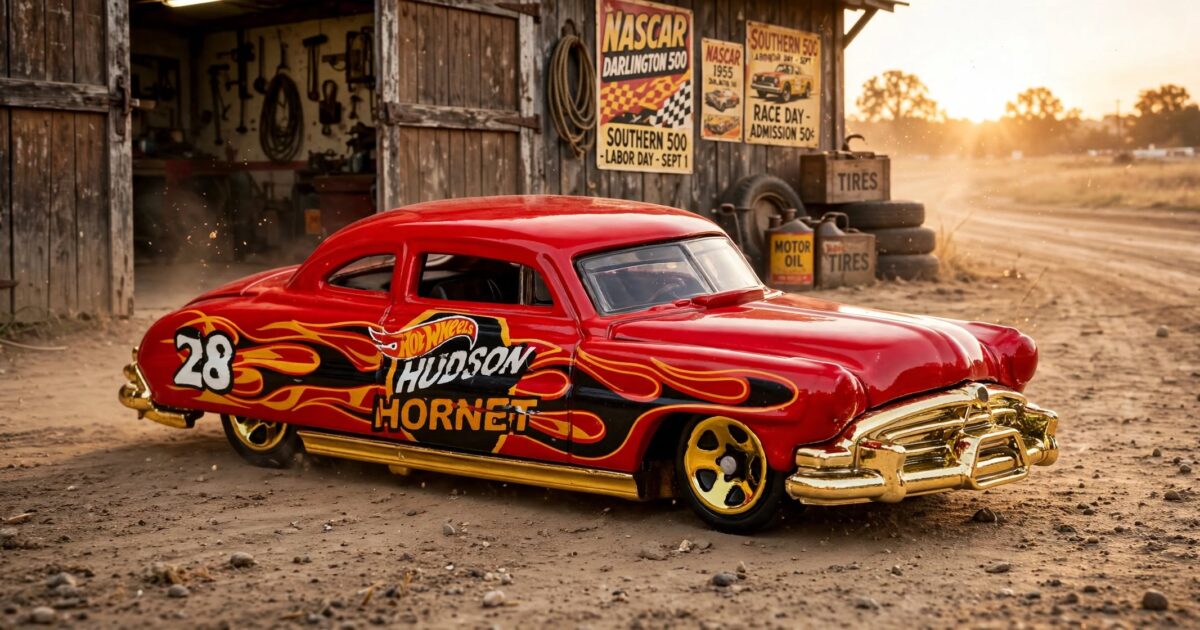
A slab sided family sedan from 1951 has no business being in a toy line built on speed. And yet here it is: long, low, dripping gold chrome, wearing a number 28 and a set of flames, and it works.
Why the real Hudson Hornet won so much
Hudson built its bodies with the floor pan dropped down between the frame rails instead of sitting on top of them. Everybody else put the floor on the frame. That one decision gave the car a far lower centre of gravity than anything else on the road, and in early fifties stock car racing it went out and beat cars with more power, repeatedly.
It won on cornering. That is why the casting makes sense: this is a genuine racing car, and the flames and the number are Hot Wheels acknowledging that history in their own language instead of building a museum piece.
The flame deco and the number 28
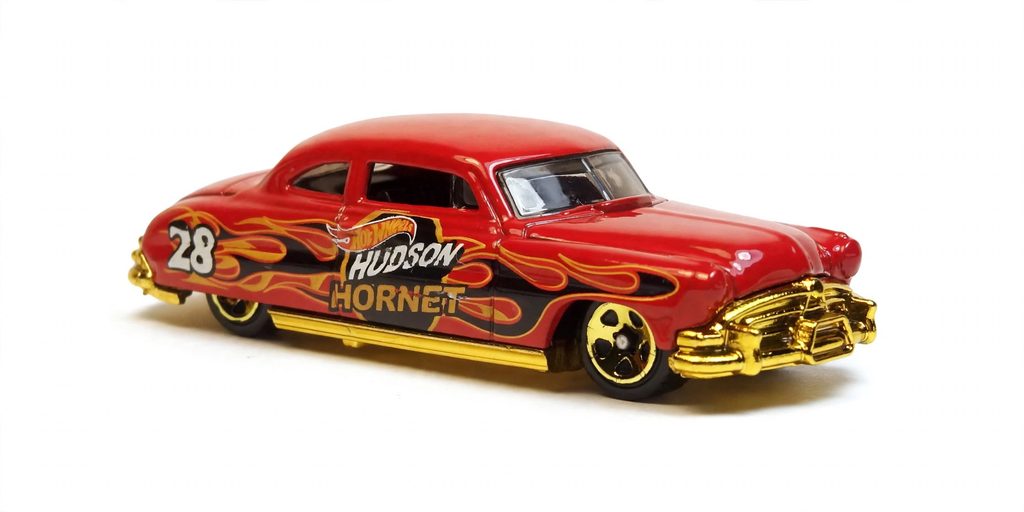
The tampo work is ambitious for a mainline release. Flames start at the rear quarter and sweep forward along the lower body in orange, yellow and dark brown layers, so not the flat two colour flames you get on most castings. A big white 28 sits inside the flame field on the rear quarter. Along the front fender and door, HUDSON HORNET runs in script under a Hot Wheels flame logo.
That is a lot of information on one side of a small car, and the reason it does not turn into noise is what they left alone. The roof and hood carry nothing at all. Your eye reads the lower band as decoration and the upper body as the car.
Gold chrome: love it or hate it
Front bumper, rear bumper, side trim and wheels on mine are gold chrome instead of silver. This is the one thing about the release that splits people, and both sides have a case.
Against: it can look gaudy, and there are versions with normal chrome that some collectors prefer for good reason.
For: the real Hudson had an absurd amount of brightwork, and gold on this warm red reads as period excess instead of as a mistake. I like it. It also photographs beautifully under warm light, which is not nothing if you post pictures.
One practical note. Gold chrome wears differently from silver. Rubbed spots go dull instead of going bright, and you cannot hide them. Check the bumper corners hard on any loose example.
Is the Hot Wheels Hudson Hornet worth collecting?
Yes, especially if your shelf is short on the 1950s or on odd body styles. Most of us have plenty of muscle cars and plenty of modern sports cars. Almost nobody has a good early fifties sedan, and this fills that hole cheaply.
There is also the animation connection, which brings in buyers who have never touched a diecast car before and know exactly what a Hudson Hornet is. I am not going to pretend that is not a legitimate reason to own one.
What to check on a loose Hudson
The gold chrome first, as above. Then the flames where they cross the door shut line.
Then something specific to this body. The sides are long and flat and completely exposed, more so than on almost any other casting in a case, so run a light across them at a shallow angle. Scratches there are very visible in hand and invisible in a phone photo.
The lower skirt is a gold painted strip running the full length of the car. On anything that got dragged around a floor, that strip is chewed. Look at it. Then roll for bent axles and check the base.
How to photograph it
This is one of the easiest cars in a collection to shoot. Long flat side for a canvas, gold chrome for a highlight, flames to give the eye somewhere to travel.
Low three quarter angle, warm light source at around forty five degrees, and it comes alive. Straight side on flattens it and throws away the shape, which is a shame because the shape is the whole reason the real car won races.
Gold chrome or silver chrome: which release to buy
Both exist and you will eventually have to choose, so here is how I would decide.
Take the gold if the Hudson is going to be a standalone piece on your shelf. It has enough presence to hold a spot on its own and the warm chrome suits the red body.
Take the silver if you are building a fifties group. Gold chrome next to four cars with conventional chrome makes the Hudson look like it wandered in from a different collection, and that undercuts the group you spent time assembling.
If you find both cheap, buy both. This is not an expensive casting and having the comparison on the shelf teaches you more about how trim colour changes a car than any amount of reading will.
Verdict
Real history, an ambitious flame job, and a gold chrome treatment that is either the best or the worst part depending on your taste. Not rare, will not appreciate, and it brings something to a shelf that no muscle car can. If you have never owned a fifties sedan in this scale, start here.