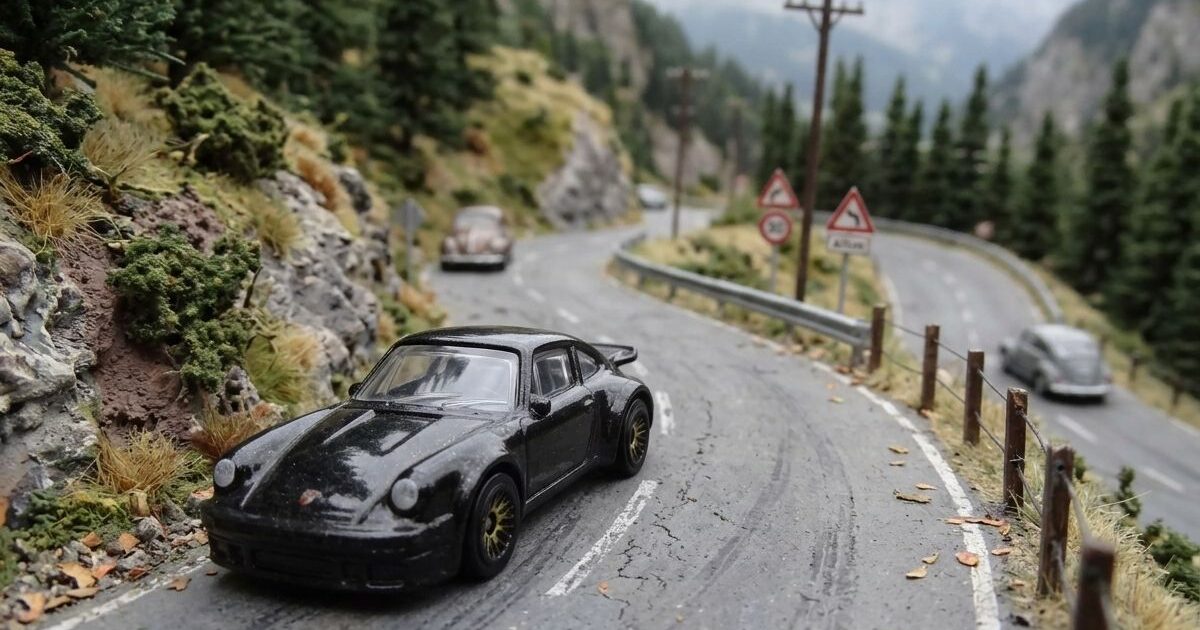
Put your thumb over the rear wing and the flares and look at what is left. A sloping roof running down into a rounded tail, two round headlights standing up on the front fenders, a nose that drops away early. It is a 911, unmodified, exactly as somebody could have bought one new.
That is unusual for a seventies race car. Most had drifted so far from anything sold in a showroom that the connection was a badge and a press release. This one kept the whole silhouette and just turned the volume up, and the casting is a good place to see it.
What was added, and what was left alone
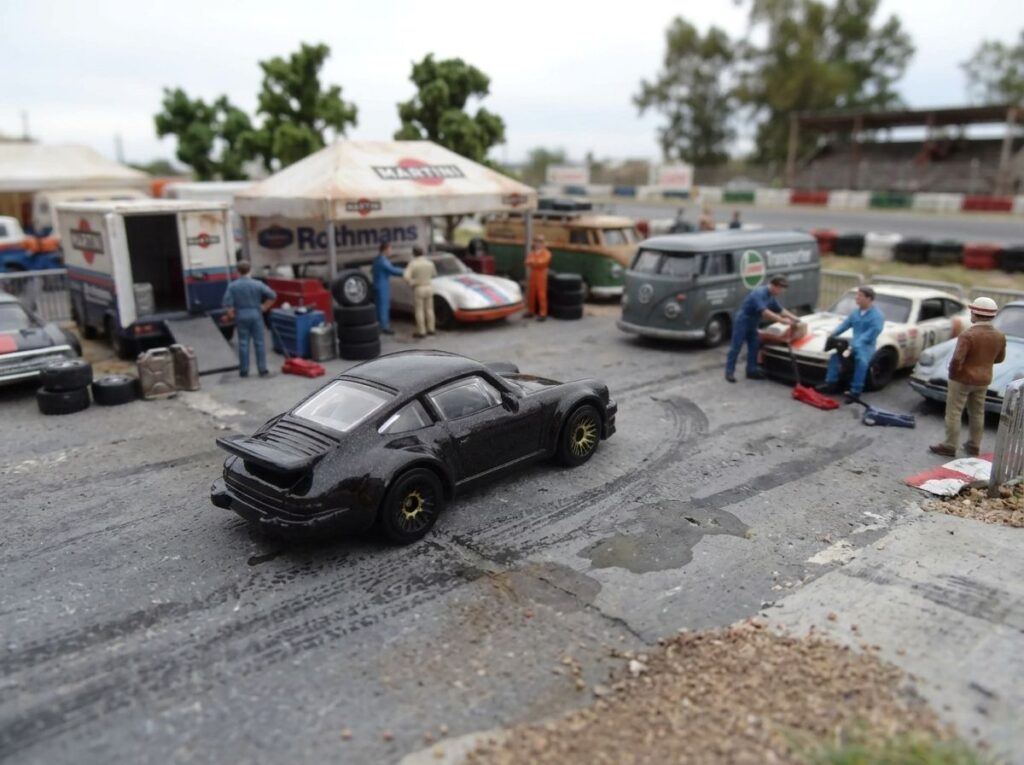
Added: enormously widened rear arches, a deep front splitter running under the nose, a whale tail spoiler standing off the engine lid with cooling grilles set into it, and wheels wide enough to fill the new bodywork.
Left alone: the roofline, the door shape, the window line, the headlight position, the way the tail falls away behind the rear wheels. Every one of those is the road car, untouched. The race parts are bolted onto a production shape instead of replacing it.
The rivets are actually there
Look closely at the edge of each rear flare and there is a line of raised dots following the curve. Those are the fasteners holding the widened panel to the body, and on this casting they are moulded in.
That matters more than it sounds. The usual compromise at this scale is to blend the flare into the body as one smooth surface, which looks fine and quietly removes the evidence that anything was ever bolted on. Here the seam is visible and the rivets are visible, so the model tells you how the real car was built. For the price, that is a generous piece of tooling.
I have the smoothed version of this elsewhere on the shelf, a nineties Porsche whose arches flow into the body with no seam at all, and holding the two together makes the difference obvious.
Black metalflake on a shape with nothing printed on it
The body is black with a heavy metallic flake that lifts to charcoal under direct light. There are no numbers, no sponsor panels, no stripes anywhere on it.
A race car with no livery is a strange object. In reality these things were covered in the names of whoever paid for the season, and a blank one reads as a car in the workshop before any of that arrived. I like it for exactly that reason, though it does mean the whole model depends on shape and shadow with no graphics to help.
The flake saves it. A flat black body would collapse into a silhouette under almost any light, and the metallic gives the surfaces something to catch so the flares and the roof still separate from each other.
Gold centred wheels and the stance
The wheels are dark with gold centres, deeply dished and wide enough that the tire shoulder sits almost level with the flare lip. Gold against black is a period correct combination and it is doing all the colour work on the car.
The stance is low and flat, with the splitter close to the surface at the front. There is no rake, which is right, because a car with that much rear bodywork needs to sit level or the back end starts to look like it is squatting.
The headlights are the only thing holding the identity
Everything about this vehicle was changed to go racing except two round lamps standing upright on top of the front fenders.
They are the reason you can identify it across a room. Lower them, flatten them or fair them into the bodywork and the car stops being recognisable immediately, which is more or less the problem the manufacturer has been managing for sixty years. On my example they are separate clear pieces with the lamp detail picked out inside, and they lift the whole front end.
Why the tail has nothing to show
Walk around to the back of most race cars at this scale and there is something to look at: an exposed engine, a visible cage, an open diffuser. This one has a flat engine lid, the spoiler and a plain lower panel.
That is a consequence of where the engine lives. With the motor sitting behind the rear axle under a closed lid, there is nothing for a casting to reveal, so the rear of this model is the least interesting angle on it. Shoot it from the front three quarter instead, low, with the flares catching light. My diorama guide covers surfaces that suit a car this dark.
Which shelf it belongs on
This is the practical reason to own one. A pure race car looks wrong parked among road cars, and a road car looks tame in a row of competition machinery. This sits on either shelf without arguing.
Very few castings manage that. Most declare which category they belong to before you have finished picking them up.
Put it with the street cars and it reads as the most extreme version of a shape you already know. Put it with the racers and it reads as the one that still has a production car inside it. The wider story of how this manufacturer has refined a single silhouette for decades is on my Porsche page.
The casting I keep turning over
Most models I own are settled after about a week. This one I still pick up, usually to look at the flare seam, because it is the detail that explains the entire car in about four millimetres of metal.
A road car, cut open at the rear quarters, with wider panels riveted over the holes so that wider tires would fit underneath. Every bit of that is visible on a three inch toy, and almost nothing else in my collection manages to document its own construction that clearly.