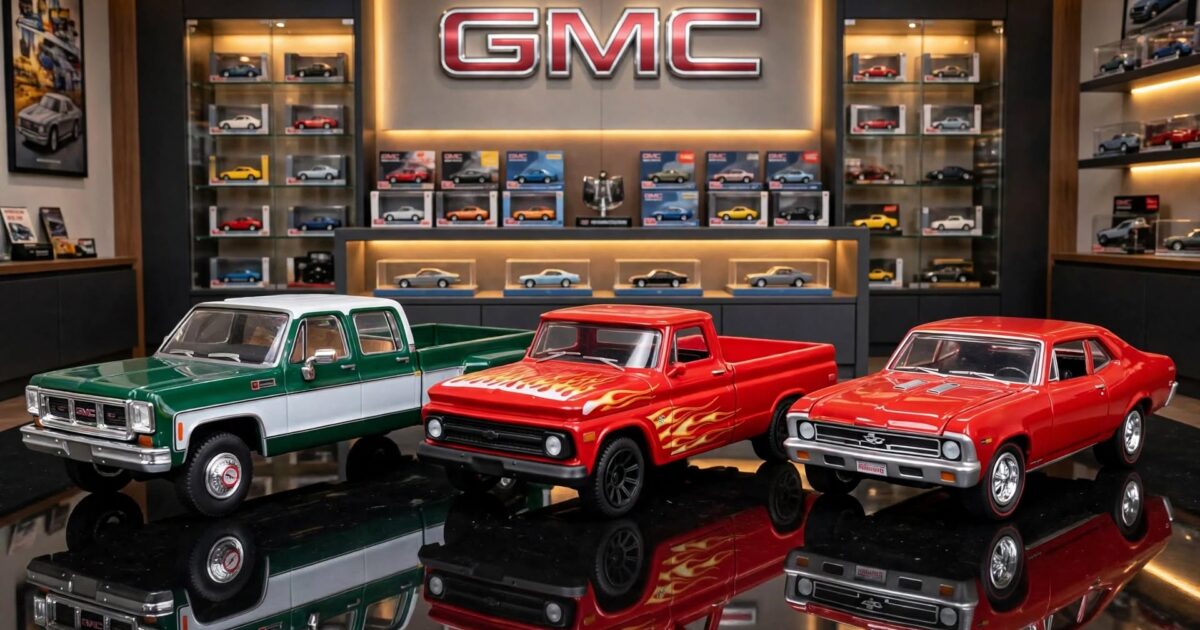
Pick up any American car on your shelf and read the base. It will say Chevrolet, or GMC, or Pontiac, or Cadillac, or Buick. What it will almost never say is General Motors, and yet one company owns or owned every one of those names. GM is the biggest presence in diecast that nobody collects by name.
That gap between the corporation and the badge is the whole story, and it explains why a hobby shelf ends up stocked with cars from brands that no longer exist.
What General Motors actually is, and why the badge never says so
GM was put together in 1908 by William Durant, who already ran Buick and spent the next two years buying up rivals. Oldsmobile came in that first year, Cadillac the next, and Oakland, which later turned into Pontiac, arrived at the same time. Durant lost control of the company he built, started Chevrolet with Louis Chevrolet in 1911, grew it fast enough to buy his way back into GM, and folded Chevrolet into the group in 1918.
So from the beginning GM was a holding company with car brands underneath it. Buyers were sold a Buick or a Cadillac. The parent name stayed on the share certificates.
How General Motors built a ladder of brands
Alfred Sloan took over in the twenties and set the structure that mattered. The idea was a car for every purse and purpose: Chevrolet at the bottom, then Pontiac, Oldsmobile, Buick, and Cadillac at the top. You started at the cheap end as a young buyer and climbed as you earned more, without ever leaving the company.
For a collector this is the single most useful thing to understand about GM. Those brands frequently shared floors, engines and even rooflines, dressed in different grilles and trim. One platform, five faces. That is the same logic the diecast industry uses when it runs a casting in a dozen liveries, and GM got there first by about sixty years.
Harley Earl and the moment styling became the product
In 1927 GM hired Harley Earl and gave him something no carmaker had: a department whose only job was how the car looked. He went on to build the first concept car, the Y-Job of 1938, and to push tailfins, wraparound glass and the kind of chrome that makes a fifties casting instantly readable at this scale.
That decision is why so many GM shapes survive being shrunk. A car designed around sculpture reads well as a small solid object. A car designed purely around packaging usually does not.
The General Motors brands that died and kept getting cast
Pontiac, Oldsmobile, Saturn and Hummer are gone. Saab was sold off. Holden, the Australian arm, closed in 2020, and Opel and Vauxhall went to a French group in 2017. By any normal measure those are discontinued products.
Open a peg at any supermarket and you will still find a Pontiac Firebird, a GTO, a Hummer. The shapes kept selling as toys long after the showrooms shut, because what collectors buy is a silhouette and a memory, not a dealer network. I find that genuinely strange and completely logical at the same time. Diecast is the last place some of these names still trade.
Chevrolet, GMC and the trucks that hold a collection together
Chevrolet is the volume brand and it shows on any shelf: Camaro, Corvette, Impala, Bel Air, C10, Silverado. GMC is the same trucks with a different grille and a slightly more expensive feel, and the two get mixed up constantly by people writing listings.
The pickups in particular are what make GM so heavily represented. Trucks suit this scale. They are tall enough to show detail, they look right on a diorama surface, and every manufacturer from Hot Wheels down to the cheap blister brands has done one. My index of car brand manufacturers has the full list of what is covered here.
What 2009 changed about General Motors
GM went into Chapter 11 in 2009 and came out as a smaller company. Pontiac, Saturn and Hummer were cut, and the brand ladder Sloan designed collapsed into four names in the United States.
Hummer came back later as an electric GMC, which tells you something about how the company now treats its own history. A dead badge is an asset to be revived when the market looks right. The same instinct keeps the old shapes circulating in toy ranges.
Collecting General Motors without noticing you are doing it
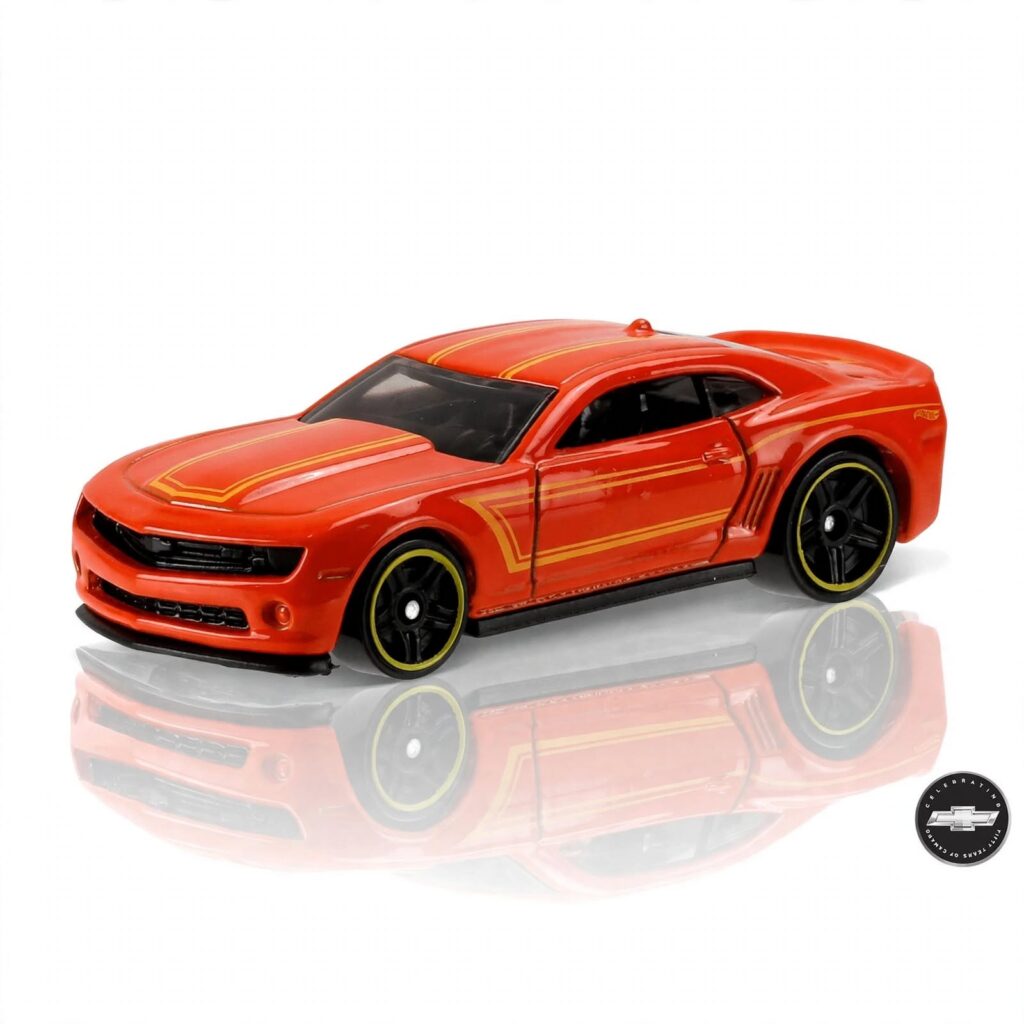
Here is the part I did not plan. When I counted my American cars, more than half carried a GM brand, and I had never once set out to buy a GM car. I bought a Camaro because I liked the shape, a C10 because I wanted a pickup, a GTO because it was on the peg.
That is what a hundred years of covering every price point does. The company is so woven into American car design that collecting American cars at all means collecting GM. The rivalry with Ford is the other half of that story, and between the two of them they account for most of the muscle and most of the trucks in this hobby.
Where I would start a General Motors shelf
If you want one row that tells the story, I would go with a fifties Chevrolet for the Earl years, a sixties Pontiac for the muscle era, a C10 or Silverado for the trucks, a Cadillac for the top of the ladder, and a Hummer for the part where the plan fell apart. Five cars, five decades, one company.
Then stand it next to a row of Mopars and you have the argument that American collectors have been having since before any of us were born. My piece on Dodge takes the other side.
Is General Motors a car brand or a parent company?
A parent company. It does not sell cars under its own name. Chevrolet, GMC, Buick and Cadillac are the brands you actually see on a car.
Which brands does General Motors still own?
In the United States, Chevrolet, GMC, Buick and Cadillac. Pontiac, Oldsmobile, Saturn and Hummer were discontinued, though the Hummer name returned as a GMC model.
Why are there so many Chevrolet models in diecast?
Volume and shape. Chevrolet sold enormous numbers of cars and trucks for decades, and many of those designs are instantly recognizable, which is exactly what a toy maker needs.
What is the difference between Chevrolet and GMC?
Historically they are closely related trucks sold through different dealer networks, with GMC positioned as the more expensive option. The sheet metal differences are usually in the grille and trim.
Are Pontiac and Oldsmobile models still produced as diecast?
Yes. Both brands ended, but their classic shapes continue to appear in mainline and premium ranges because collectors still want them.