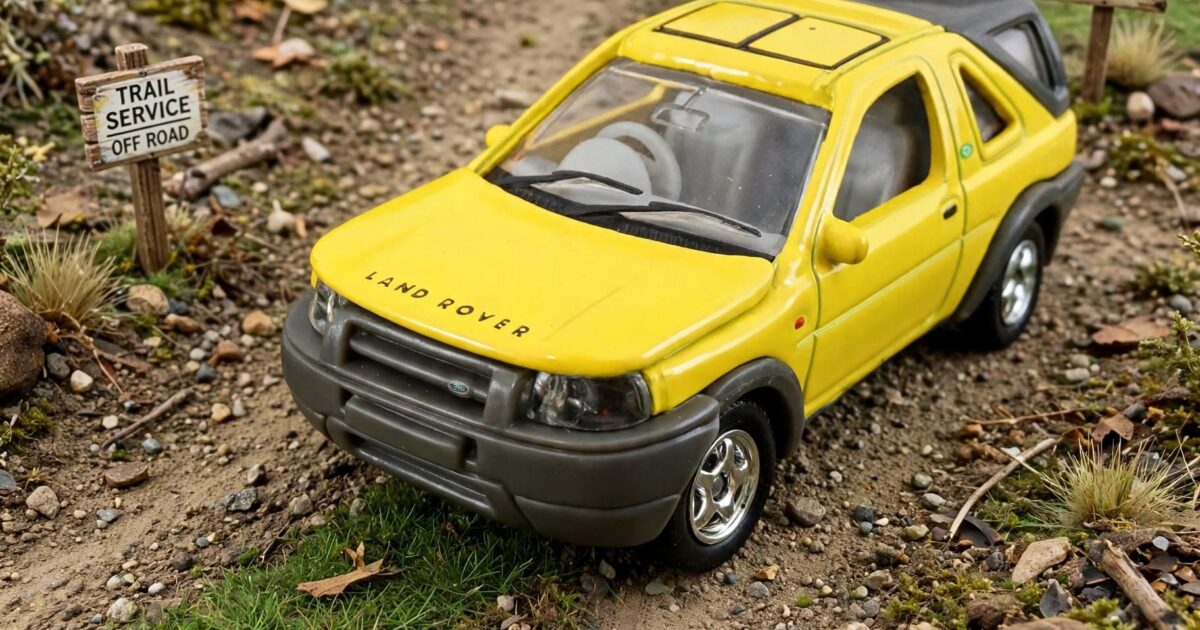
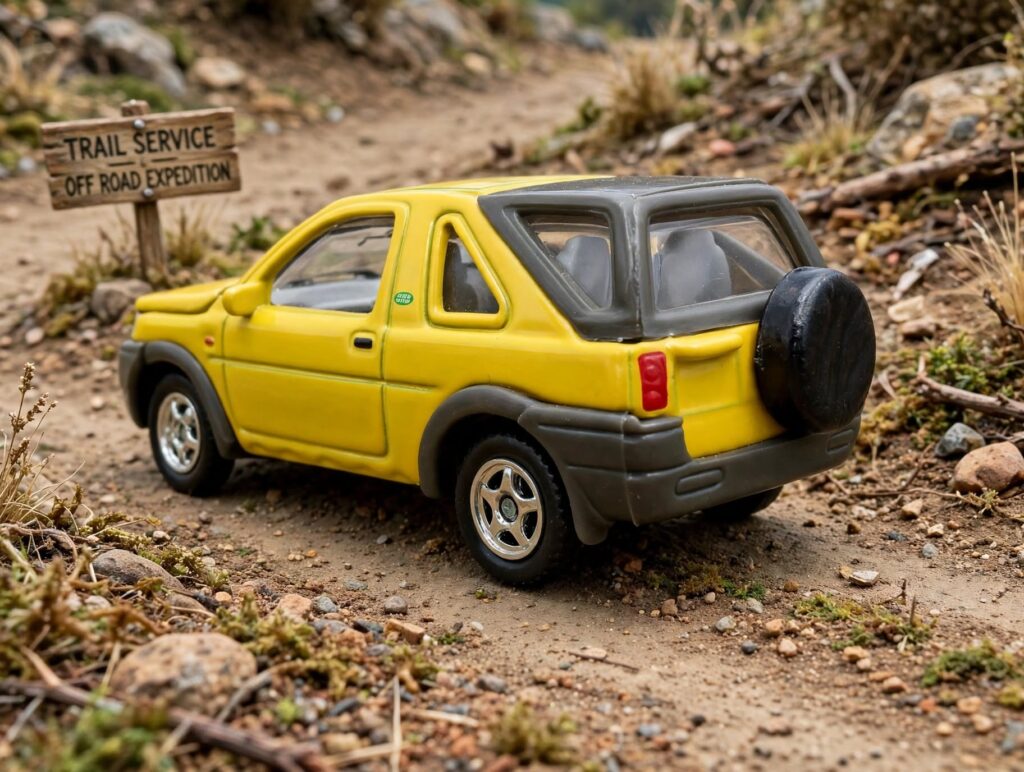
Stop and count the colors on this model. Yellow body, grey bumpers, grey wheel arch trim, grey sills, grey roof section over the rear, black tire on the tailgate, chrome wheels. That is a lot of contrast for a vehicle carrying no stripes, no decals and no tampo work at all beyond a single name printed on the hood.
None of it is paint. The grey parts are unpainted plastic, moulded in color and clipped to the body, which means the factory got a second and third tone for free. On a small casting that is about as close to a cheat code as the industry gets.
What the Welly Land Rover Freelander captures
The shape of a late nineties compact off roader, which is a very specific thing. Upright glass, short overhangs, a flat hood with a visible step down to the grille, and a stubby body with a sloping rear quarter panel.
The spare wheel hangs off the tailgate on its own carrier, which was the defining signature of this entire class of vehicle. Without it the back end would read as an ordinary hatchback, and the casting would lose most of its identity.
Unpainted cladding as a period signal
Here is what I find interesting. In the nineties, manufacturers left bumpers and arch trim in raw grey or black plastic on purpose. It said this vehicle is tough, it said scratches do not matter to anybody, and it said you can take it somewhere muddy without crying about the paint.
Within a decade that look had gone completely. Everything got body colored bumpers because buyers decided unpainted plastic looked cheap. So a model with grey cladding is date stamped as clearly as a tail fin or a vinyl roof, and anybody who grew up around these vehicles reads that signal instantly.
Why that trim is a gift to a casting
Two reasons, both practical. First, a separate plastic part costs less than a second paint operation, so the factory gets contrast without adding a step. Second, and more important, the grey breaks up the body.
A small yellow box with nothing on it anywhere would look like a bar of soap on wheels. Run a dark band around the lower edge and suddenly the vehicle has a waistline, the arches read as arches and the eye has somewhere to travel.
There is a catch. Unpainted plastic never matches the sheen of painted metal, so on close inspection the grey parts look flatter and slightly cheaper than the yellow ones. At arm’s length it reads as a two tone vehicle. Under a lamp at close range it reads as two materials.
The grey roof section and the glass
Behind the front doors the roof changes color, grey instead of yellow, with its own framing around the rear side windows and the hatch glass. On the real vehicle that was the hardback, a removable roof over the rear load area.
The casting treats it as a separate upper piece, which is accurate, and which gives the profile a strong horizontal break right where the body starts to slope. Through the glass there is a pale interior with seats visible front and rear, and because the windows are tall and upright you end up seeing a lot of it.
The front end and the lettering on the hood
The grille is a grey panel with horizontal slots and a badge in the middle, flanked by clear headlight units with the lamps picked out inside them. Below that sits a deep grey bumper with its own lower valance and recesses where the fog lamps go.
Across the hood, in fine spaced capitals, it says LAND ROVER. It is printed, not cast, and on my example it is sharp with even letter spacing. That is the only lettering anywhere on the body, which is restraint I appreciate on a vehicle this plain.
On the roof there are two black rectangles printed where the real vehicle had its sunroof panels. A flat graphic standing in for a recessed feature is always a compromise, and here it is the one place the model shows its price.
Chrome wheels on a working vehicle
This is where I disagree with the design team. The wheels are bright chrome five spoke designs, and they are too shiny for what this vehicle is.
A compact off roader with mud ready plastic cladding should be riding on something duller, in silver or grey, the way the real ones did. Chrome says shopping centre on a Saturday morning, and everything else about this model says farm track in the rain. It is the one note that fights the character of the whole casting, and a set of duller wheels would fix it completely.
Using a small off roader in a scene
It is an easy subject. Grass, dirt, a wooden ramp or a farm gate behind it, and the vehicle immediately looks like it belongs there. Yellow helps more than you would expect, because it separates cleanly from green and brown backgrounds in a way that silver or dark green never manages.
Shoot it from a low front three quarter angle so the spare wheel stays in frame behind the body. If you are building surfaces to shoot on, my diorama guide covers what works at this size.
What the yellow Freelander is for
Filling a gap most shelves have. Collections are full of supercars and muscle, and almost empty of the vehicles people actually bought in enormous numbers, which in the late nineties meant exactly this kind of compact high riding three door.
It is also cheap, well proportioned and easy to find, which makes it a sensible early buy for anybody still working out what they actually like. My starter guide goes into choosing a direction before spending real money. Put this one on a patch of grass, keep it well away from the chrome wheeled show cars, and it does exactly what it was built to do.