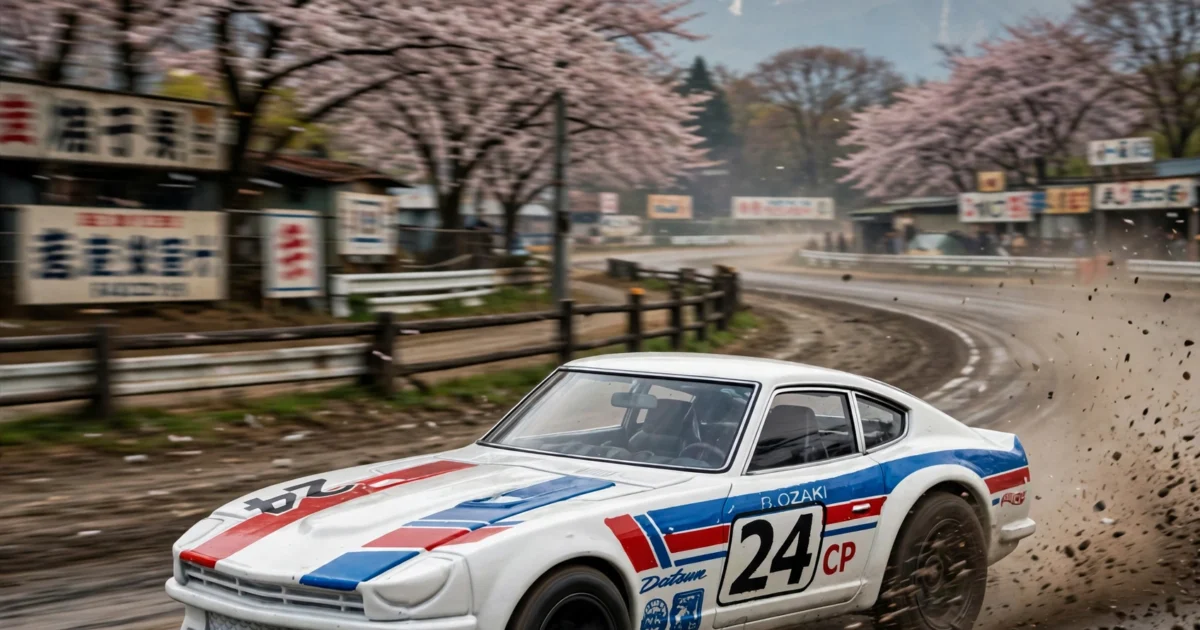
White body, red and blue stripes over the bonnet and along the flanks, a black 24 in a white roundel, a driver name printed just ahead of it. Anyone who knows American sports car racing from the early seventies recognises the scheme before they read a word.
Mattel put it on their Datsun 240Z and the result is one of the best looking small cars you can buy at mainline money.
Why the 240Z is such good source material
The original Z convinced a lot of American buyers that Japanese manufacturers could build something you wanted instead of something you settled for. Long bonnet, fastback roof, and a shape that borrowed enough from European grand tourers to feel familiar at a fraction of the price.
It sold in huge numbers and it went racing successfully in production classes, which is what the livery on this casting is pointing at. The white with red and blue striping and the number roundel evoke the American team that campaigned Datsuns to national titles, and the driver name on the side reinforces it.
How accurate is the casting?
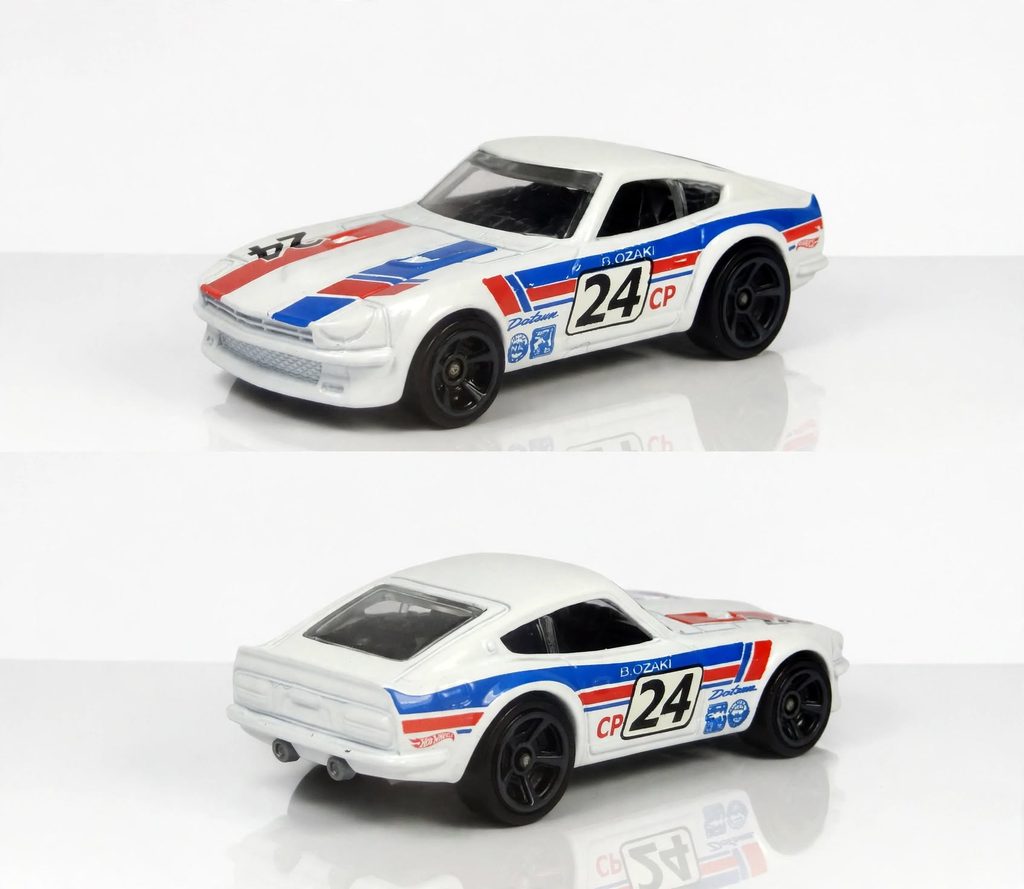
More accurate than I expected before I had one in hand. The bonnet length against the cabin is correct, the roofline falls at the right angle, and the rear hatch reads properly instead of being simplified into a slope.
The front has correct recessed headlight buckets under a slight brow and the grille opening is a fine mesh instead of a black smear. The one clear liberty is the arches, which are flared beyond stock, and on this body that is fine because the period competition cars ran wide arches too.
The rear end deserves a mention on its own. Twin exhaust tips moulded in under the valance, tail lights picked out, and the roofline meeting the hatch cleanly. Rear ends are usually where 1:64 castings go lazy and this one does not.
Printing on a curved bonnet
The stripes start on the nose, run over the bonnet as a red over blue pair, and carry along the upper flank to the rear quarter where they follow the arch line. A second thinner pair frames the number roundel low on the door, with small contingency style decals behind the front wheel and Datsun script in two places.
The number 24 is also printed on the bonnet. That is the detail I would point at if somebody asked why this release is better than average, because printing on a curved horizontal surface is harder than printing on a flat door and most liveries in this scale skip it.
The problem with white diecast
White is a difficult body colour. It shows every flaw in the paint and every misalignment in the tampo, and there is nowhere to hide.
On mine the printing is clean and the white is bright instead of creamy, which is what you want and what you should check for. Loose examples stored in sunlight go slightly yellow, and a yellowed white car will never look right parked next to a fresh one. You notice it immediately and then you cannot stop noticing it.
Is the Hot Wheels 240Z worth collecting?
One of the essential Japanese castings, alongside the usual Skyline and Supra suspects. Cheap, widely released in different colours, and the tooling survives close inspection.
If you are starting a Japanese section, start here instead of with a modern car. The seventies stuff is where the interesting shapes are and this is the friendliest entry point.
It is also one of the best cars in the range for photography. White reflects light evenly, the stripes give the composition a line to follow, and the shape is clean enough that it does not need a complicated background to look good.
Buying a loose 240Z
White paint first, as above. Look across the bonnet and roof under angled light for scuffing, and check the colour against something you know is fresh if you can.
Then the tampo. The bonnet stripes cross the highest point of the car and take the most handling, and the number on the bonnet sits exactly where thumbs land.
Then the lower valance for scraping, a roll test, and confirm both roundels are intact. If you are buying from photos, ask for one taken straight down onto the bonnet. Side photos hide the exact wear you care about on this casting, and sellers know it.
Building a Japanese shelf around it
The Z anchors a seventies Japanese group nicely. Pair it with period cars instead of modern JDM heroes and the shelf gains a decade instead of a vague nationality.
A racing liveried Z next to street spec cars from the same years also gives you the contrast between what people drove and what people raced, which is more interesting than a row of cars that all did the same thing.
Which 240Z release should you buy first?
The casting has appeared in plain colours, in racing liveries and in premium versions, and I would go for a racing livery first even though the plain ones are often better looking objects.
The reason is that the shape alone does not tell you anything. In flat orange it is a nice silhouette and nothing more. With the stripes and the number it points at the racing history, and that gives anyone looking at your shelf a reason to ask about it.
Premium versions with rubber tyres and metal bases are the obvious upgrade and they cost several times as much. My honest view is that on this particular casting the mainline version already gets the important things right, so spend the difference on two more cars instead.
Verdict
Accurate proportions, sharp tampo including printing on curved surfaces, and a livery with real motorsport history behind it. Watch the white paint when buying loose. Otherwise buy it without thinking about it.