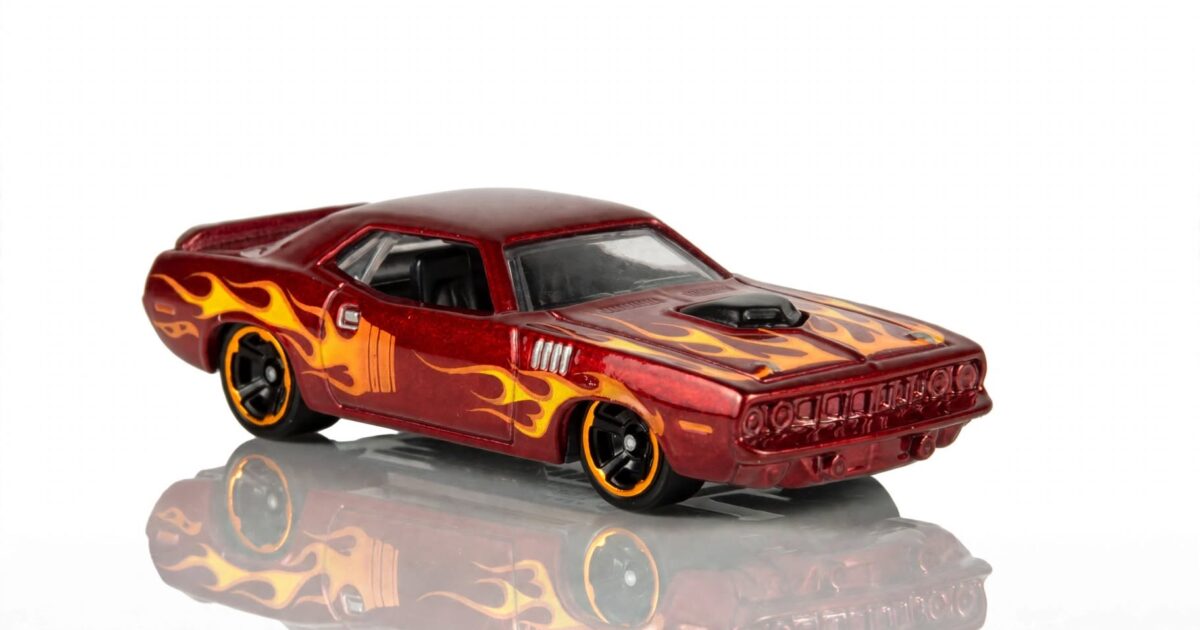
I bought this one by accident. It came inside a bag of loose cars I picked up mostly for two other castings, and when I tipped the bag out on the table this dark red Cuda rolled out with orange flames down both sides and I forgot about the cars I had actually wanted. Six months later it is still on the shelf and the two I paid for are in a drawer somewhere.
What car is the Hot Wheels Plymouth Cuda based on?
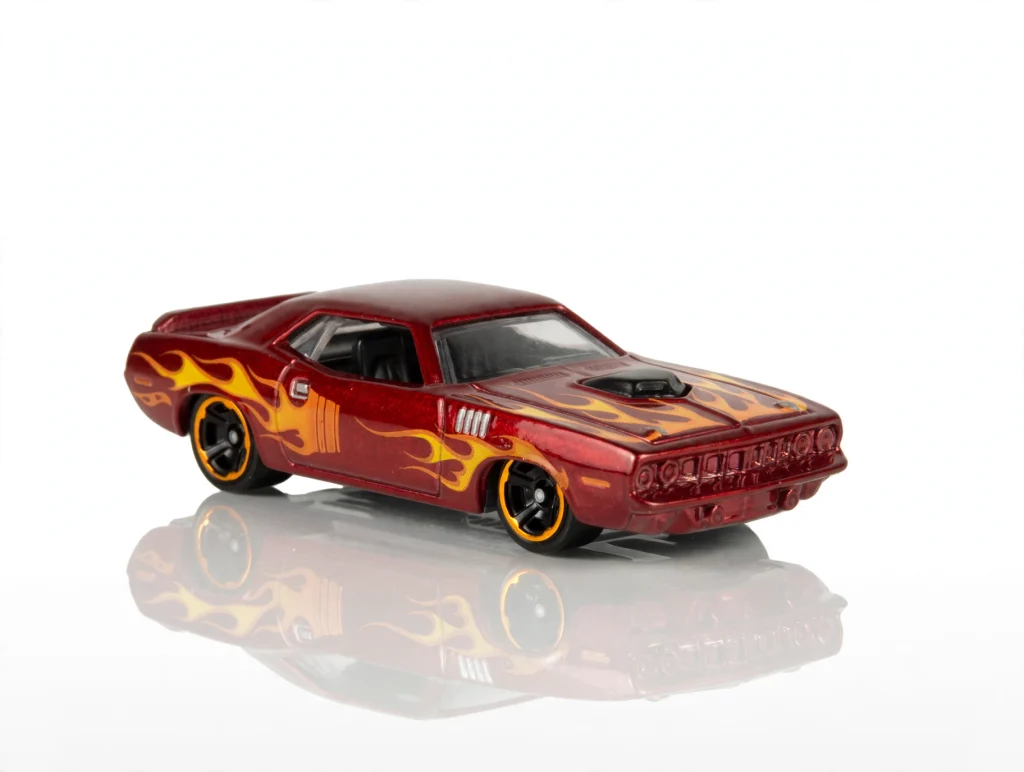
The 1971 Plymouth Barracuda, last year of the second generation E-body. After that model year the insurance companies and the emissions rules finished off the whole class, so 1971 is the one people chase.
You can date it from the side of the car. That year, and only that year, Plymouth put four gill vents in the front fender behind the wheel arch, and quad headlights up front. Both are on the casting. If you are trying to work out which Barracuda tool you are looking at in a blurry auction photo, count the gills.
How accurate is the casting?
Not very, and I do not mind. Mattel stretched the rear deck and pushed the roof back, so the car reads longer and lower than the real one. The nose is squared off and the grille is a row of vertical slots moulded straight into the body.
If you collect for accuracy this will annoy you. Go and buy a premium release or a Matchbox and you will be happier. What you get here instead is presence. The thing looks like it is doing 60 sitting still on a shelf, and that is a real quality even if it is not a measurable one.
The flame tampo and the moulded blower scoop
The flames are the reason anyone buys this release. They start at the front bumper, run over the hood, wrap the fenders and trail back along the doors in orange over yellow. On a dark red body they read clean from across a room. I have seen the same flame treatment on lighter colours and it turns to mud, so the base colour is doing a lot of work here.
The hood scoop is moulded into the body instead of being a separate plastic piece. Cheaper for Mattel, and you can see it: the scoop has no real depth, it is a black rectangle with a raised lip. The upside is that it will never snap off, which is more than I can say for the rear wing.
My car sits on black five spokes with a yellow outer ring, picking up the flame colours. It is a better pairing than plain chrome. Wheel swaps between releases are common on this body, so yours may not match mine.
Is the Hot Wheels Plymouth Cuda worth collecting?
For most people, yes, with one condition: buy it because you like looking at it, not because you think it will be an investment. This is a mainline car produced in enormous numbers. It will never behave like a Super Treasure Hunt or a Red Line Club release, and anyone telling you otherwise is trying to sell you one.
What it does give you is a big, obvious Mopar shape in a colourway that gets along with almost anything else on the shelf. If you are building a muscle car row, it earns its slot the day it arrives.
Buying a loose ’71 Cuda: what to check
Flames wear from the front. Look at the hood tip and the leading edge of both front fenders for thinning, because that is where fingers land when someone picks a car up.
Then the wing. It is tall, squared off, and it spans the full deck, which makes it the first thing to break. Look at the car from directly behind. If one end sits higher, it has been bent back into shape by somebody at some point.
After that, the boring checks. Roll it on a flat surface and watch for a wobble, which means a bent axle. Look through the windscreen for scratching in the clear plastic, the kind you never see in a listing photo and always notice in your hand. Check the base for cracks around the rivets.
Building a Mopar shelf around it
Mine lives between a ’69 Charger and a ’70 Superbird. Three loud Mopars from the same short window, lined up in order of how ridiculous they are. It looks deliberate, which is the whole reason to collect by theme instead of by rarity.
I would take three related cars in average condition over three unrelated mint ones. The first arrangement tells you something. The second is just storage.
Which flamed Cuda are you looking at?
The same body has carried flames more than once, and the differences are small enough that auction photos blur them together. Mine is dark metallic red with orange over yellow flames and black five spokes with a yellow ring.
Check the base colour under decent light first, because metallic red and plain red look identical on a phone screen and completely different in hand. Then the wheels. Chrome five spokes, plain black wheels and the yellow ringed version all exist on this casting, and swapped wheels on a loose car are common enough that you should assume nothing.
The flame pattern itself is the least reliable way to tell releases apart, since Mattel reuses tampo artwork across colours. If a seller tells you a particular flame layout makes a car rare, ask which release they mean and then go and look it up before you agree.
Verdict
Common, cheap, and one of the best looking flame decos in the mainline range. It will not make you money. It photographs beautifully, it costs about as much as a coffee, and there is something to be said for a car that is simply good and simply available in a hobby where everyone spends their energy chasing things they cannot find. If you see one loose with clean flames, take it.