I bought this one for a reason I am slightly embarrassed about. Not the model, not the brand, not the opening tailgate. The color. It was sitting under a shop light and the blue had that deep metallic flake that most small cars never get to show off, and I picked it up before I had looked at anything else.
Three months later I still think that was the right call, and the reason has to do with what a big dull body is actually good for.
Why the Majorette GL-Class is mostly about its finish
A full size three row Mercedes SUV is not an exciting object. It has no romance, no racing history, no story anybody tells at a car meet. It takes children to school.
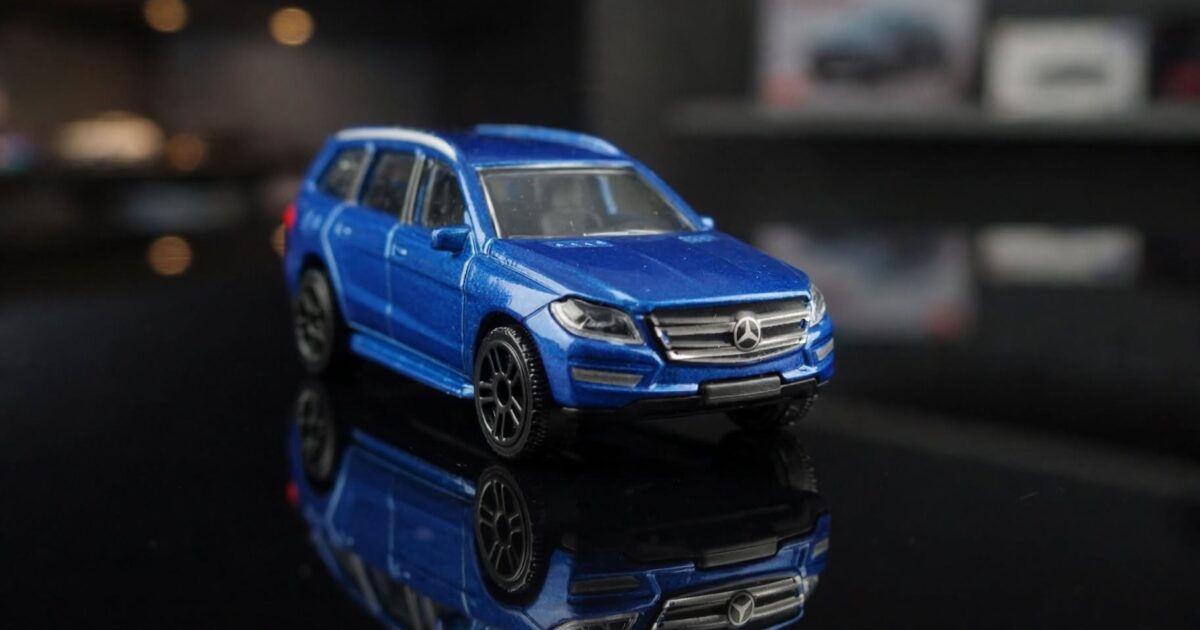
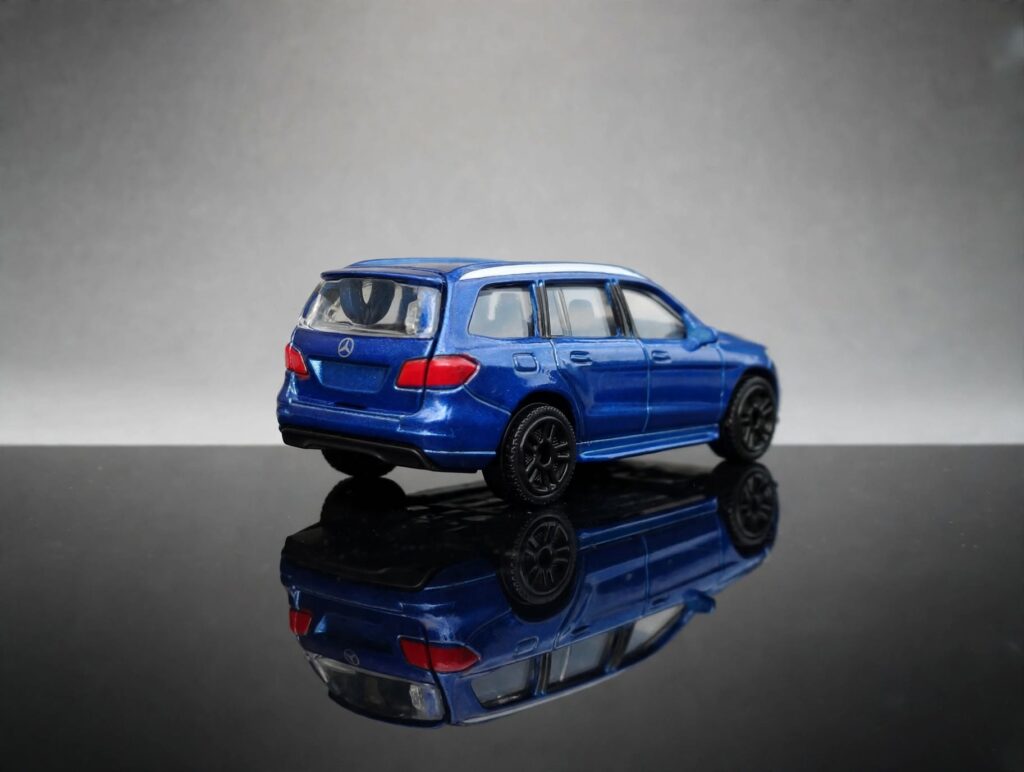
What it has is surface. Long flat doors, a long flat hood, a roof you can see all of at once. On a low slung sports car a metallic paint is broken up by curves and shadows before your eye can read it. Here you get a few square centimeters of uninterrupted blue in every direction, and the flake in it catches light across the whole panel at the same time.
Metallic blue needs a big flat body
Look at the hood in direct sun and the particles in the paint light up as a sheet. Turn the car ten degrees and the whole panel shifts a shade darker. That is the effect you pay for with a metallic finish, and most 1:64 castings are too small and too sculpted to deliver it.
My example has even coverage with no thin spots along the roof edges or the top of the arches, which is where budget paint usually fails first. The lower bumper trim and the sills are molded in a separate black, cleanly divided from the blue with no overspray.
What the Mercedes GL front end gets right
The grille is the identifying feature and the casting leans on it hard. Two broad horizontal chrome bars with a large three pointed star in the middle, proportionally bigger than the real one. Beside it the headlights are clear inserts with some internal shape to them, not painted blocks, and they pick up light properly from a front three quarter angle.
Below that there is a black lower intake and a silver skid plate section. Those two pieces give the nose some depth, which matters because the real vehicle is essentially a wall with a badge on it. Without them the front would read as flat.
The tailgate opens, and that changes less than you expect
It lifts, it stays up, it closes flush. The hinge works properly, which is more than some opening parts manage at this price.
What is behind it is an empty plastic cavity. No seats folded down, no load floor detail, nothing. So the feature is a mechanism rather than a window into anything, and after the first week I stopped opening it. I would have taken a molded rear interior over the hinge, though I understand why the hinge is what sells the model in a shop.
Majorette Premium against the supermarket blister
This comes from the brand’s upper line, and the difference against a basic blister car is visible without looking hard. Better paint, clear headlight pieces instead of printed ones, an opening part, and more consistent assembly.
It is also the brand’s whole argument. Majorette sits in a gap that the American brands mostly ignore, making ordinary European vehicles with a level of finish above the cheapest end. I made the longer case in my piece on Majorette as a brand, and the Majorette Silverado is the same approach applied to an American truck.
Wheels, roof rails and the small silver details
The wheels are black five double spoke designs, and they suit the vehicle. Modern SUVs wear dark wheels in real life, so this is one of the rare cases where a manufacturer’s default black wheel is also the accurate choice. They fill the arches without sticking out past the bodywork.
The roof rails are picked out in silver and run the full length of the roof as separate raised rails rather than painted lines. Up close you can see daylight under them in places, which is a nicer piece of molding than this vehicle really deserves.
The stance is correct. It sits tall, level, and with the right amount of arch gap for something designed to carry seven people and their luggage.
The one thing I would warn you about
Metallic paint shows every scratch, and mine has picked up a few on the hood and along the roof. Hairline marks that would be invisible on a solid color read as pale lines against the flake, because a scratch breaks the particle layer and scatters light differently.
So if you buy this one, keep it off a desk where things get pushed around, and do not store it loose in a tin with other cars. The finish is the reason to own it and it is also the most fragile thing about it.
What a Majorette SUV does on a shelf full of sports cars
It fixes a problem I did not know I had. A display made entirely of supercars, muscle cars and race liveries looks like a showroom, and showrooms are not places anybody recognizes. Add two or three ordinary vehicles and the same shelf starts to look like a street.
This is the best kind of car for that job, because it is large enough to anchor a scene and boring enough that nothing about it competes for attention. In a layout it reads as parked traffic immediately. My notes on building a 1:64 diorama go into why that matters more than people expect.
Would I buy another Mercedes GL at this price
Yes, and in a darker color. Black or graphite with the same flake would be even better under a single light, and it would hide the scratches that this blue is going to keep collecting.