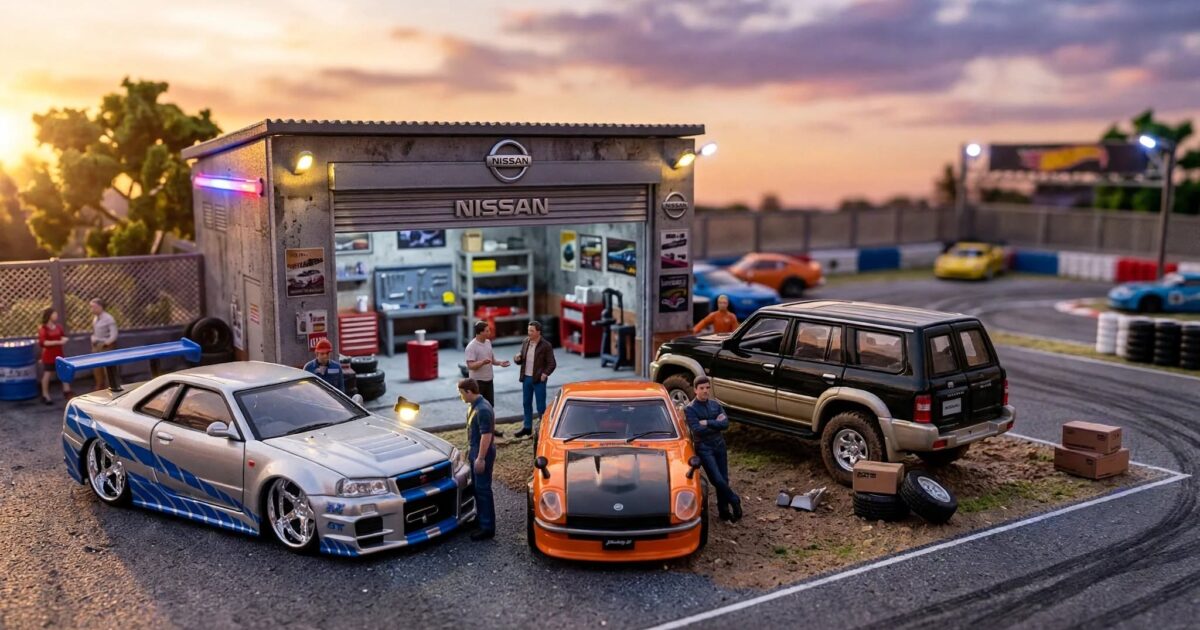
Something confuses every collector of these sooner or later. You have a small model of a Japanese sports car. The badge on the nose says one thing, the base says another, and the internet argues about which is correct.
Both are. For most of the twentieth century, the company known at home as Nissan sold its cars abroad under the Datsun name, and the changeover happened gradually enough that plenty of vehicles exist with both badges. If you collect Japanese cars at small scale, this is the first thing to get straight.
Datsun and Nissan: one company, two names
The short version is that Datsun was the export brand and Nissan was the company. Cars sold in Japan wore one badge, cars shipped overseas often wore the other, and through the late seventies and early eighties the Datsun name was phased out in favour of Nissan everywhere.
Then it came back. The name was revived decades later for a range of low cost models aimed at developing markets, which means a Datsun badge on a vehicle tells you very little on its own without knowing the decade.
For a collector this matters practically. Search for one name and you will miss half of what exists. Catalogue your shelf under one name and you will eventually have to go back and fix it.
Where the name Nissan came from
It is an abbreviation. The company grew out of a holding company called Nihon Sangyo, and the contraction of those two words became the name on the cars. That holding company also had interests well outside the car business, which was normal for large Japanese industrial groups of the period.
The motor company itself was established in the early 1930s under Yoshisuke Aikawa, and its first vehicles were small cars built with British engineering help, under a licensing arrangement with an established manufacturer in the United Kingdom. Building somebody else’s design under licence was the standard way into the industry at the time, and several famous manufacturers started exactly the same way.
The Prince merger and what it brought
In 1966 Nissan absorbed Prince Motor Company, and that single corporate decision shaped a large part of what collectors chase today. Prince brought two model lines with it, and one of them was the Skyline.
Everything that name went on to mean, the racing, the performance versions, the cult following that grew outside Japan decades later, arrived through a merger instead of from Nissan’s own drawing boards. The Gloria came across in the same deal.
The 240Z and why every brand has made one
If a Japanese car was going to break into diecast ranges built for American and European buyers, it was always going to be this one. A long hood, a short tail, a fastback roof and a straight six, sold at a price that undercut everything it looked like.
The shape also happens to be easy to cast well. The proportions are classic sports car proportions, the surfaces are simple, and there is nothing fiddly to lose when it gets shrunk to three inches. That combination is why it turns up in almost every brand’s catalogue, in every price bracket, year after year.
That also makes it the cheapest way to compare brands against each other. Buy the same car from three makers and the differences in tooling and paint land in front of you.
Why Japanese cars arrived late to diecast ranges
Toy ranges follow the market they sell into. For decades that meant American muscle in American stores and European hatchbacks in European ones, with Japanese vehicles treated as background traffic by both.
What changed was the audience. The children who grew up around these cars in the eighties and nineties became the adults buying collector models, and the brands followed the money. A Skyline or a Silvia in a mainline range would have been unthinkable in 1985 and is routine now.
The Nissans nobody casts
There are plenty. The company has built pickups, vans, taxis, saloons and some genuinely enormous off road vehicles, and almost none of that appears on a peg.
That gap exists for every manufacturer. The exciting cars get made, the working ones get skipped, and a collection ends up representing a motor show instead of a street. If you want the ordinary vehicles, you have to seek out the brands that specialise in them, which I covered on the diecast car brands page.
Nissan and Renault
Since 1999 the company has been tied to Renault in an alliance that has been rearranged more than once, most significantly in 2023 when the two rebalanced their cross shareholdings. Mitsubishi joined the group later.
For the purposes of a shelf this matters less than it sounds, since the cars stayed distinct. It does mean that a French hatchback and a Japanese saloon on the same shelf may have more in common underneath than their badges suggest. The wider manufacturer picture is on my car brand manufacturers page.
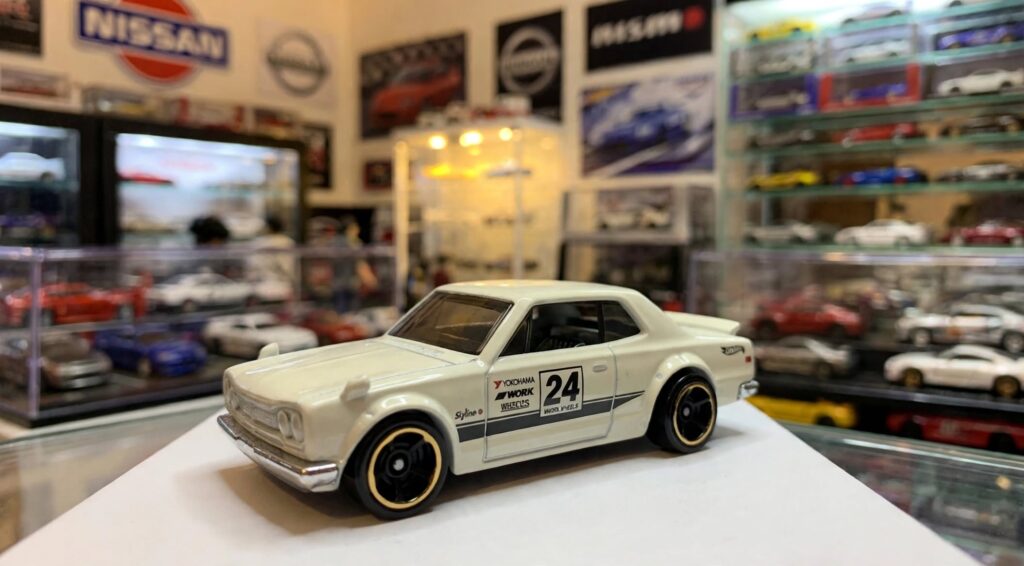
Is Datsun the same as Nissan?
Yes. Datsun was the export name used for decades by the company called Nissan, phased out in the early eighties and revived much later for a separate low-cost range.
Which Nissan is the most common in diecast?
The 240Z, by a wide margin, followed by the Skyline in its various performance forms. Both have been produced by nearly every brand in the hobby.
Why do some models say Datsun and some say Nissan?
Because the changeover took years and because castings copy whichever badge the real car wore. Two models of the same vehicle can legitimately carry different names.
Are old Datsun castings more valuable?
Not automatically. Age helps, but condition, packaging and how many were produced matter far more. A common casting from 1975 in poor condition is still a common casting.
Where should a new collector start with Nissan?
With a 240Z from a mainline range. It is cheap, available everywhere, and it gives you a reference point for judging every other version you come across later.