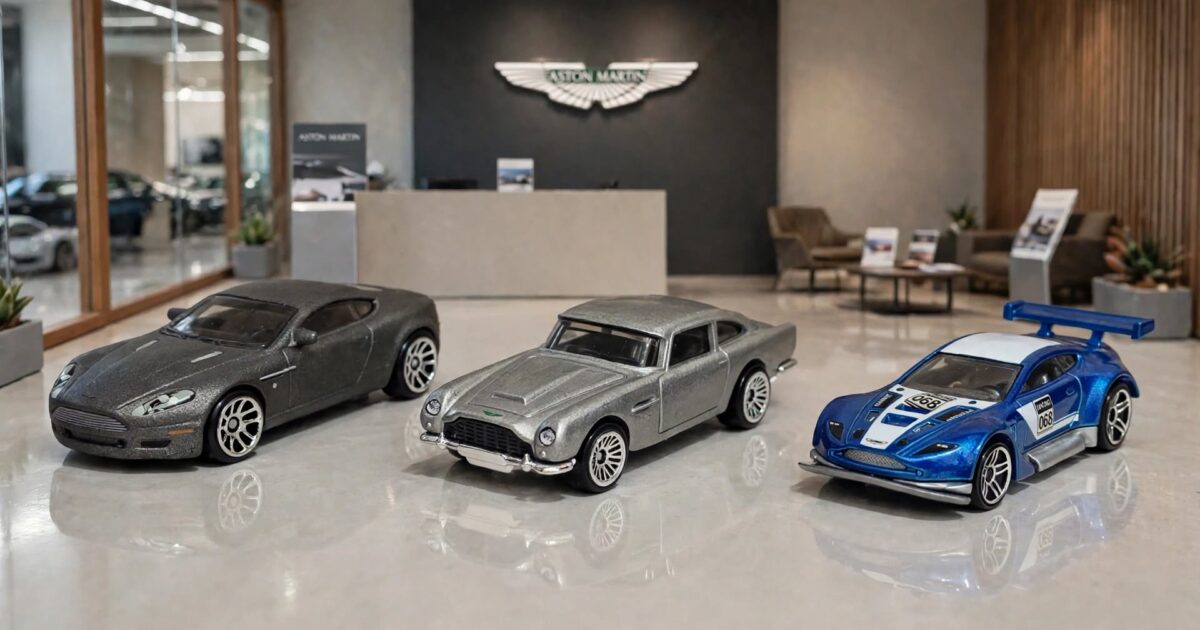
Put an Aston Martin next to an Italian supercar on a shelf and the difference is immediate. One is all wedges, scissor doors and colours you would never choose for a normal car. The other is a long, calm shape in dark green or silver, built for somebody who wanted the performance without the audience.
That restraint is the whole brand, and it explains both why the real cars have lasted more than a century and why they are harder to find in a toy aisle than almost any other famous marque.
A hill climb gave the company its name
The company began in 1913, founded by Robert Bamford and Lionel Martin as Bamford and Martin. Martin raced, and one of the places he raced was a hill climb at Aston near Aston Clinton, where he did well enough that the name stuck to him.
By 1914 the firm had taken the name Aston Martin, which makes it one of the few car companies in the world named after a piece of road instead of a person or a place of manufacture. That detail tells you what the founders cared about.
The David Brown years
Money and engineering arrived together in the late 1940s, when the industrialist David Brown bought the company and then bought Lagonda as well, merging the two into the business that still carries both names.
Brown also gave the cars his initials. The DB prefix that collectors know from DB4, DB5 and everything since is simply a man signing his own work, and it has outlived him by decades.
Le Mans, 1959
The high point of the racing programme came in 1959, when the DBR1 won the twenty four hour race at Le Mans. For a small British manufacturer competing against far better funded operations, that result was the credential the brand had been chasing since 1913.
After that, Brown shifted the focus toward road cars. It turned out to be good timing, because the thing that would make Aston Martin a household name was about to arrive from an unexpected direction.
The company had spent four decades proving itself on circuits to an audience of enthusiasts. What came next reached everybody else.
The film car that changed everything
In 1964 a silver DB5 appeared in a British spy film, fitted with equipment no real car ever had, and the brand stopped being a small specialist concern known mainly to enthusiasts.
That association has never gone away. The films kept using the cars, including a model built specially for the production in 2015 that never reached customers at all. For a company that sells a few thousand cars a year, decades of appearing on screen is a marketing budget nobody could buy.
For collectors it has another effect. A large share of the Aston Martin castings ever produced are of that one silver car, which means the rest of the range is thinner than it should be.
Why Aston Martin castings stay scarce
Here is the practical problem for a collector. Toy ranges are built around what sells on a peg, and what sells is loud: wings, flares, colours that read as fast from two metres away.
An Aston is the opposite. The appeal of the shape lives in proportion and surface, qualities that need a good casting and good light to come across at all. Add to that a manufacturer that builds in small numbers and has historically been selective about licensing, and the result is a brand that turns up far less often than its reputation suggests.
What to look for in a small Aston Martin
Proportion first. These cars have a long hood, a cabin set well back, and a grille shape that has survived almost unchanged for sixty years. Get those three wrong and the casting reads as a generic coupe with a badge.
The grille is the tell. On a good casting it is a wide, low shape with rounded upper corners, set into the nose instead of bolted onto it. On a poor one it becomes a plain black rectangle and the whole car loses its identity.
Then colour. Dark green and silver are the shades the brand is known for, and both are hard to photograph well. If you want to know what to check before buying a casting in any finish, my guide to starting a diecast collection covers condition and where to look.
Where Aston fits among the supercar makers
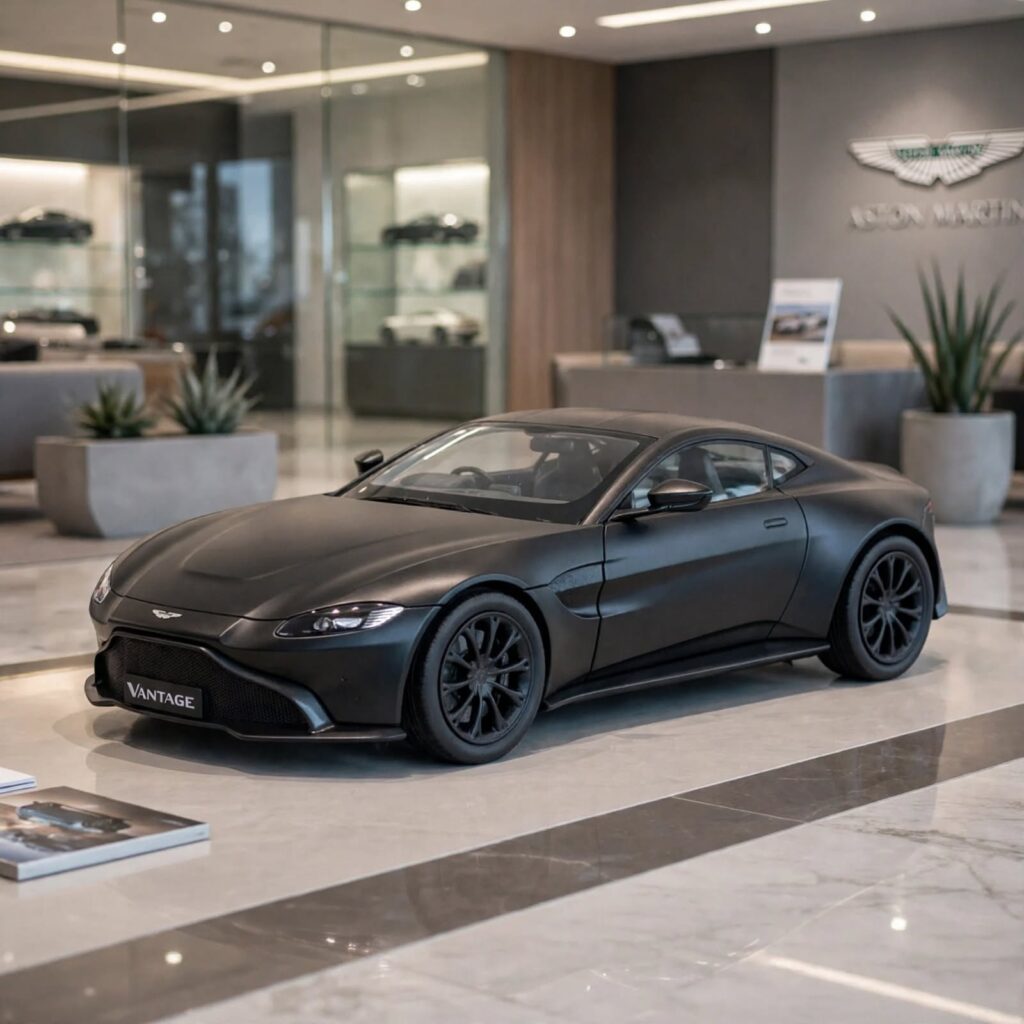
It sits between two categories and belongs to neither. It is not an Italian supercar brand, since the cars are grand tourers built for distance instead of theatre. It is not a mainstream performance manufacturer either, because the volumes are tiny and the prices are not.
That middle position is exactly why an Aston is useful on a shelf full of louder things. Put one between a wedge shaped supercar and an American muscle car and it makes both of them look like they are trying too hard. For the wider picture of which manufacturers show up in this hobby and why, see my car brand manufacturers page.
Does Hot Wheels make Aston Martin cars?
Yes, though far less often than Italian or American brands. Castings turn up in mainline ranges periodically, never as a permanent fixture.
Why is Aston Martin associated with James Bond?
A silver DB5 appeared in the 1964 film Goldfinger and the connection has continued across the series ever since, including cars built specifically for the films.
What does DB stand for on an Aston Martin?
David Brown, the industrialist who bought the company in the late 1940s and put his initials on the cars.
Is Aston Martin British?
Yes. The company was founded in London in 1913 and has remained a British manufacturer through several changes of ownership.
Which Aston Martin is the most collectable in diecast?
The DB5 appears most often because of the film association, which also makes it the version most brands choose to license when they produce one.