Every model on my shelf is a copy of something. This one is a copy of a copy. The Challenger SRT8 is a modern car built to look like a car from forty years earlier, so the casting is a miniature of a tribute, and the tribute is where things get interesting.
Because a tribute has to exaggerate. The designers of the real car could not simply reissue the old shape, so they took the parts people remembered, the long hood, the flat roof, the thick rear quarters, and made each one more pronounced than the original ever was.
What the Hot Wheels Dodge Challenger SRT8 inherits
All of that exaggeration, faithfully. The hood on this casting runs forever before it reaches the windscreen. The roof is a flat plate with almost no curve to speak of. The rear quarter is a solid slab that meets a short, high tail.
Set it beside a model of the original and the differences jump straight out at you: the modern car is longer, taller and much heavier through the middle of the body. The model is accurate, so it inherits all of that inflation along with the shape.
Satin black and cream stripes
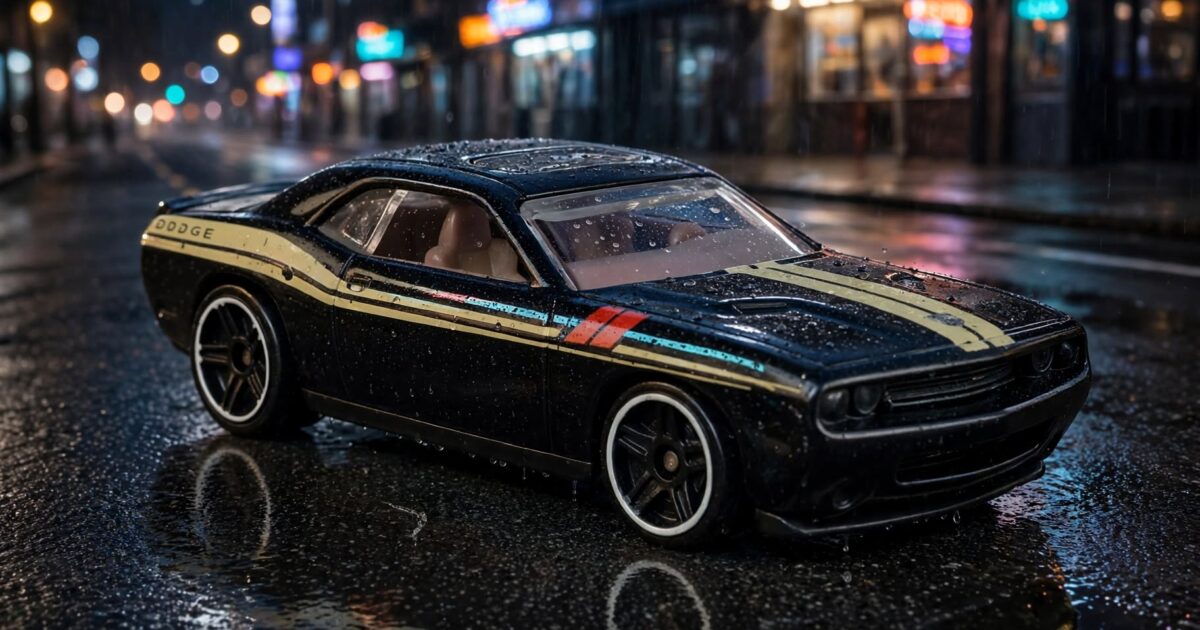
The body is black with a satin finish, closer to a deep charcoal than to a wet gloss. A pair of cream stripes runs along the upper flank and over the rear quarter, with DODGE lettered inside the stripe just ahead of the taillight panel.
On the front fender there are two short hash marks in orange and red, set at an angle across the stripe. Those marks come straight from sixties racing practice, and here they sit on a car built four decades later, which is the whole retro game compressed into one small graphic.
The printing on mine is clean, with the stripe crossing the door gap without a step and the hash marks sitting at the same angle on both sides.
Black wheels with a white line
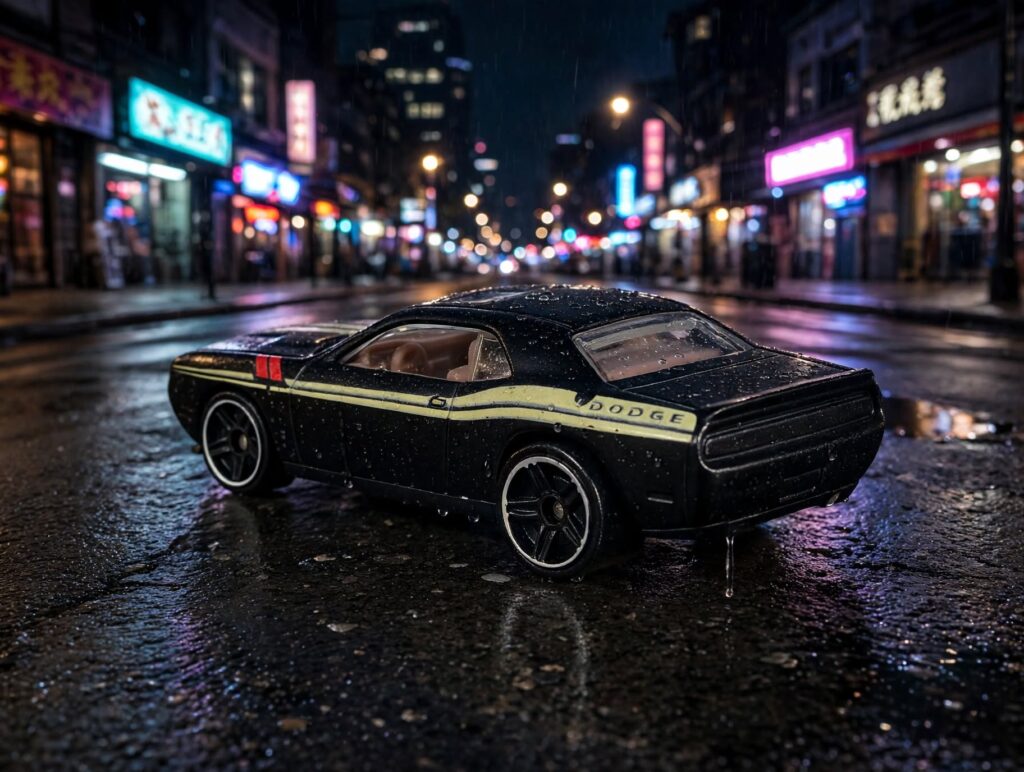
The wheels are black five spoke designs with a thin white ring around the outer edge. It reads as a whitewall at a glance, another sixties cue grafted onto a modern car.
They are also large, which is correct for the real vehicle. Modern muscle cars wear big wheels, and shrinking them would have made the casting look like a rental version.
The stance is level and low, with the body sitting close over the tires and very little gap in the arches. A rake would have been wrong here. These cars sit flat and heavy in reality, and the casting keeps that.
The tan interior is a deliberate signal
Through the windows there is a tan plastic interior, warm and light against the dark body. Modern performance cars almost always come with black cabins, so this is not a copy of what the real car usually wore.
It is a period cue. Tan and saddle interiors belong to the era the car is imitating, and dropping one into a modern body pushes the whole model further toward the thing it is pretending to be. I like the choice, even though it is probably the least accurate decision anywhere on the casting.
Hood, roof and the printed sunroof panel
The hood carries two raised shapes where the real car has its vents, cast in instead of printed, so they catch light along the top surface. The front end is a flat black panel with the headlights sunk into the corners.
On the roof there is a printed rectangle standing in for a sunroof. It is a flat graphic on a flat surface, and it is the one place where this casting reads as a toy. A recessed panel would have cost more and looked far better.
The rear is better. The taillight panel is a full width black strip with the lamps printed inside it, which matches how the real car runs its light bar across the whole tail, and the printing on mine is even from one side to the other.
What this one does that the green SRT8 does not
I already own this casting in green, and putting them together makes the point of this article visible. The green car reads as a modern performance machine: clean body, no stripes, color doing all the talking.
The black one reads as a period tribute. Same casting, same proportions, and a completely different story, and the only difference between them is paint and tampo. That is the lever Hot Wheels pulls hardest of all, and it is the reason a single mold can produce a dozen cars that feel completely unrelated to each other on a shelf. If you want to know which wave any version shipped in, the card code tells you, and I explained how to read it in Hot Wheels case codes.
Is a black mainline muscle car ever a smart buy
Black castings with stripes get talked about as collectible far more than they deserve, usually by somebody who happens to want to sell you one. Mainline cars are produced in enormous numbers, and the overwhelming majority of them stay cheap forever.
Buy this one because the stripes look good on a satin black body. I went through the whole question in are Hot Wheels a good investment, and nothing about a black Challenger changes the answer.
The retro copy I keep anyway
There is a version of me that finds this whole exercise a bit silly. A new car imitating an old one, then a small model imitating the new car, then me buying it because the stripes remind me of something I never actually saw.
That version of me loses. The casting is well proportioned, the graphics are sharp, the satin finish photographs better than gloss, and the tan interior is a small joke that works. Three layers of imitation stacked on top of each other, and the thing still ends up on the shelf where I can see it.