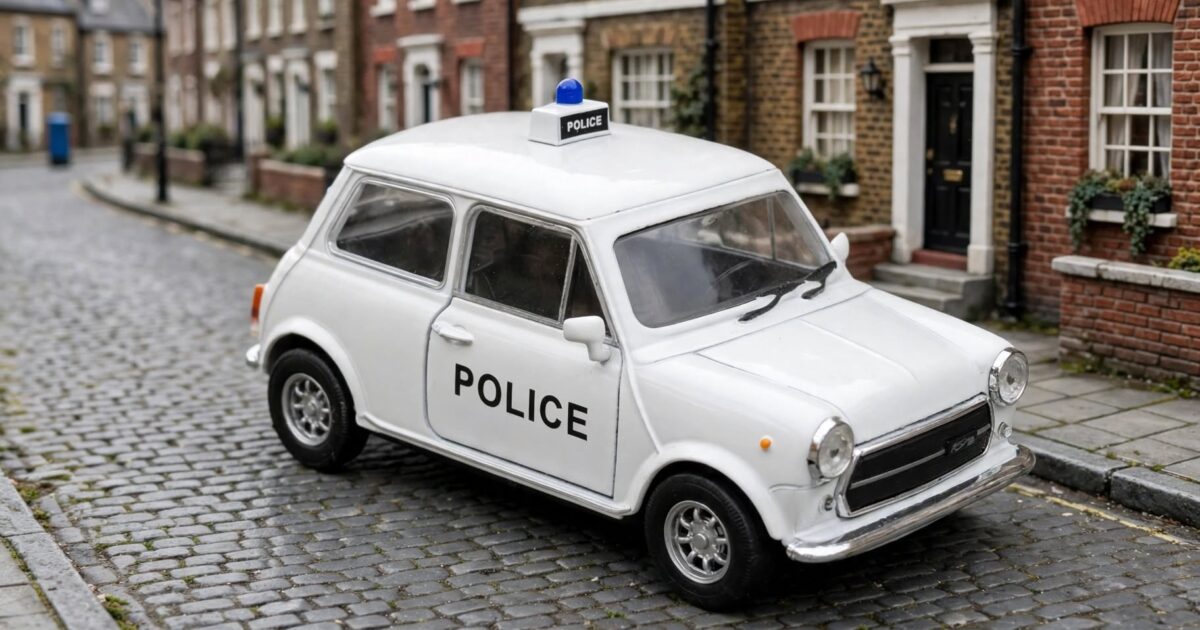
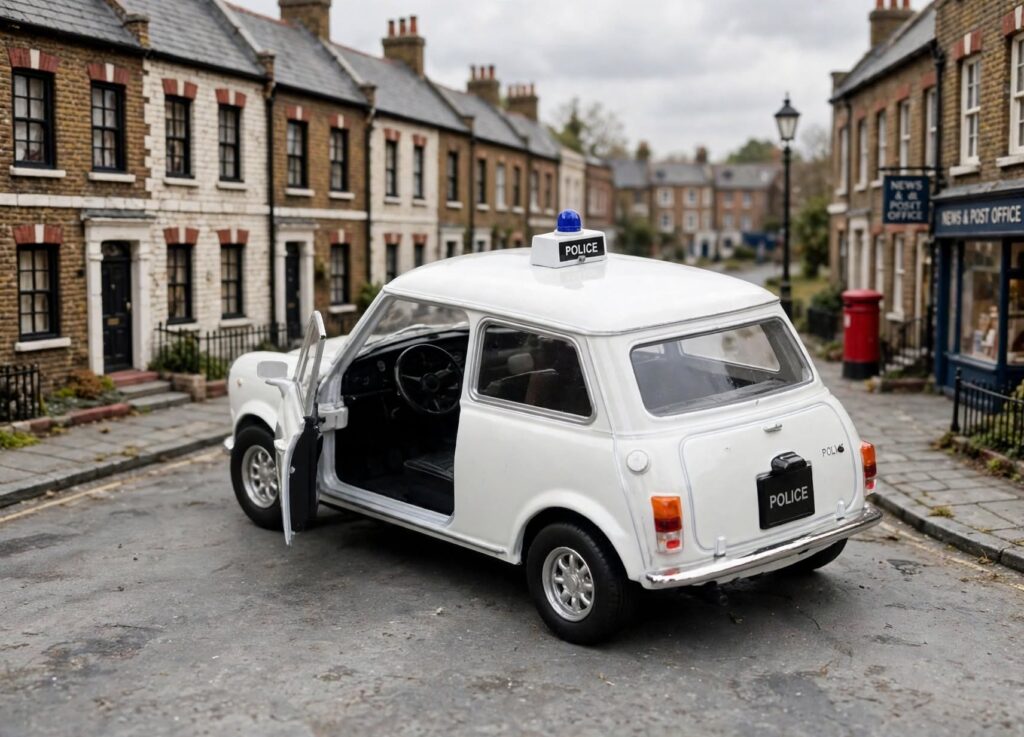
A police car today is an SUV or a large sedan, chosen so it can carry equipment, block a lane and intimidate somebody in a mirror. Put that next to this white Welly Classic Mini Cooper Police and the comparison is almost funny. The Mini is shorter than most modern hatchbacks and narrower than almost everything on the road.
That was exactly the point. For a stretch of decades, police forces in Britain and elsewhere ran small cars because the streets they patrolled were narrow, fuel was expensive and the job was mostly about getting somewhere quickly in a city. The vehicle itself tells you what the work looked like.
What the Welly Classic Mini Cooper Police gets right
The shape first. The Mini is a box with the wheels pushed into the corners and almost no overhang at either end, and the casting respects that. The roof is flat, the sides are flat, the windscreen sits nearly upright, and the wheel arches are simple flares riveted onto a flat panel.
The body is plain white with POLICE printed in black on both doors. On the roof sits a small white box with POLICE lettered on its side and a blue dome on top. That is the entire livery, and it is accurate to the simplicity of the period.
Chrome is doing most of the work here
Look at where this model spends its money. There are chrome bumpers front and rear with overriders, a chrome grille with horizontal bars, chrome headlight rings, chrome window surrounds running all the way around the glass, and chrome wheels with fine spokes.
On a white body that chrome is the only contrast there is. Take it away and you have a plain white box. The real cars were the same, which is why the chrome trim matters more on a Mini than on almost any other small car.
The 1:32 scale question
This is a larger scale model, so it will not sit with 1:64 cars. The twist is that a Mini at 1:32 ends up roughly the size of a normal car at a smaller scale, so it is far easier to live with than most models at this size.
If you want one big model to put on a desk without it taking over, a tiny car at a large scale is the smart way to do it.
The weight helps too. There is enough metal in the body to give it heft without making it a brick, and the doors shut with a small click instead of flopping. Those are the things a larger scale buys you, and they are the reason people keep drifting up from 1:64 even when they swear they will not.
What the open doors show you
Both front doors open on visible hinges, and behind them there is a black interior with seats, a dash and a steering wheel. The cabin is tiny, which is exactly correct, and the door cards are flat panels because there was nothing to detail on a car this basic in the first place.
What you notice with the doors open is how thin the body is. A real Mini had almost no structure between the occupant and the outside, and the model captures that: the door is a shallow shell, the sill is narrow, and the whole thing feels like a tin box with seats in it.
The roof beacon and the fragile parts
The beacon assembly is a separate piece glued to the roof, and it is the obvious weak point. It stands up above a flat panel with nothing around it to protect it, and a knock from almost any direction will shear it off.
Mine is still straight and the blue dome is clear with no clouding at all. If you are buying secondhand, look at that part first, then check the chrome bumpers for bends. Thin chrome plated plastic does not survive being dropped.
The wing mirrors are the third thing to check. They are small white stalks mounted on the doors, and they stick out far enough to catch on a sleeve or a shelf edge.
Period police cars as a collecting theme
A patrol car from fifty years ago is a different object from a patrol car today, and the gap between them is interesting on its own. Lining up a few vehicles across the decades shows you how the job changed: small and quick, then bigger and heavier, then high and armored.
You do not need many to make the point. Three or four vehicles spread across different eras makes a display that explains itself without a single label, which is more than most shelves manage. If you are still working out what direction to take your collecting, my starter guide has a section on choosing a theme.
Does a model like this hold value
Probably not in any way you should plan around. Larger scale models from the volume brands are produced in quantity and sold cheaply, and the ones that appreciate tend to be limited runs from specialist makers.
Buy it because you want a Mini police car sitting on your desk. I went through the same reasoning about small castings in are Hot Wheels a good investment, and the conclusion transfers cleanly to this scale.
Why this one stays even though the scale is wrong
Every rule I have about keeping the collection coherent says this model should not be here. It does not match anything else I own. It cannot go into a scene with my other cars. It is from a brand I mostly buy at a much smaller size.
It stays because it makes me think about something none of the sports cars do, which is that somebody once looked at the smallest car on the road and decided it would make a fine patrol vehicle. That decision would be unimaginable today, and this model is the only record of it anywhere in my collection.