Six generations across nearly sixty years, and almost every collection stops at two of them. People buy a first-generation Camaro because it is beautiful and a modern one because it is current, and the forty years in between get skipped entirely.
That is a shame, because the skipped generations are where the interesting decisions happened.
Why the Camaro exists at all
Ford launched the Mustang in 1964 and it sold in numbers nobody at General Motors had predicted. Chevrolet had nothing to answer with.
The Camaro arrived in 1966 as a 1967 model, built specifically to take the Mustang on. That origin shapes everything about it: the proportions, the engine options, the trim levels, all of it designed against a competitor rather than from a blank sheet.
The two cars have been measured against each other ever since, which is why a Camaro shelf and a Mustang shelf tell a better story together than either does alone.
First generation, 1967 to 1969
The one everybody wants, and with reason. Clean proportions, a wide stance, and a face that works from every angle.
The SS carried the big engines, the RS was the appearance package with hidden headlights, and the Z/28 was built for Trans-Am racing. Those three names still mean something to collectors sixty years later.
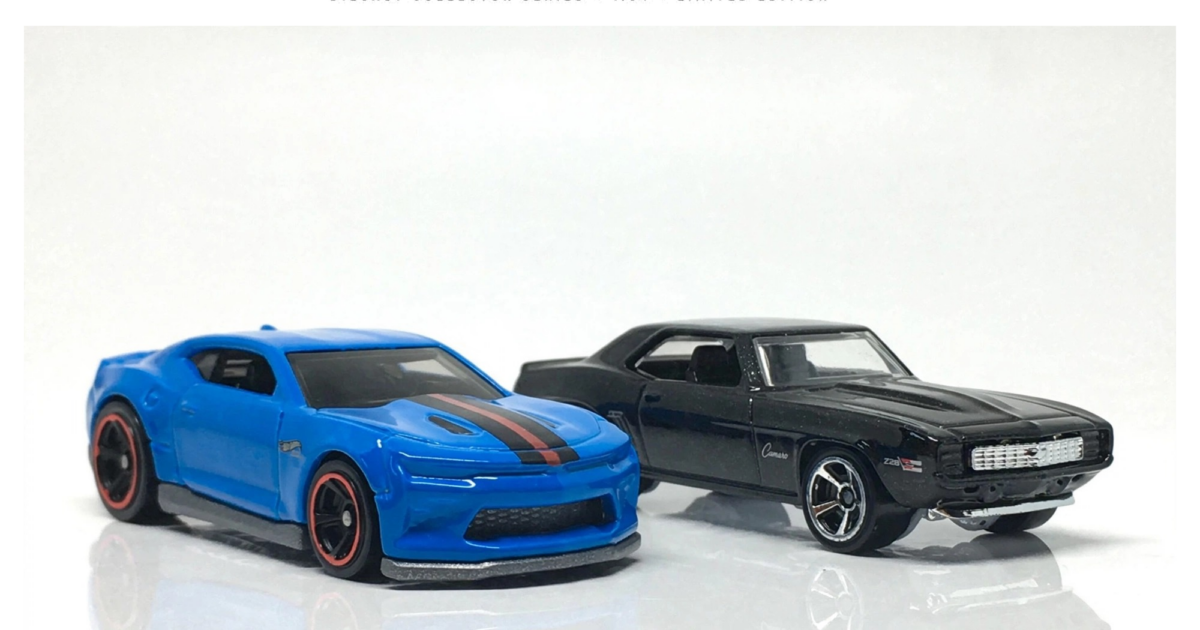
The 1969 restyle is the version most casting manufacturers reproduce, with the deeper body creases and the revised grille. If you are buying one first-generation Camaro casting, it will probably be a ’69, and that is the right choice.
Second generation, 1970 to 1981
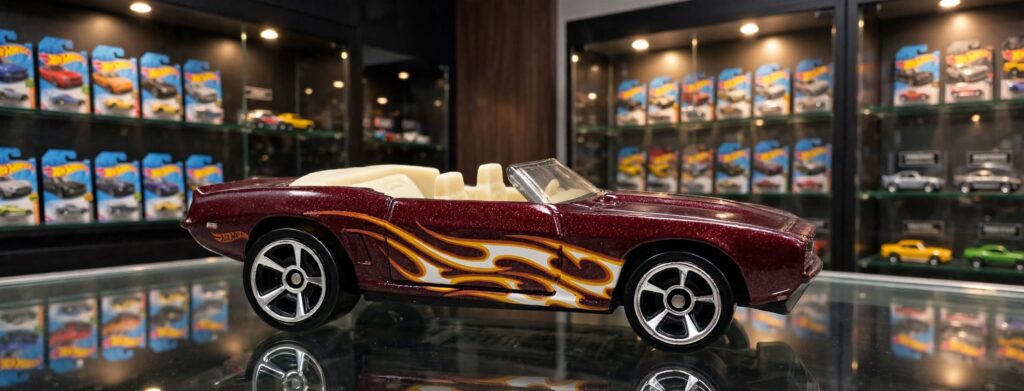
The long one, and the one that gets ignored.
It launched as a genuinely good-looking car with a European influence that the first generation never had. Then emissions rules, the oil crisis and safety regulation reshaped it year after year, and by the end it looked completely different from how it started.
That slow transformation is exactly why it is interesting. A 1970 Camaro and a 1981 Camaro are the same generation and look like different cars.
Our review of the Hot Wheels ’81 Camaro Z28 covers the late version, which is cheap because almost nobody collects it.
Third generation, 1982 to 1992
The wedge. Angular, low, with a huge glass hatch at the back and a shape that could only be from the eighties.
The IROC-Z is the one people remember, named after the International Race of Champions series. It was the performance version and it defined the decade’s idea of what a fast car looked like.
Castings of this generation are scarce, which is the usual pattern with unfashionable eras. Manufacturers make what sells, and for twenty years nobody wanted eighties cars. That is starting to change.
Fourth generation, 1993 to 2002
Smoother, rounder, and the most aerodynamic Camaro to that point. The pop-up headlights and the long sloping nose give it a look that reads as nineties immediately.
It is also the generation that ended. Chevrolet stopped building the Camaro in 2002 with no replacement planned, and for seven years the nameplate simply did not exist.
For collectors this is the hardest generation to find in 1:64. It fell between the classic era that people collect and the modern era that manufacturers currently make, so it is underrepresented everywhere.
Fifth generation, 2010 to 2015
The revival, and a deliberate one. After the concept car appeared in 2006, the production version arrived heavily referencing the 1969 car, with the same proportions reinterpreted at modern size.
That retro approach is why it aged well. A car designed to look like 1969 was never chasing the present, so it does not date the way its rivals do.
It is also physically enormous compared to the car it references, which is the thing photographs never convey. Park a fifth-generation Camaro next to a real ’69 and the modern one looks like it swallowed the original.
Our review of the Hot Wheels Camaro Convertible covers the open version of this generation.
Sixth generation, 2016 onward
Smaller, lighter and sharper than the fifth, built on the Alpha platform shared with Cadillac. Chevrolet presented it in 2015, and the restraint is obvious next to its predecessor.
Where the fifth generation was all mass and attitude, this one is all creases. Hard lines along the flanks, a narrower greenhouse, and a front end built around slim headlights.
This is also the generation that scales best to 1:64, because hard edges survive being shrunk and soft surfacing does not. Our reviews of the Hot Wheels ’16 Camaro SS and the Camaro ZL1 go through what separates the two castings.
Building a Camaro generation shelf
Six cars, one per generation, is one of the most satisfying displays you can assemble in this scale, and it costs very little because most of the castings are mainline cars.
The reason it works is that each generation looks nothing like the last. Lined up in order, you get sixty years of American design decisions in a row of cars that fit on one shelf.
The hard ones to find are the second, third and fourth generations. Start hunting those first and pick up the first and sixth whenever you want, because they are always available.
Which Camaro casting should you buy first?
The ’69 if you want the beautiful one, and a sixth-generation car if you want the best-executed casting.
My own suggestion is neither. Start with the generation nobody collects, because the second and third are cheap now and will not stay that way. Eighties and seventies cars have been climbing in the real market for a decade and the diecast side follows.
Buying the famous ones is easy at any point. Buying the unfashionable ones is only easy while they are unfashionable.
Frequently asked questions
How many Chevrolet Camaro generations are there?
Six, from 1967 to the present, with a seven-year gap between 2002 and 2010 when the model was out of production.
What is the difference between SS, RS and Z/28?
SS denoted the performance engine package, RS was an appearance package, and Z/28 was built around racing homologation requirements.
Why did Chevrolet stop making the Camaro in 2002?
Sales had declined through the late nineties and the segment itself had shrunk. The nameplate returned in 2010 after the retro concept car of 2006 proved there was demand.
Which Camaro generation is best for diecast collectors?
The first and sixth are the most widely produced in 1:64. The second, third and fourth are harder to find and more interesting precisely because of that.