Somebody hands you a small metal car. It cost about a dollar, it has a logo on the base, and apparently some of these are worth thousands. Both things are true, and the gap between them confuses almost everyone who arrives at this hobby.
Here is what Hot Wheels actually are, and what matters once you start paying attention.
What is a Hot Wheels car, exactly?
A die-cast model vehicle, roughly 1:64 scale, which works out to about 7 cm long for a typical car. The body is zinc alloy, usually with a plastic base, plastic windows and plastic wheels.
Mattel launched the brand in 1968 and has produced it continuously since, which means there are now thousands of different models in circulation.
The scale is worth understanding because it is loose. A 1:64 pickup and a 1:64 sports car are both made to fit the same packaging, so the pickup is proportionally smaller than it should be. Nobody in this hobby treats scale as a precise measurement.
Why do Hot Wheels have that name?
Because of the wheels, which was the whole competitive point at launch.
Matchbox had been selling die-cast cars for years and dominated the market. Mattel’s advantage was a wheel design with thin axles and low friction, which made the cars dramatically faster down a sloped track.
That is also where the orange track came from. Hot Wheels sold speed, and the track existed to demonstrate it. Matchbox sold accuracy, and still does, which is why the two brands feel so different sixty years later.
Mainline, premium and chase cars
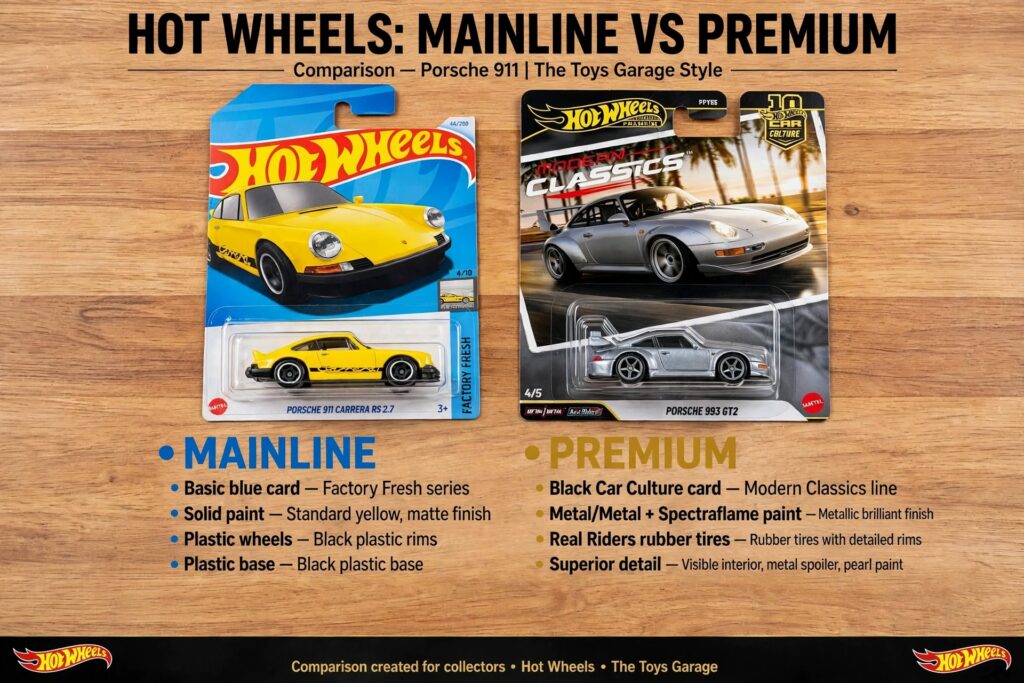
The first thing worth learning, because it explains price differences that otherwise make no sense.
Mainline cars are the standard ones, sold in supermarkets and toy shops for about a dollar. Plastic base, plastic wheels, produced in enormous numbers. This is most of what exists.
Premium lines cost several times more and get a metal base, rubber tyres and more detailed printing. The difference is obvious in your hand.
Chase cars are deliberately scarce versions hidden inside normal cases. Treasure Hunts and Super Treasure Hunts are the ones people hunt for, and our guide to Treasure Hunts versus Super Treasure Hunts explains how to spot them.
Are Hot Wheels worth money?
A small number are, and it is a much smaller number than the internet suggests.
The cars that command real prices share the usual traits: low production, excellent condition, genuine demand. That means Redline-era cars from 1968 to 1977, premium and chase releases, factory error cars, and a handful of prototypes.
Everything else is worth roughly what you paid. A common mainline car bought today will still be a common mainline car in ten years.
We go through this properly in are Hot Wheels a good investment, including why treating them as an asset usually disappoints.
What a Redline is and why it matters
If you inherit a collection, this is the first thing to check.
Hot Wheels made between 1968 and 1977 had a red stripe printed on the tyre sidewall. Collectors call these Redlines, and that single detail separates the early cars from everything that followed.
They also used Spectraflame paint, a deep candy finish over polished metal that later cars did not get.
A Redline in good condition is worth looking up. A Redline still on its unopened card is worth looking up carefully.
Real cars, fantasy cars and why both exist
Roughly half the range reproduces actual vehicles under licence, from Ferraris to pickup trucks. The rest are Hot Wheels originals, designed in-house with no real-world counterpart.
That second category confuses newcomers who assume every casting is based on something. It is not, and sellers sometimes describe fantasy castings as if they were real cars.
Both are legitimate to collect. Just know which one you are holding, because it changes what there is to research.
How to start collecting without wasting money
The common mistake is buying everything, which gets expensive and produces a shelf that says nothing.
Pick a constraint instead. One manufacturer, one decade, one body style, one country of origin. A shelf of forty cars that share a theme is more interesting than four hundred bought at random, and far cheaper.
Buy loose rather than carded while you are learning. Loose cars cost a fraction of sealed ones and you can inspect them properly.
Our beginner’s guide to collecting die-cast cars covers the practical side in more detail.
Hot Wheels against the other brands
Worth knowing early, because Hot Wheels is not the only option and it is not always the best one.
Matchbox, now owned by the same company, builds realistic vehicles at correct ride heights, including the vans and trucks nobody else makes. Matchbox versus Hot Wheels goes through the differences.
Majorette covers European everyday cars that the American brands ignore entirely.
Greenlight and Johnny Lightning sit at the detailed end, with rubber tyres and metal bases, for several times the price.
Buying one car from each teaches you more about this hobby than reading about it does.
Frequently asked questions
What scale are Hot Wheels?
Approximately 1:64, though it varies by model because every car is designed to fit the same packaging.
How can I tell how old a Hot Wheels car is?
Check the base, which usually carries a copyright year and the country of manufacture. Red stripes on the tyres mean 1968 to 1977.
Are Hot Wheels and Matchbox the same company?
Mattel owns both brands today, and they are run as separate lines with different design philosophies.
Should I open the package or keep it sealed?
Sealed cars hold more resale value. Open cars are more fun to own and photograph. You cannot have both with the same car, so decide what you are collecting for.
How many Hot Wheels cars exist?
Thousands of distinct castings, in far more colour variations, produced continuously since 1968. Nobody owns them all.