Count the 1932 Fords in your collection. I counted four, which is more than any other single body. Every diecast brand makes one. It’s the default hot rod, the shape that turns up in every lineup year after year, and most end up in a drawer. This dark green Hot Wheels ’32 Ford stayed out, and the reason has almost nothing to do with the casting itself.
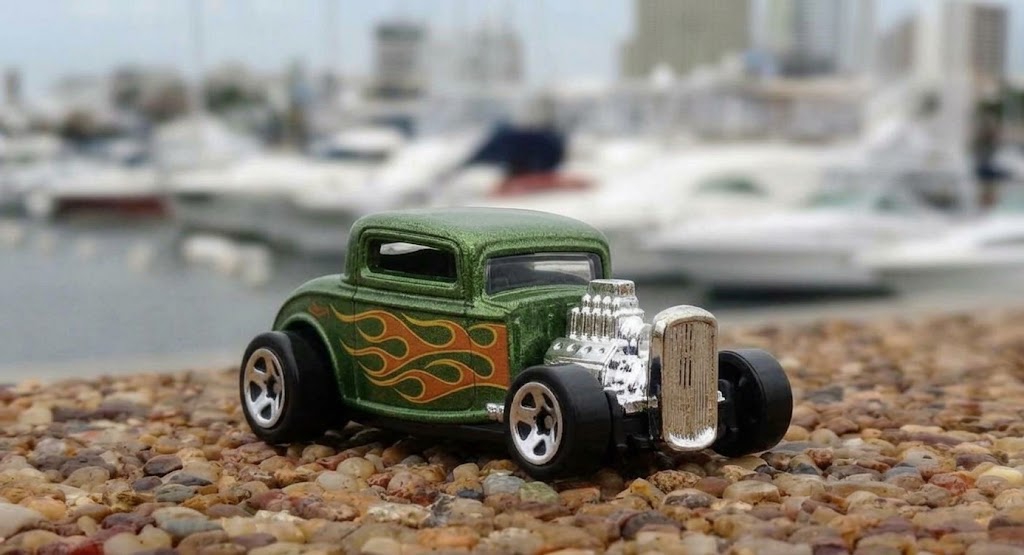
Hot Wheels ’32 Ford hot rod in dark green metallic
It’s the color. Hot rods at this scale come in red, black, yellow or primer gray, and after a while they all blend together on a shelf. This one is a deep metallic green with a heavy flake, somewhere between British racing green and a bottle. In shade it reads almost black. Turn it toward the light and the flake lights up.
Green hot rods existed in the real world, but they were never the popular choice, and that’s exactly why this one stands out in a row of red ones. It’s the kind of color a guy picks when he’s building the car for himself and not for a magazine.
Why the chopped roof works on the Hot Wheels ’32 Ford
The roof is cut down hard. The side glass is a narrow slot, and the windshield is short enough that a driver would be looking through a mail slot. That chop is what makes the casting work in the hand, because it drops the visual weight of the body and leaves the engine as the tallest thing on the car.
The body has no fenders and no running boards, so the wheels sit in open air. Between the cab and the grille there’s nothing but machinery. At full size that’s an unforgiving look. Shrunk down, it means the casting reads as three distinct blocks: grille, engine, cab.
Flame graphics on the ’32 Ford hot rod body
Yellow and orange flames run along the lower door and the cowl, with a thin outline keeping them separate from the green. They sit low, below the beltline, and they stop before the rear of the body.
On mine the printing is clean, with the orange core sitting inside the yellow edge and no bleed between them. There’s a small Hot Wheels flame logo on the cowl ahead of the door, which is the only branding on the body. I’d have preferred it hidden, but it’s small enough to ignore in photos.
The chrome blown V8 on the Hot Wheels Deuce coupe
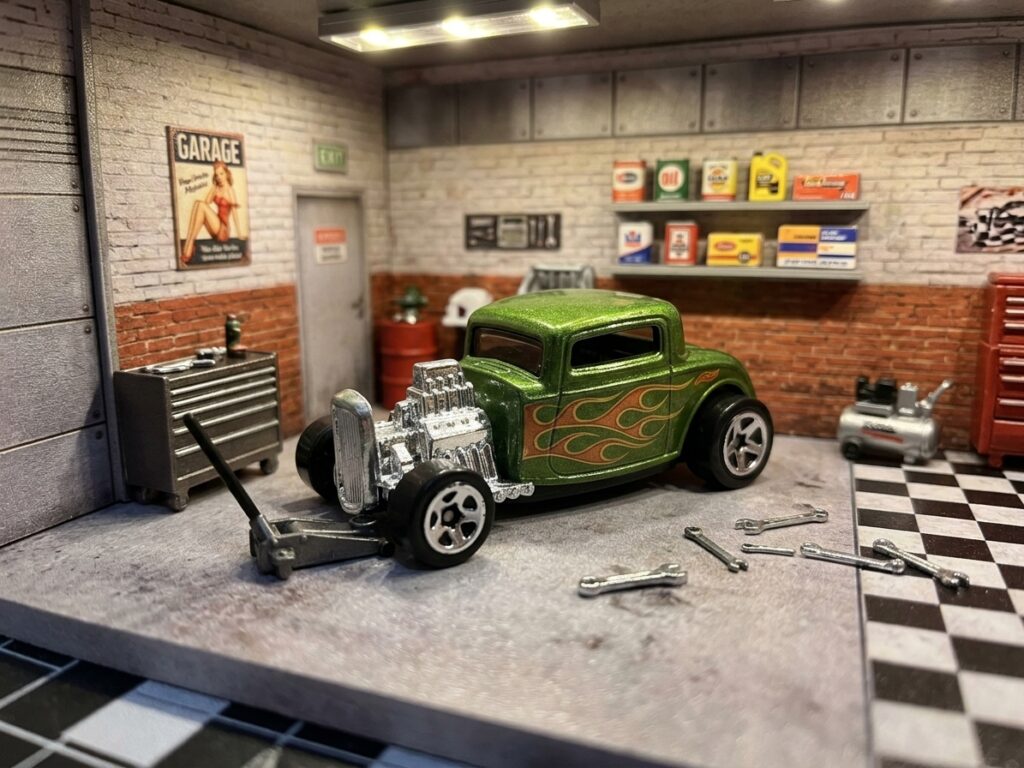
The engine is the whole front half of this car. A chrome V8 sits exposed with a blower on top and eight injector stacks standing up in a row, and ahead of it there’s a polished cylindrical tank where a radiator would normally go.
It’s one chrome piece on my example, and the plating is bright with no dull spots. Over time chrome parts on loose cars pick up fingerprints and scratch easily, so if you buy one secondhand, look at the stacks first. Bent or scuffed stacks are the usual damage.
The engine also sets the car’s height. Looking at it from the side, the blower sits level with the chopped roof, so the profile is a long flat line broken only by the cab. That balance is the difference between a rod that looks right and one that looks like a body dropped on a chassis.
Big rear slicks and small front wheels on the ’32 Ford
Classic drag proportions. The rear tires are fat and smooth with white five spoke centers, and the fronts are noticeably narrower. The whole car sits nose down, which puts the grille close to the ground and lifts the tail slightly.
That rake does a lot of work. A level stance on a fenderless rod looks like a parts cart. The forward tilt makes it look like it’s pulling against the brakes.
The rear axle is visible between the body and the tires, with no bodywork hiding it. You can see the exhaust pipes running down the side too, short and chrome, ending just behind the door. Details like that only work because there are no fenders to cover them, and they give the lower half of the car something to look at.
How this compares to the other Fords in my collection
It’s the oldest shape I own by a long way, and it still looks more aggressive than anything from the sixties sitting next to it. If you want the broader picture of what Ford has given the hobby, from the rods to the muscle era, I put that together on my Ford page.
What surprised me is that this car makes the fifties and sixties stuff look polite. Park it next to a stock sedan and the sedan suddenly looks like a piece of furniture.
Is the ’32 Ford a good first hot rod for a new collector
Yes, and for a practical reason. The shape is so common that you’ll find one from almost any brand at almost any price, which makes it a cheap way to learn what you like: fenders or no fenders, exposed engine or closed hood, flames or plain paint. My starter guide covers how to build a first shelf without spending much.
Start with a cheap mainline Deuce and keep it on the desk a month. If you still reach for it, go find the nicer version with rubber tires.
Why this green ’32 Ford beat my other Deuce coupes
I own four 1932 Fords. Three are red or black with the same flames and the same chrome, and I honestly can’t tell them apart from across the room. This one I can spot instantly, and that’s the entire argument for it.
Color is the cheapest way a casting can earn its spot. If Hot Wheels ran the same body in dark blue or a muted bronze, I’d buy that one too, and the red ones would stay right where they are, in the drawer.