My first reaction when I pulled this one off the peg was that it looked unfinished. Then I turned it around and looked straight down into the cabin, and that’s where the whole car happens. Seats, dash, the top folded behind the rear seats. A Camaro coupe hides all of that under a roof. This white Hot Wheels Chevy Camaro convertible puts it on display, and it made me look at a car I thought I knew in a different way.
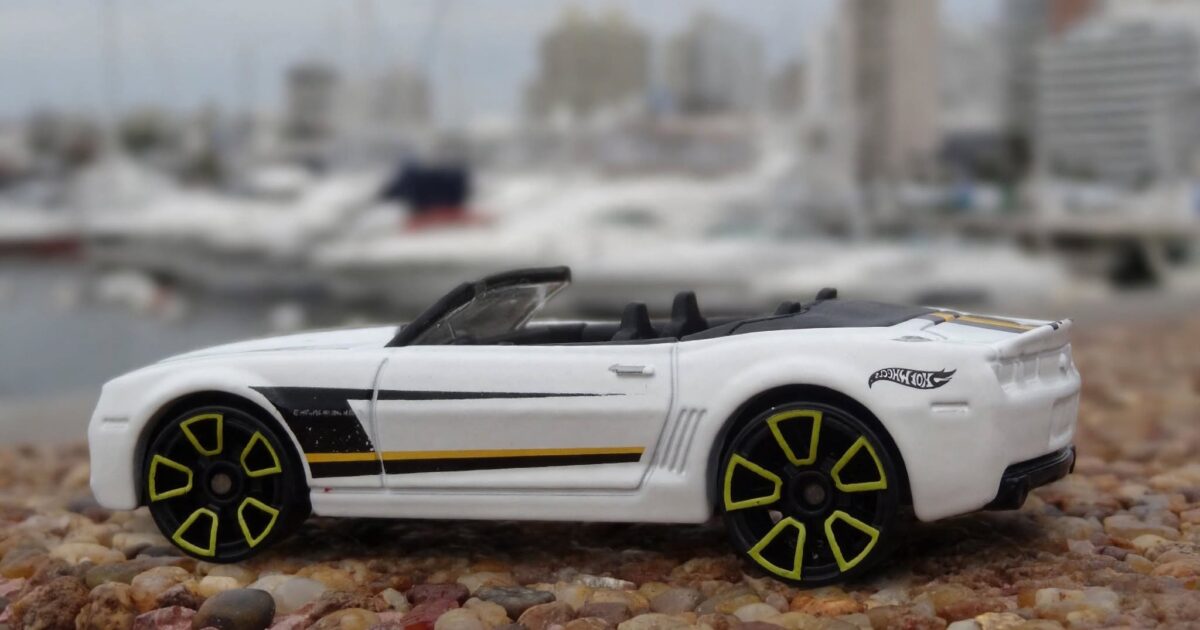
Hot Wheels Camaro convertible white with black and yellow stripes
The body is a flat, slightly creamy white. A black panel runs along the lower front of each door with CAMARO lettered into it, and from there a black stripe with a thin yellow line runs back toward the rear wheel. Up top, the trunk lid carries two black stripes with yellow edges, so the theme ties the side and the tail together.
It’s a simple scheme and it suits the car. White with black accents keeps the shape readable, and the yellow is just enough to stop it from looking like a rental.
The tampo quality on mine is good. The stripe crosses the door gap without a step, and the CAMARO lettering is readable even at this size, which is more than I can say for some of the tiny scripts Hot Wheels prints on fenders. There’s a small red dot of paint near the front wheel on my example, a factory slip, and I’ve decided I like it. It proves the car came from a real line and not a render.
Is this the Camaro Convertible Concept casting
Here’s something I had to stop and check. The shape on this car, with the long hood, the sharp rear haunches and the gills behind the door, matches the convertible concept Chevrolet showed before the production car arrived. Hot Wheels has made both concept and production Camaros over the years, and they’re easy to mix up on the peg. Flip the car over and read the base before you file it in your list. I once tagged a car wrong that way and took months to notice the mistake on my list.
How Hot Wheels handles an open top body at 1:64
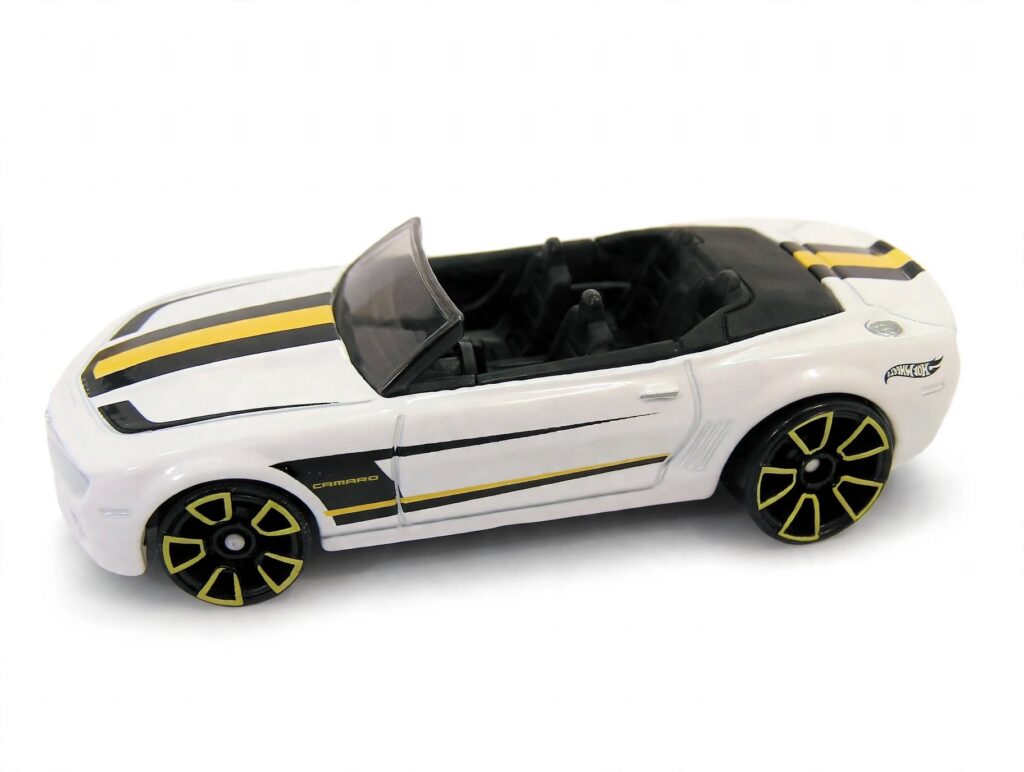
Convertibles are hard at this scale. Without a roof, the body has less metal tying the front to the rear, so the casting needs a thick windshield frame and a solid interior tub to stay rigid. Hot Wheels solved that with a black frame around the glass and a black plastic interior that fills the whole cabin.
The interior shows four seats, a dash with a steering wheel, and the folded top molded as a hump behind the rear seats. None of it is painted in detail, but the shapes are clean, and that’s what you see from above.
The trade off is weight. With less metal up top, the car feels lighter in the hand than a coupe, and it rolls a little differently on a track. What I noticed is just how much the interior color decides the look. Black works here because it matches the stripes, but a tan or red cabin would turn this into a completely different car, and that’s the version I keep hoping for.
Black and yellow wheels on the Camaro convertible
The wheels are black with open spokes outlined in bright yellow, and they’re the part people comment on first. On a white car they pop hard. Some collectors hate painted outlines on wheels, and I get it, but here the yellow matches the stripes, so it looks planned.
They’re a bit large for the arches, which is normal for a mainline Hot Wheels car. The stance is level, with a small gap at the rear wheel that I’d close if I could.
Windshield frame and cabin detail on a roofless Hot Wheels car
The frame is the weak point. On my example it’s straight, but on the peg I’ve seen copies with the frame bent backward from the blister pressing on it. Check that before you buy. A bent frame on a convertible is impossible to hide, since it’s the tallest part of the car.
The glass inside the frame is clear and thin. Looking through it from the front, you can see the dash and steering wheel, which is a nice touch on a car this cheap.
Why an open Camaro feels different from the coupes
I have three modern Camaro coupes on the site already, and all three are about aggression: hood vents, big wheels, muscle. This one isn’t. Take the roof off and the car stops looking angry and starts looking like a weekend car. It’s the same family, but the mood is relaxed, and to me that’s a reason to own it even if you already have a coupe or two.
It also photographs differently. With a coupe you shoot the side and the front. With a convertible, the best shot comes from above, where the interior fills the frame.
Best way to display a Hot Wheels convertible
Put it low. On a high shelf, an open car looks like a coupe with a missing roof. At or below eye level, you see into the cabin, and that’s the whole point. In a scene, park it near a beach road, a drive-in or a parking lot with the top down. My 1:64 diorama guide has a few easy setups that work for open cars.
If you’re unsure which wave yours came from, the code on the card tells you; I explained how in my piece on Hot Wheels case codes.
Where the white Camaro convertible sits now
It stays, and it now sits down on the lowest shelf where I can look into it. It isn’t my favorite Camaro, but it’s the one that changed how I see the shape. I’d like to see the same casting in dark red with a tan interior. Until then, the white one does the job.