Most cars exist because a designer had an idea. This one exists because of a tax, and the story behind it is better than anything on the spec sheet.
The tariff that shaped the car
The United States applied a much higher import duty to light trucks than to passenger cars, a difference large enough to make importing a small pickup commercially pointless.
Subaru’s answer was to bolt two rear facing seats into the cargo bed. With seats back there the vehicle could be classified as a passenger car rather than a truck, which meant the lower rate applied.
Two plastic seats in an open bed, exposed to the weather, facing backwards. It was absurd, it was legal, and it worked.
That is why the BRAT exists in the form it does, and it is the kind of story that makes a casting worth owning beyond how it looks.
What the vehicle actually was
Underneath the odd body, a small four wheel drive Subaru estate with the back cut off and a bed added.
That combination gave it genuine capability. Four wheel drive was unusual on anything car sized at the time, and the BRAT could go places that a two wheel drive pickup could not while being far easier to live with day to day.
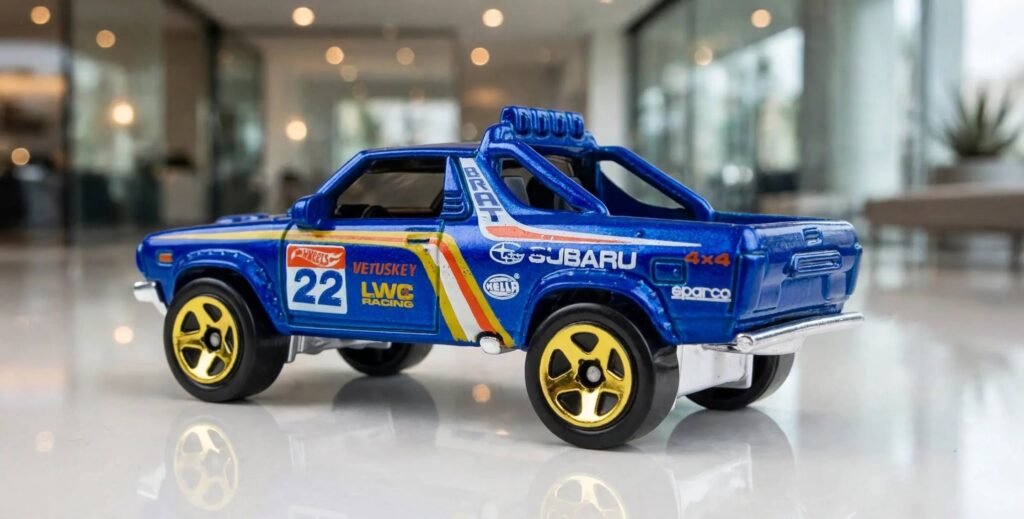
The proportions on the casting tell you this immediately. It sits tall for a car and short for a truck, with a stubby bed and a cab that occupies most of the length.
Rally livery and the equipment on it
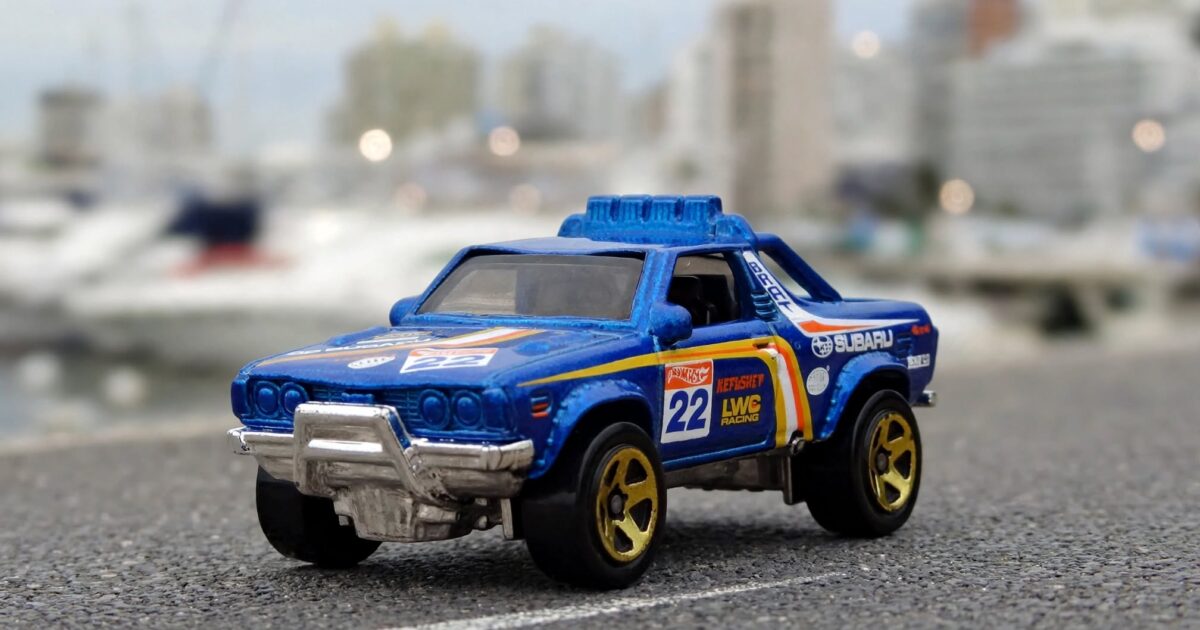
Blue with a number 22 on the door, Subaru script on the bonnet and the rear quarter, and a stripe package in white, red and yellow running along the flanks and over the nose.
The hardware is where this casting earns its keep. There is a chrome bull bar across the front with auxiliary lights moulded into it, a light bar on the roof, and a Sparco logo among the sponsor decals.
The wheels are gold, which is a specific reference. Gold wheels on a blue Subaru is one of the most recognisable brand liveries in motorsport, and using it here connects a vehicle from the early eighties to the rally identity Subaru built decades later.
Whether that is historically accurate for a BRAT is another question, and it is a deliberate anachronism that works.
Where the BRAT sits in a collection
It fits three groups and belongs properly to none of them, which is part of the appeal.
It is a pickup, so it works with trucks. It is a rally vehicle, so it works with motorsport cars. It is Japanese, so it works with a JDM shelf.
My preference is the truck shelf, because that is where the shape looks strangest and therefore most interesting. Next to a full size American pickup it looks like a toy of a toy, and the size difference is genuinely funny.
Buying a loose BRAT
The bull bar is chrome, separate and protruding at the front, which makes it the most exposed part of the casting. Check it from directly ahead for bending and for scraping on the lower edge.
Then the roof light bar, which stands at the highest point and gets knocked.
Then the sponsor decals, which are small printing on a busy livery. A BRAT with worn decals loses most of what makes this version interesting, since the body underneath is plain.
Blue metallic hides fine scratching and shows chips. Check the bonnet edges and the bed corners.
Japanese vehicles that are not sports cars
The Japanese section of most collections is all Skylines, Supras and Z cars, because those are what manufacturers make and what collectors chase.
What gets missed is everything else Japan built: small trucks, vans, kei cars, estates and oddities like this one. Those vehicles were far more common in reality and they are far rarer in 1:64.
The BRAT is an easy way into that territory, and it has enough motorsport dressing to sit comfortably beside the sports cars while being nothing like them.
Anachronistic liveries and whether they matter
Worth thinking about, because manufacturers do this constantly.
Putting a modern brand identity on an older vehicle is technically wrong and often looks right, because the identity is what people recognise. Gold wheels and blue paint say Subaru to anyone who has watched rallying, regardless of what year the vehicle is from.
The argument against is that it flattens history. Somebody looking at this casting might reasonably assume a BRAT rallied in these colours, and as far as I know it did not.
I do not mind it here, and I mention it because a casting that mixes eras is worth knowing about before you use it as a reference.
Verdict on the BRAT
A genuinely strange vehicle with a better origin story than most supercars, wearing hardware that the casting reproduces properly and a livery that belongs to a different decade. Cheap, ignored, and more interesting than another Skyline. Check the bull bar before you pay.