1971 is the year the muscle era ran out. Compression ratios dropped to meet new fuel requirements, insurance had priced young buyers out, and everything that made the previous five years possible was being withdrawn.
The Chevelle SS convertible sits right on that line, and it is the last of its kind in a way most cars never get to be.
Why 1971 matters
The change was regulatory rather than commercial. Manufacturers had to lower compression so engines could run on lower octane fuel, which meant less power from the same displacement.
At the same time insurance companies had worked out what these cars were and started charging accordingly, which removed the buyers.
So a 1971 SS is a genuine muscle car built in the year the category began dying. The cars that followed wore the same badges with progressively less behind them.
Convertibles and what they show you
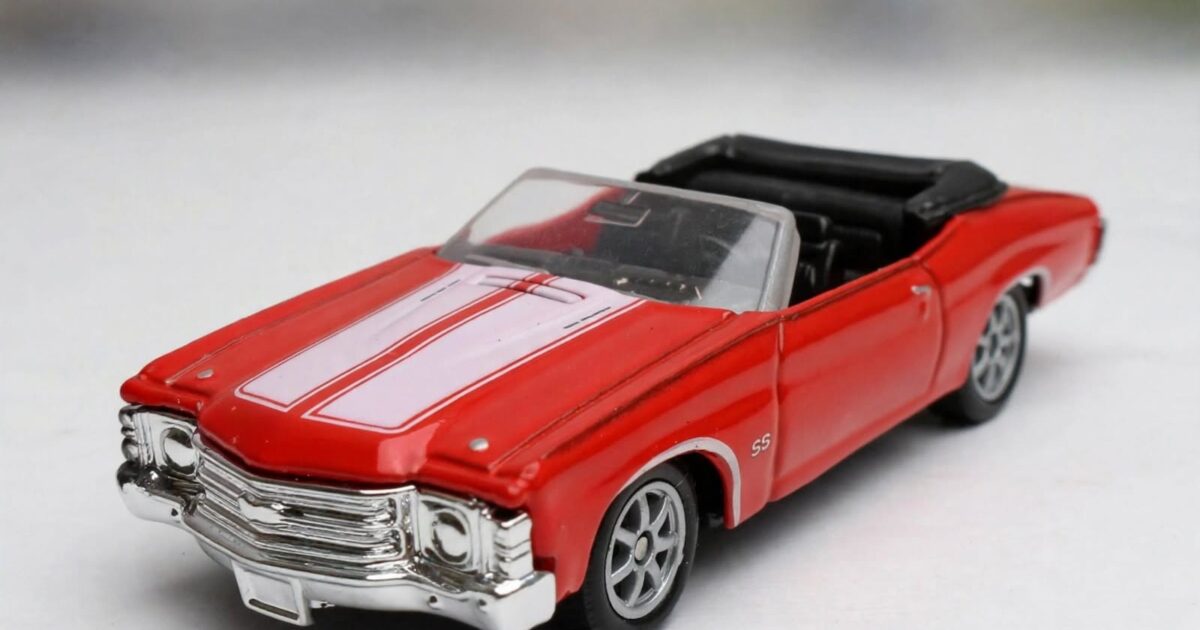
The roof is down and stowed under a black cover behind the seats, which leaves the entire cabin open.
On a casting that is worth a lot. You can see the seats, the centre console, the steering wheel and the dashboard, none of which would be visible on a closed coupe behind tinted glass.
The windscreen frame is chrome and stands alone above the body, which is both the best detail on the car and the most fragile. Nothing protects it.
The stripes run over the boot lid and the folded top cover rather than along the sides, which is correct for this model and a reminder that not every muscle car wore its graphics on the flanks.
Red with white stripes
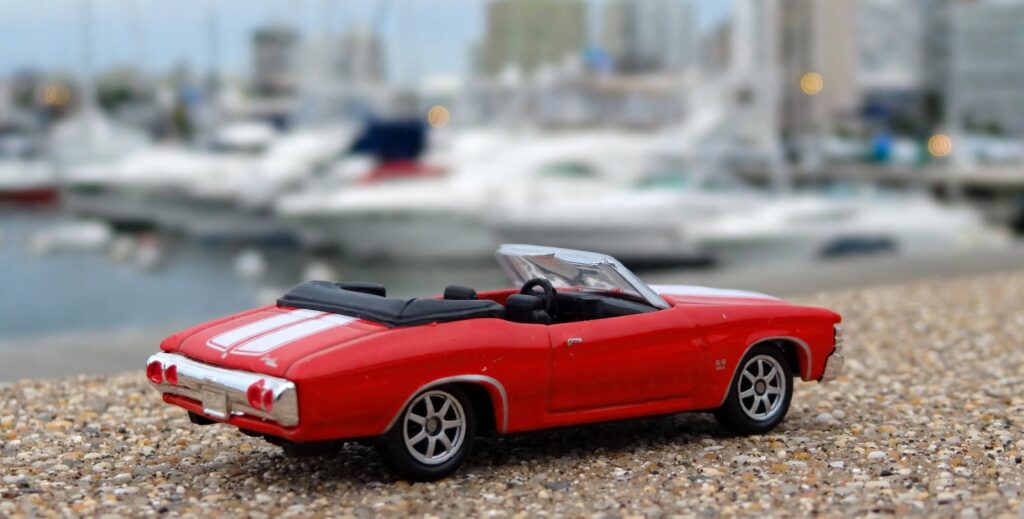
Bright red with twin white stripes running front to back over the bonnet and the deck, and an SS 454 badge printed low on the rear quarter.
That badge is doing the same job as the CJ 428 on the Mercury I looked at recently: telling you the engine, in the place the real car carried it.
The chrome is extensive and correct. The front and rear bumpers, window surrounds, and wheel arch trim are all picked out rather than painted.
Welly kept the ride height realistic, which on a convertible matters more than usual. A lowered open car looks like it is sagging.
Welly on American subjects
I have mostly looked at Welly doing European cars, where the brand fits naturally. American muscle is a different test.
The strengths carry over. Realistic proportions, correct ride height, licensed badges in the right places, clean chrome.
The weakness carries over too. The wheels are generic multi spoke chrome, and on a 1971 Chevelle that is wrong. Period cars ran either steel wheels with caps or specific five spoke designs, and neither looks like what is fitted here.
It is the same parts bin problem that affects every brand in this price bracket, and it is more noticeable on a car this well known.
Convertible or hardtop?
Most muscle cars exist as both and the choice changes what the casting gives you.
A hardtop is more robust, easier to store and shows the roofline the designer drew. For cars where the roof is part of the shape, like a fastback, that matters.
A convertible shows you an interior and gives the casting somewhere for the eye to go, at the cost of fragility and dust.
For the Chevelle I would take the convertible, because the roofline was never the point on this car and the open cabin adds more than the roof would.
Buying a loose Chevelle convertible
The windscreen frame comes first. It is thin, chrome, unsupported and standing at the highest point of the body. Bent frames are extremely common and impossible to straighten without marking the chrome.
Then the open cabin. Look straight down into it under good light for dust and scratching on the interior, which has no glass protecting it.
Then the stripes on the bonnet crown and the SS badge on the rear quarter.
Red shows chips clearly against bare metal. Check the wing edges, the boot lip and the bumper corners.
Open cars and how to store them
A convertible needs different storage from a coupe and most people learn this the hard way.
Dust falls into the cabin and stays there, because there is no glass to keep it out. Over a year on an open shelf the interior goes grey.
The windscreen frame also catches on anything it passes, so sliding a convertible in and out of a drawer full of other cars is how frames get bent.
Individual compartments in a case solve both problems, and they are worth using for open cars even if you store everything else loose.
Bottom line
A well proportioned casting of a car from the year the era ended, with a visible interior, correct badges and extensive chrome. The wheels are wrong and the windscreen frame needs care. For the price, still an easy recommendation.