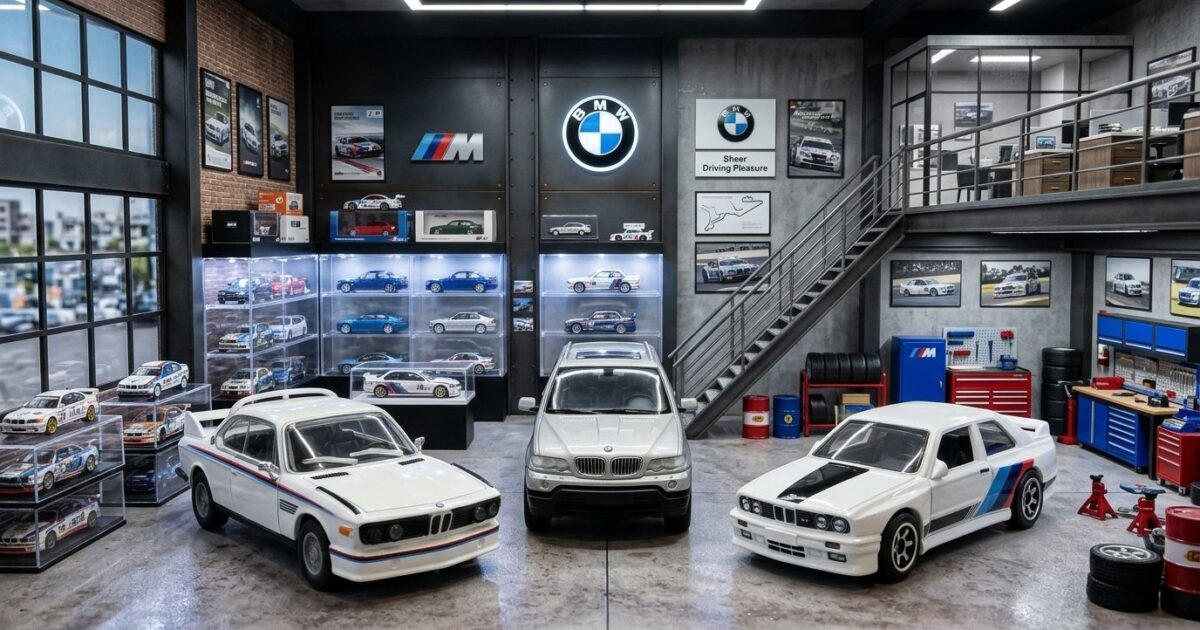
Ask somebody about their Mustang and they say a year. Ask about their Camaro and they say a generation. Ask a BMW enthusiast about their 3 Series and they say E30, and expect you to know what that means.
No other manufacturer gets talked about this way. The internal engineering code escaped the factory and became the name people actually use, and that changes how the brand gets collected.
What the codes mean for a collector
E30, E36, E46 and the rest are development designations, the reference a factory uses to keep one generation separate from the next. Enthusiasts adopted them because the marketing names are useless here: a 3 Series has been in production for decades across completely different cars.
So when you catalogue a shelf, the model name tells you almost nothing. Two castings badged the same way can be twenty years and two design philosophies apart, and the only way to file them properly is by the code.
This is the one manufacturer where I write the chassis code into my own list before the model name. It saves me an argument later.
The roundel is not a propeller
Everybody repeats the story that the blue and white badge shows a spinning propeller against the sky. The company built aircraft engines, so it fits neatly.
The shape came first. The quartered blue and white circle takes its colours from the Bavarian flag, set in a black ring carried over from the firm that preceded it. The propeller reading arrived later, in advertising, and it stuck because it was a better story than a regional colour scheme.
From aero engines to motorcycles to cars
The early business was aircraft engines, built under wartime demand in the second half of the 1910s. When the Treaty of Versailles banned German aero engine production, that business disappeared overnight.
What followed was a decade of motorcycles, then a car factory bought in Eisenach at the end of the 1920s. The first cars were small and licensed from elsewhere. By the mid 1930s the company was building its own designs and winning races with a light two seater, which is where the sporting reputation started.
The sixties car that saved everything
The model that matters most here is not a supercar. It is the compact saloon launched in the early 1960s, a clean, modern, mid sized car that sold in the numbers the company badly needed.
Everything recognisable about the brand today descends from that decision: a sporting saloon of moderate size, sold to people who wanted to drive it themselves. The sports coupes and the supercars came later, sitting on top of a business that ordinary four door cars were paying for.
Which generations the toy brands actually cast
Not the ones you would expect. Toy ranges follow collector nostalgia, and that runs about thirty years behind the showroom.
That is why the boxy saloons and coupes of the seventies and eighties keep reappearing, while the cars in dealerships now are cast far less often. A shape has to spend two decades being unfashionable before a toy company decides there is a market for it.
The kidney grille is the whole problem
Every BMW casting lives or dies on one feature. Two vertical openings side by side, separated by a thin bar, sitting in the centre of the nose.
Get the proportions right and the car is instantly recognisable from any angle. Get them slightly wrong, make them too tall, too narrow, too deeply recessed, and the whole face collapses. At three inches long there is very little margin, which is why the difference between a good BMW casting and a poor one usually comes down to that one detail and not to the paint.
The second thing to check is the kink in the rear window pillar, a small upward bend near its base, present on almost every car the company has made since the sixties. A casting that smooths it away loses something nobody can name but everybody notices.
What a shelf of BMWs looks like
Mine has an eighties saloon, a nineties coupe in racing colours, a modern short wheelbase coupe and a large luxury saloon from a brand that works in bigger scales. Four cars, four decades, almost nothing in common beyond the grille.
That spread is the argument for collecting this marque. Most brands have one shape they keep returning to. This one has reinvented the same idea every few years for half a century, and the castings document the changes better than any single model could. If you are still deciding how to organise a collection, my starter guide covers choosing a direction.
Where BMW sits among the German marques
Three companies dominate this part of the market and the differences are real. One sells arrival and presence. One sells competence and restraint. This one sells driving, and it has built its entire identity on that single promise since the sixties.
On a shelf that translates into castings that look compact and purposeful instead of large or flashy. For the wider picture of which manufacturers turn up in this hobby and why, see my car brand manufacturers page.
What does BMW stand for?
Bayerische Motoren Werke, meaning Bavarian Motor Works. The company is based in Munich.
Is the BMW logo a propeller?
No. The blue and white quarters come from the colours of the Bavarian flag. The propeller interpretation came later, through advertising.
What do E30 and E36 mean?
They are factory development codes for particular generations of the 3 Series. Enthusiasts use them because the model name alone does not identify which car you mean.
Which BMW is most common in diecast?
The 3 Series in its eighties and nineties forms, particularly the M versions, along with the classic 2002 and the seventies racing coupes.
Does BMW own other car brands?
Yes. The group owns MINI and Rolls-Royce. It also held the Rover group during the nineties before breaking it up and selling the parts.