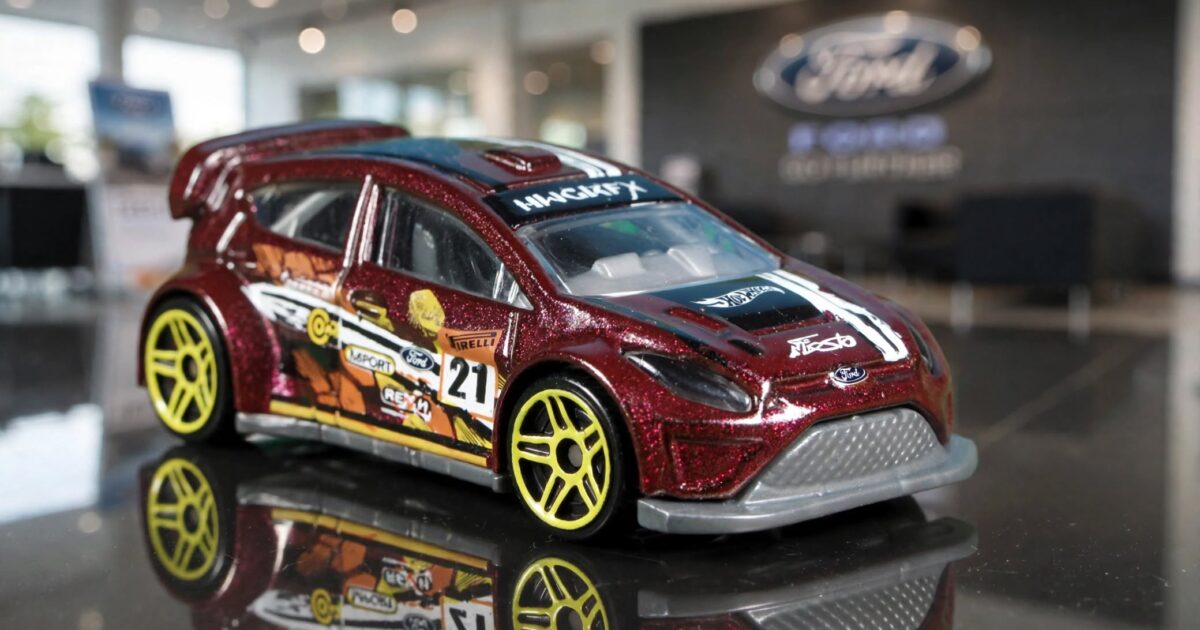
Every other casting on my shelf wants to be spotless. Polished paint, no dust, nothing in the panel gaps. This dark red Hot Wheels Ford Fiesta WRC is the exception. I photographed it on clean green felt, looked at the result, and the car seemed like it was waiting for something. Rally cars don’t belong on carpet. They belong in a ditch with mud up the doors, and that gap between how this model looks and how it should look is the most interesting thing about it.
Hot Wheels Ford Fiesta WRC in dark red metallic
The paint is a deep red with heavy metallic flake, closer to a wine than a fire engine. It’s an unusual choice for a rally car, since most of them wear bright colors so spotters can find them in the trees, and it makes this one look like a shakedown car before the sponsors arrived.
The flake is coarse enough to catch light along the flanks, and on my example it’s even across the roof and the long door panels. White stripes run over the hood and down the sides, breaking up the dark body.
Reading the sponsor graphics on the Fiesta WRC doors
The number 21 sits in a white panel on the lower door, with a cluster of small logos around it. Ford appears in an oval, there’s a name that reads as bercari, another that looks like REXH, and a small shield badge below the mirror.
Across the rear side window there’s a black band with HWGRFX printed in white. That’s the Hot Wheels graphics house signature, used on castings where the designers invented the livery instead of licensing a real team’s. Knowing which is which changes how you read a car, so check the doors before you tell anyone this is a works entry.
The roof wing and spoiler on the Fiesta WRC casting
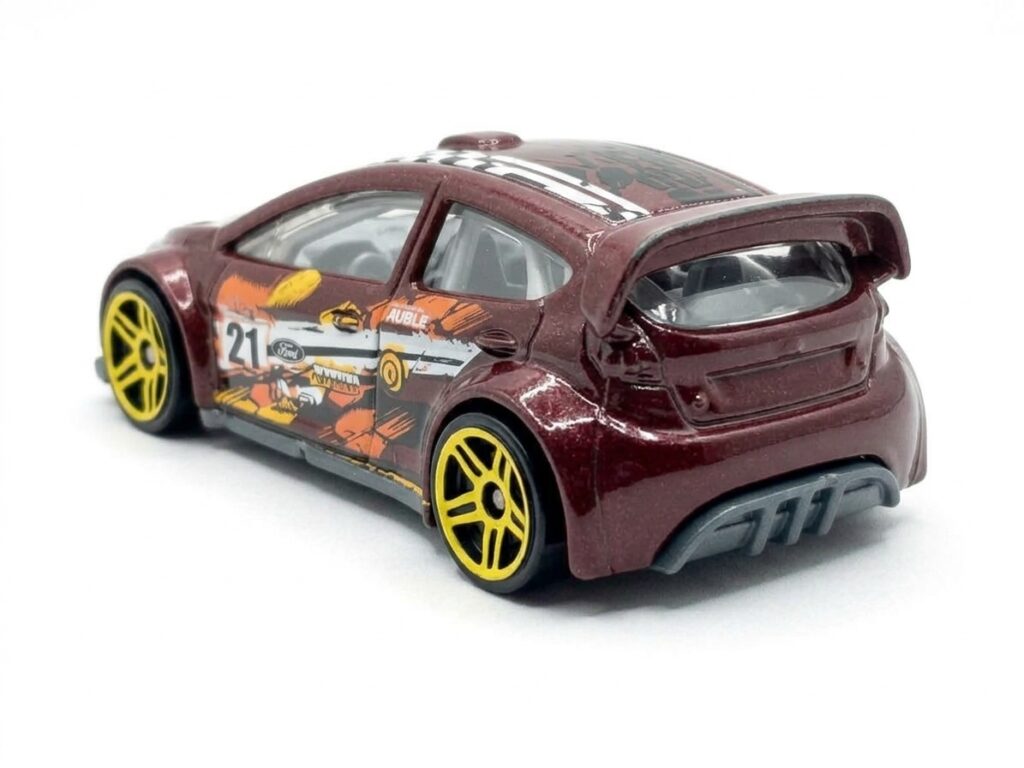
There are two wings on this car. A large one stands off the hatch on thick supports, painted body color, and above it the roof edge carries a second lip spoiler that runs the full width of the car.
Real WRC Fiestas ran exactly this arrangement, with a roof extension feeding air to the main wing. It’s the kind of detail that could have been simplified at this price and wasn’t. From the side, the two wings stack into a shelf over the rear of the car and give the profile a distinct silhouette.
A small vent scoop is cast into the roof ahead of the spoiler, and the rear window is blacked out with a honeycomb pattern printed over it. Through the side glass you can see a gray interior with a cage and a single seat.
Why the Fiesta hatchback shape works as a rally casting
A hatchback is short, tall and square at the back, which is the opposite of what usually looks good at 1:64. Most small cars end up looking like a brick with wheels.
What saves this one is the width. The arches are pushed out well past the doors, the track is wide, and the body sits low between them. A real rally Fiesta is nearly as wide as a sports car with a hatchback standing on top, and that contrast between the narrow greenhouse and the wide base is what the eye reads as fast. Take away those flares and this would be a shopping car wearing stickers.
Hot Wheels Fiesta WRC wheels and front splitter
The wheels are bright yellow with a five spoke design, and they’re the loudest thing on the car. Against the dark red they work, mostly because rally teams really do run colored wheels so the crew can spot the car coming into service.
Up front there’s a gray plastic splitter that wraps under the bumper and extends past the nose. It’s the same gray used for the lower body trim along the sills. On a mainline casting I’d expect that part to be black or body colored, so the extra piece is a nice surprise.
The tires are smooth with no tread pattern, which is the one place the model gives itself away. A real gravel car runs chunky blocks you can see from across a service park, and plain tires on a rally casting look off to me.
How to photograph a rally car at 1:64
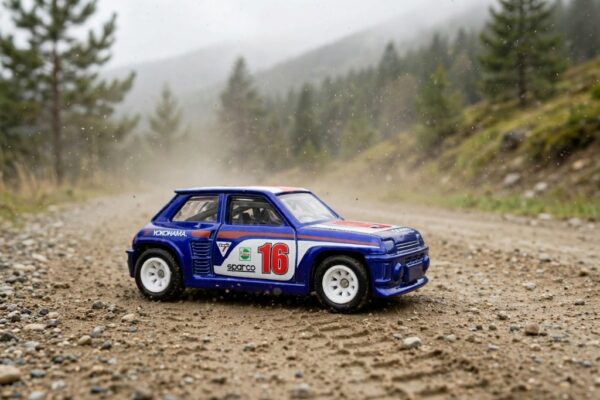
Take it off the clean surface. Gravel, dirt, a patch of dry grass, anything with texture under the tires does more for this car than any amount of good lighting. Shoot low and leave some space ahead of the car for the road to run into.
A little dust on the lower body sells it completely. I use a dry brush and dust from a windowsill, and it wipes off afterward. For setting up small outdoor scenes, my diorama guide covers surfaces and backgrounds that suit this kind of car.
Where the Fiesta sits among Ford castings
Ford has given this hobby more shapes than any other manufacturer, from the thirties rods through the muscle years to the modern race cars, and I pulled that history together on my Ford page. The Fiesta is the newest thing on that list and the only one built for gravel.
Next to a Mustang or a Cobra it looks tiny and a bit silly. On its own, shot low on a dirt road, it looks like the most serious car in the collection.
Why I keep the Hot Wheels Fiesta WRC dirty
I’ve decided this one lives a different life from the rest. The muscle cars stay clean on their shelf. This one gets taken outside, parked on gravel, dusted up and photographed.
If you buy one, resist the urge to display it next to your polished cars. Give it a rough surface and a low camera angle instead. It’s the only casting I own that gets better the dirtier it looks, and treating it like a shelf queen wastes almost everything the designers put into it.