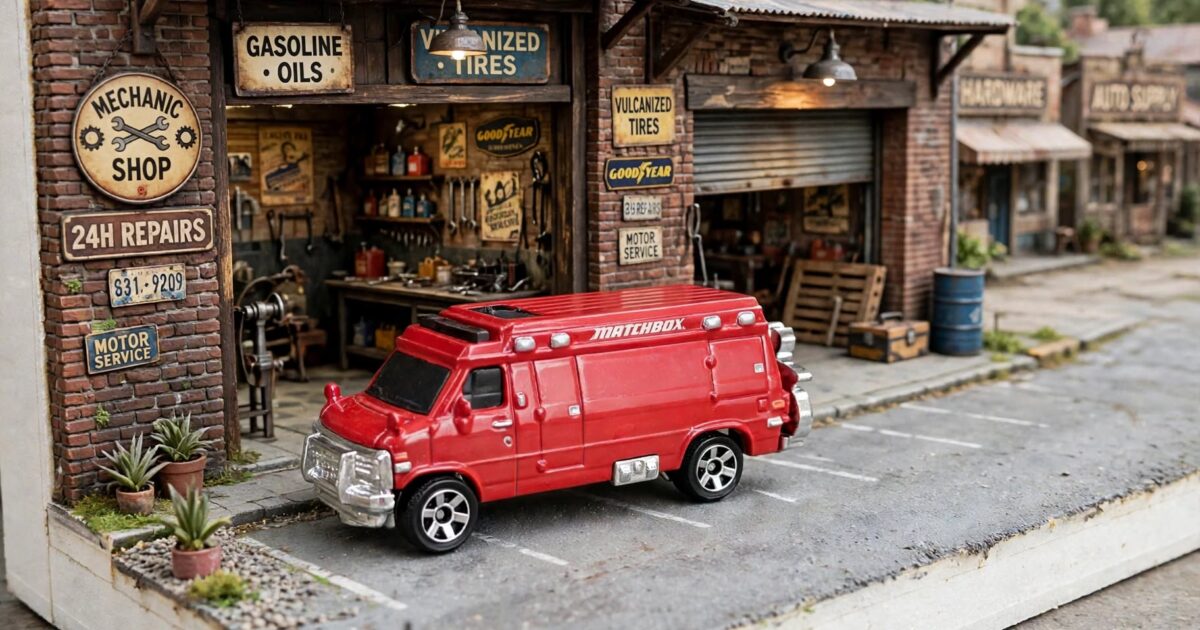
There is a word printed in white along the upper flank of this red van, right where a plumber or a florist would have put their own. The word printed there is MATCHBOX.
I have gone back and forth on it for years. It is the brand advertising itself on its own product, which is either charming or cheeky depending on the morning you ask me, and it is the single thing that decides what this casting is good for.
What the Matchbox Custom 1995 Chevy Van gives you
A full size American panel van in bright red, with a chrome grille, chrome front and rear bumpers, chrome mirrors on stalks and a row of small marker lights along the roof edge. The side glass is blacked out behind the front doors, which is correct for a van built to carry cargo instead of people.
The body is a long flat slab with almost no shaping, which is exactly what these vehicles were. A box sitting on a chassis with a nose grafted onto the front of it.
The chrome motorcycle changes the whole thing
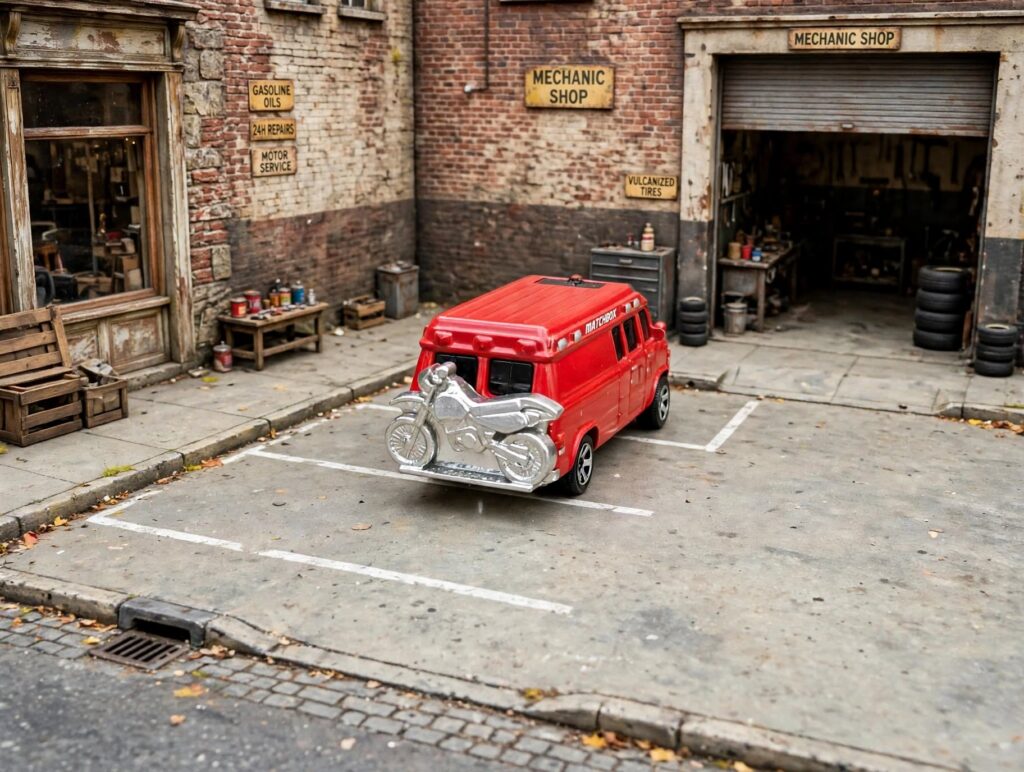
Mine came with a bike. A separate chrome motorcycle that sits on a platform at the side of the van, moulded in one piece, with the wheels, the bars, the seat and the frame all picked out.
This matters more than it sounds. A second vehicle in the package doubles what you can do with it: the van turns into a support vehicle, the bike becomes the thing being delivered, and suddenly a static model has a story attached. For a few extra grams of metal, the toy arrives with a scenario already built into it.
Where the bike works and where it does not
Set up properly, the bike is the best feature here by some distance. Park the van, place the bike alongside it and you have a scene without building anything.
The problem is that it is loose. A separate accessory at this scale goes missing, and a chrome part scratches the moment it touches anything else in a box. If you buy one secondhand, assume the bike is gone unless the listing shows it, and check the chrome for rubs if it is there.
The platform it sits on is part of the van, so the bike has somewhere definite to go, which is better than the loose accessories that just rattle around in the blister. It still lifts straight off, though, and nothing holds it down.
Red paint and the chrome up front
The red is bright and glossy, laid on evenly across an enormous flat side panel, which is harder than it sounds because there is nothing on that surface to hide a flaw.
The front end is where the money went. A full chrome grille with horizontal bars, chrome bumpers at both ends, chrome mirrors and chrome wheels. On a vehicle this plain, that brightwork is the only relief anywhere, and without it the van would read as a red brick with wheels.
The roof detail and the small stuff
Along the top edge of the body there is a row of cast marker lights, the kind these vans carried to show their width to other drivers at night. There is also a panel in the roof that reads as a hatch or a vent.
Those details do a lot. The upper half of a van is a huge empty surface, and breaking it up with a line of small shapes is the difference between a vehicle and a shoebox.
At the back there are chrome exhaust stacks running up behind the rear wheel, which is a custom touch on an otherwise working vehicle. The word Custom is in the casting’s own name, so they are honest about it, but they are still the one thing here that no working delivery van would ever carry.
The problem with a brand name as a livery
Here is my honest complaint. Every time I put this van into a scene, the lettering pulls the viewer straight out of it. A street scene with a mechanic shop and a marked parking bay holds together until somebody reads the word on the van and remembers they are looking at toys.
Older castings did this constantly, and collectors are split on whether it is part of the charm. For me it depends on the purpose: on a display shelf it is fine, in a photographed scene it is a problem. If you build scenes, my diorama guide has a section on keeping everything in the frame consistent.
Panel vans as a collecting subject
They are badly underrated. A van is a rolling billboard, which is why real ones carry the best graphics on any road, and why diecast brands have used them for decades as a cheap way to issue one casting in a hundred different liveries.
The tooling cost is paid once and the graphics do the rest. For a collector that means a van is the easiest shape to end up owning six of without noticing.
One brand built its reputation on working vehicles like this while the other was busy lowering everything and adding flames, and I set out that difference in Matchbox versus Hot Wheels.
The van, the bike, and the name on the side
Taken purely as an object, this is a good casting. The proportions are right, the chrome is generous, the red is well applied and the bike is a genuine bonus that most packages do not include.
Taken as a model of a real vehicle, the lettering holds it back. I would happily pay more for the same van in plain white or in a made up trade livery, something with a phone number and a business name, because then it could sit in any scene without announcing what it is. Until that version turns up, this one stays on the shelf where the advert does no harm, with the motorcycle parked alongside it.