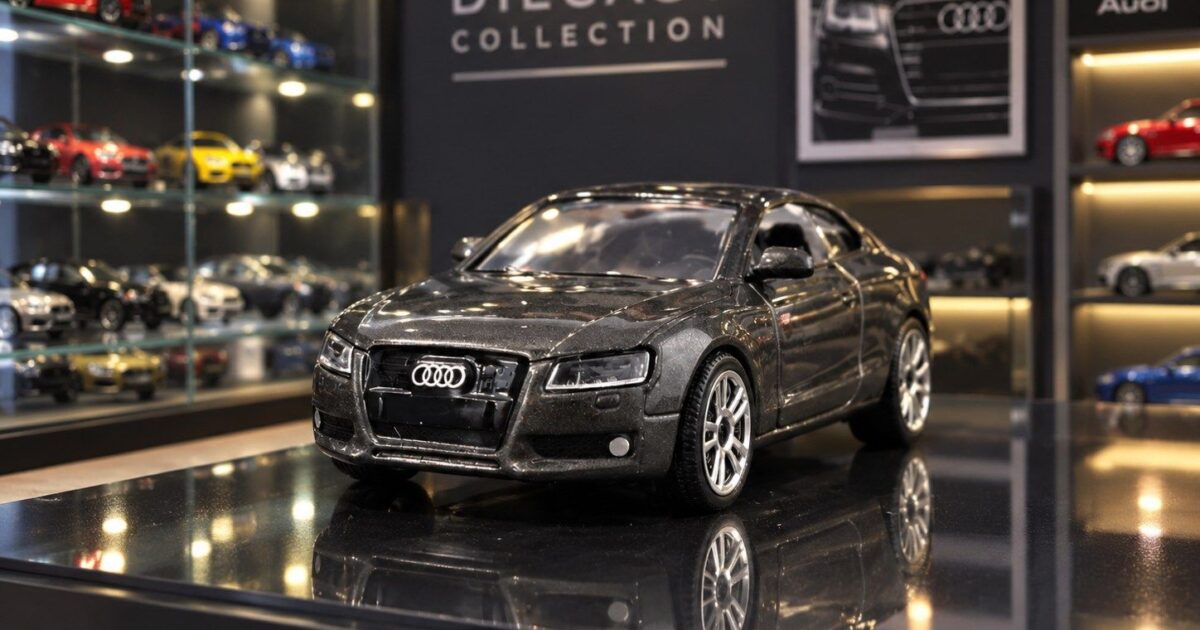
There is nothing to say about this car and that is exactly why it is worth writing about.
No wing, no stripes, no flames, no story about beating anybody. A dark grey German coupé that somebody drives to work. If the casting is any good, it has to be good at the only thing available to it: being the right shape.
Plain cars are the harder test
A supercar casting can be mediocre and still look impressive, because the shape underneath is doing the work. Wide, low, angular, covered in vents.
A mid-size coupé has none of that cover. It is a long bonnet, a cabin, a boot and some gentle surfacing, and if the proportions are off there is nothing to distract you from it.
So when I want to judge a manufacturer rather than a subject, I look at what they do with something ordinary. This is that test for Majorette.
It is also the test most manufacturers avoid taking, which is why ordinary cars are rare in this scale. A mediocre supercar still sells. A mediocre coupé looks like nothing at all.
What the A5 is supposed to look like
The real car was the one where Audi’s design language settled. A long bonnet, a cabin set well back, a single unbroken line running from the headlight along the flank to the tail, and almost no decoration anywhere.
That line is the whole design. Audi called it the tornado line and built the surfacing of the car around it.
On the casting it is there, running the full length of the body at the right height, and it catches light exactly the way it should. Get that wrong and the car becomes anonymous.
The grille does the identifying
The single-frame grille is Audi’s face and it is the first thing a licensing department would reject if it were wrong.
Here it is a large blacked-out trapezoid with the four rings printed in the centre, flanked by headlight units with internal detail picked out. The rings are small, correctly proportioned, and legible.
That badge is also the quickest check on any licensed casting. If a manufacturer got access to real reference material, the badge is right. If they were working from photographs, it is approximate.
The headlights carry the same evidence. On the real A5 the units have internal structure visible through the lens, and here that structure is moulded rather than printed flat. At this size nobody would have complained about a silver smear, which makes the extra effort worth noticing.
Dark grey metallic, and the problem with it
The colour is realistic and it is a nightmare to photograph.
Grey has almost no colour of its own, so like black it can only show you reflections. Under a single overhead light you get a bright streak and a dark body and no sense of the shape at all.
What works is a large soft source low and to one side, which spreads the highlight into a gradient that follows the surfacing. Then that tornado line appears, and the car stops looking flat.
It is also the most common colour on real European coupés, so the realism is accurate even if it is inconvenient.
Opening doors on a smooth body
Majorette fits opening doors across much of the range, and on this body the cost is higher than usual.
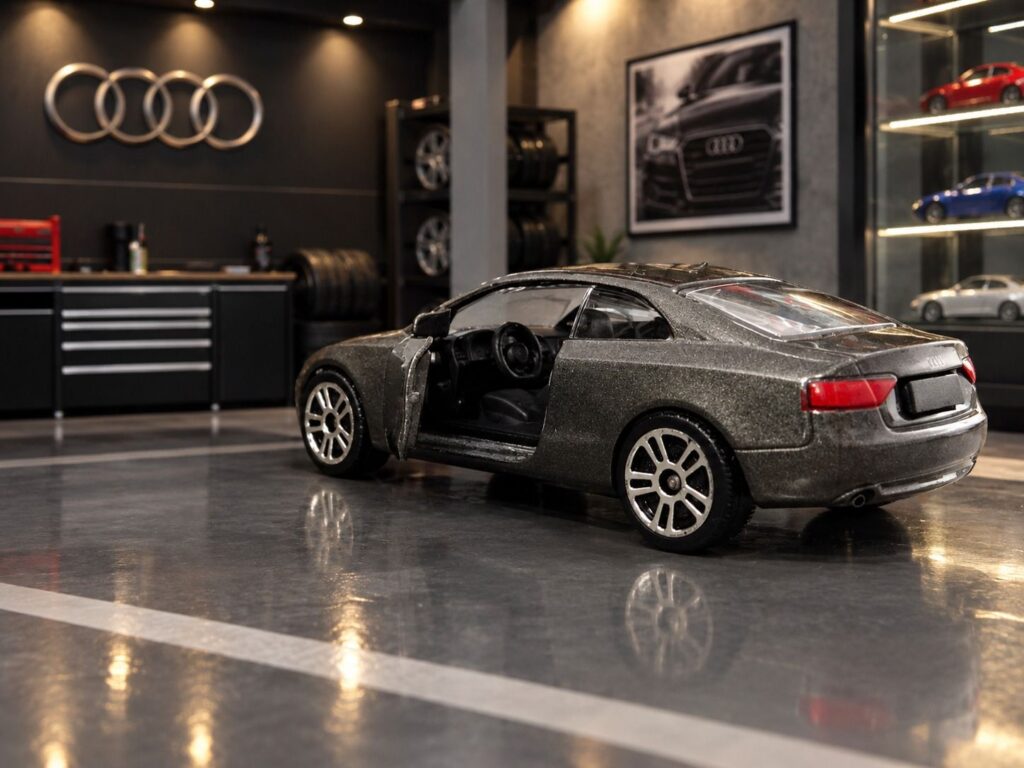
A door that opens needs clearance, which means wider shut lines. On a car whose entire design rests on one uninterrupted line running down the flank, a wide gap cutting across that line is the worst possible place for it.
You can see it in the photographs: the door sits slightly proud and the shut line is visible from a distance, which it would not be on a fixed-body casting.
The gain is an interior with seats, a dashboard and a steering wheel. Whether that is worth interrupting the defining feature of the car is a judgement call, and on this one I would have taken the tighter body.
Everyday European cars are missing everywhere
I keep writing this and it keeps being true. Count the ordinary cars on a typical 1:64 shelf and you reach zero.
Everything is a supercar, a muscle car or a modified truck, because that is what sells to children. The result is a display with no baseline: put four exotics together and the eye stops registering how extreme any of them are.
One grey coupé fixes that. It gives the shelf a sense of scale and makes the loud cars look deliberate rather than relentless.
It also changes what a diorama says. A street with four exotics parked on it reads as fantasy. Add one grey commuter car and the same street reads as a place where somebody happens to own something expensive, which is a more interesting scene.
Majorette covers this territory better than anyone, which is consistent across everything of theirs I have looked at. Our guide to Majorette diecast worth collecting goes through the range.
Buying a loose A5
Start with the door fit, since that is the known weak point. Open and close it, look at whether it sits flush, and check the hinge area for looseness.
Then the four rings on the grille, which sit at the front where handling concentrates and which are the detail that identifies the car as licensed.
Then the lower front valance, which is dark and sits proud.
Grey metallic hides fine scratching well and shows chips as light marks against the dark paint. Inspect edges rather than panels, and ask for a photo under soft side light rather than trusting an overhead shot.
In short
An honest casting of a car with nowhere to hide, with the defining body line correctly placed and licensed detail where it matters. The opening doors cost it more here than they would on a busier shape.
Buy it for the same reason you would buy a sedan: not because it is exciting, but because a shelf of only exciting things stops being interesting.