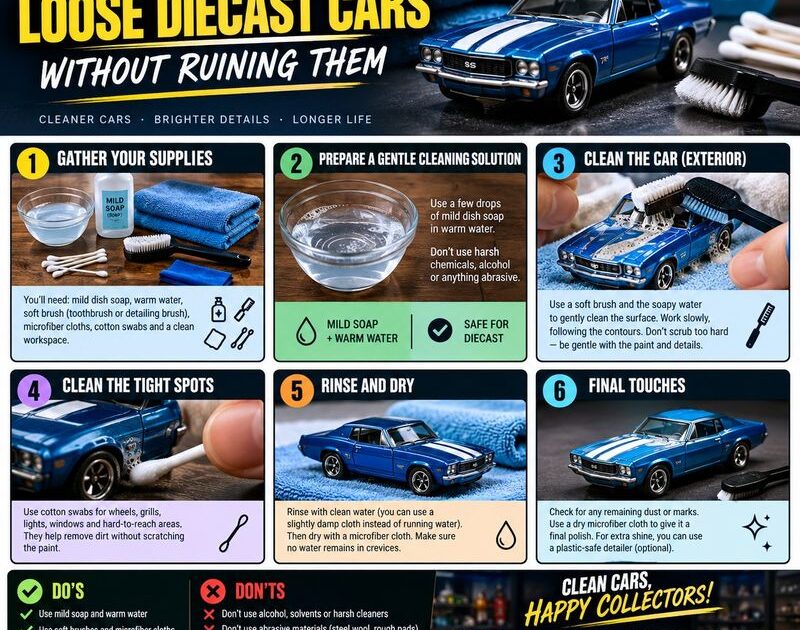
You buy a box of loose cars, or you find one in a garage, and under the grime there might be something good. The temptation is to get it clean fast.
That is how printed decoration disappears. Here is the careful version.
The rule that matters most
Dirt sits on top. Tampo sits on top too.
Printed decoration on a diecast car is not under the paint and not baked in. It is applied to the surface, and anything aggressive enough to lift grime off that surface is aggressive enough to lift the printing with it.
So the question is never how to clean a car thoroughly. It is how little you can do and still improve it.
Start with a dry brush
Before any liquid touches the car, get the loose material off.
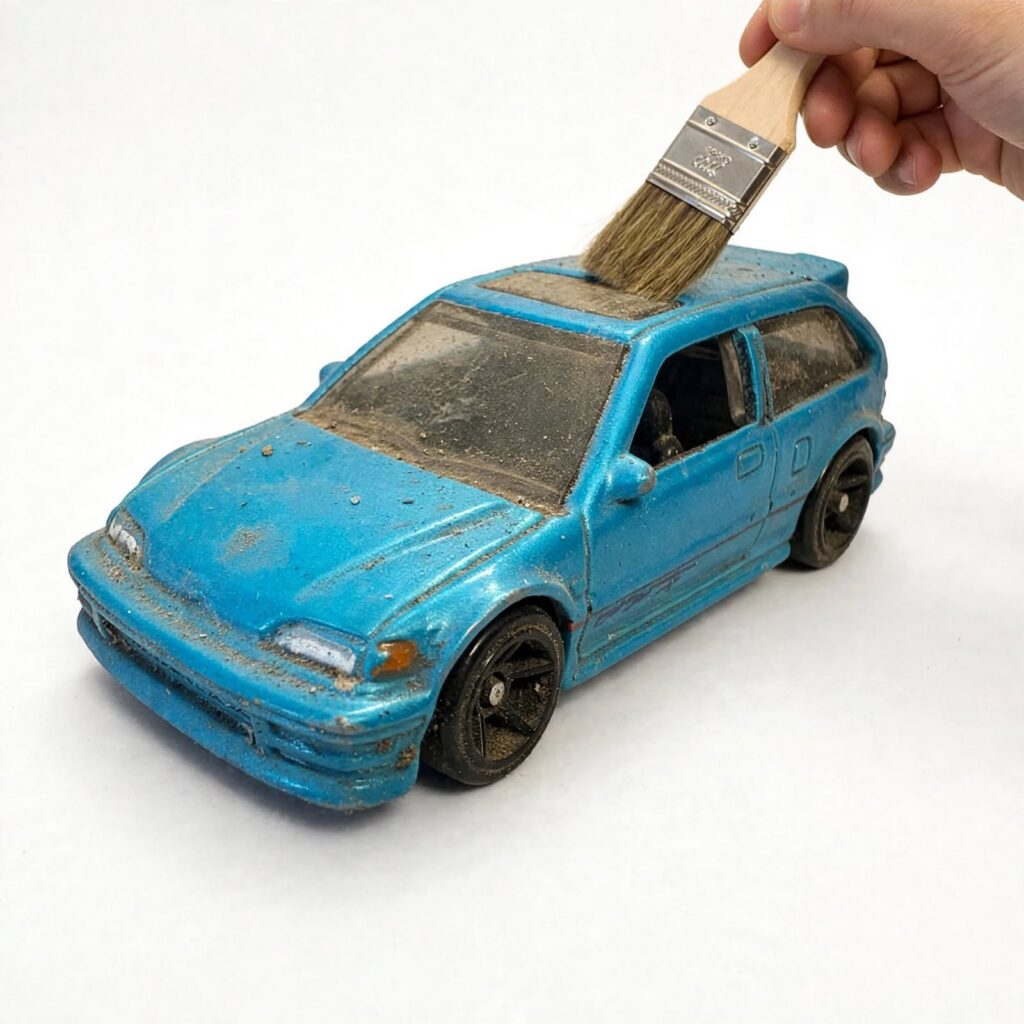
A soft brush, the kind used for makeup or for cleaning camera lenses, removes dust from panel gaps, grilles and open cabins without rubbing anything against the paint.
For a car that has been in a box for years, this alone often does most of the work. Dust is not stuck to anything. It is just sitting there.
Do the interior of open cars from above, and work the brush out of the recesses rather than pushing dirt deeper into them.
Warm water and mild soap, applied sparingly
For actual dirt, the conservative approach is water with a small amount of mild dish soap, applied with a soft cloth or a cotton swab rather than by submerging the car.
Submerging is where people get into trouble. Water gets behind the windows, into the chassis, and around the rivets, and it does not come out easily. A car with water trapped inside can develop problems that were not there before.
Wipe, do not scrub. If dirt does not come off with light pressure, it is either not coming off or it is taking tampo with it.
Dry immediately and completely, paying attention to the gaps where water collects.
What to keep away from a diecast car
The things that work on real cars and destroy models.
Solvents. Alcohol, acetone, nail polish remover, white spirit. These remove tampo on contact. Some collectors use them deliberately for exactly that reason when stripping a car for a custom build.
Abrasive polishes. Anything with cutting compound in it is designed to remove a layer of material. At this scale there is no layer to spare.
Hot water. Heat can affect plastic parts and loosen adhesives.
Toothbrushes. Too stiff. They scratch paint and lift printing at the edges.
Ultrasonic cleaners. Effective and far too effective. Collectors report tampo lifting off in them.
Rust, and why it is usually the end
Rust on the base or around the axles is a different problem from dirt, and it is mostly not fixable at this scale.
The metal is thin, so by the time rust is visible, material has already been lost. Treatments that work on larger metal objects are too aggressive here, and mechanical removal takes the base finish with it.
What you can do is stop it spreading: get the car completely dry, keep it dry, and store it away from humidity. Our guide to storing a diecast collection covers the conditions that cause this in the first place.
A rusty car is a parts car or a shelf car. It is not going to come back.
Wheels, axles and whether to touch them
A car that will not roll usually has a bent axle, not a dirty one, and bending it back rarely works.
Dirt wrapped around an axle can be teased off with a brush or a dry cotton swab. That is worth doing. Lubricating the axles is not: oil attracts dust, and in a few months you have a worse problem than you started with.
If the wheels are scuffed, leave them. Polishing a plastic wheel face removes the finish and leaves a dull patch that looks worse than the scuff did.
When cleaning costs you money
This is the part worth knowing before you start.
On a car with real value, originality matters more than appearance. A collector buying a Redline-era car wants honest wear, not a car that has been worked on, and evidence of cleaning can reduce what it is worth.
The same logic applies to anything with original packaging. Cleaning a box is almost always a mistake.
If a car might be valuable, find out what it is before you touch it. Our guide to Hot Wheels as an investment covers which ones those are.
The honest answer: often, do nothing
A loose car with light wear and a bit of dust is a loose car with light wear and a bit of dust. Brushing it is fine. Beyond that, you are usually trading character for shine and ending up with less of both.
My own collection lives in boxes, and the maintenance it gets is a brush and keeping the storage dry. That is less satisfying than a restoration project and it is what the objects actually need.
Frequently asked questions
Can I wash diecast cars with water?
Lightly, using a damp cloth or cotton swab with mild soap. Avoid submerging them, because water trapped inside the chassis is difficult to remove.
What removes tampo from a diecast car?
Alcohol, acetone and other solvents, abrasive polishes, stiff brushes and ultrasonic cleaners. All of these lift printed decoration.
How do I clean a diecast car without removing paint?
Start dry with a soft brush. If you need liquid, use warm water with a trace of mild soap, wipe gently, and dry completely.
Can rust be removed from diecast cars?
Not meaningfully. The metal is too thin, and anything strong enough to remove rust removes the surrounding finish. Prevention is the only real answer.
Should I clean a valuable diecast car?
Generally no. Originality is part of what makes it valuable, and cleaning can reduce the price a collector will pay.