Most storage advice for this hobby assumes you own forty cars. Once you pass a few hundred, the official cases stop being an answer, because filling them costs more than the collection did.
Here is the system I use, what it cost, and where it falls short.
The measurement that decides everything
Nine centimetres of internal depth. That is the number worth remembering before you buy any box.
A 1:64 car is roughly 7 cm long. If the box is deep enough, the cars stand on end rather than lying flat, and a given footprint holds several times more.
Most organiser boxes sold for small parts are too shallow for this. They look fine in a photograph and then you discover the lid will not close over a car standing up. Measure before buying, not after.
Hardware organiser cases, not collector cases
The boxes doing most of the work in my collection come from the hardware aisle. The ones intended for screws, nuts and fittings: a plastic case with a carry handle, a clear or semi-clear lid, and movable orange dividers.
Three things make them better than purpose-built collector cases for bulk storage.
The dividers move. You pull them out or add them, so one box becomes two sections, three or four depending on what you are putting in it. A case with fixed compartments cannot adapt.
They stack and they carry. The handle matters more than it sounds once you are moving boxes around.
They cost a fraction. You can buy ten of these for what a few official cases cost.
What goes in the official Hot Wheels cases
I have two, and that is deliberate.
Official cases have individual compartments, so nothing touches anything else. That is genuine protection and it is the right place for the cars that need it.
What stops them being the whole answer is capacity and price. Two cases hold a small fraction of a large collection, and scaling up to cover everything would cost more than most of the cars in it.
So they hold the vulnerable ones. The rest live in hardware boxes.
Which cars need their own compartment
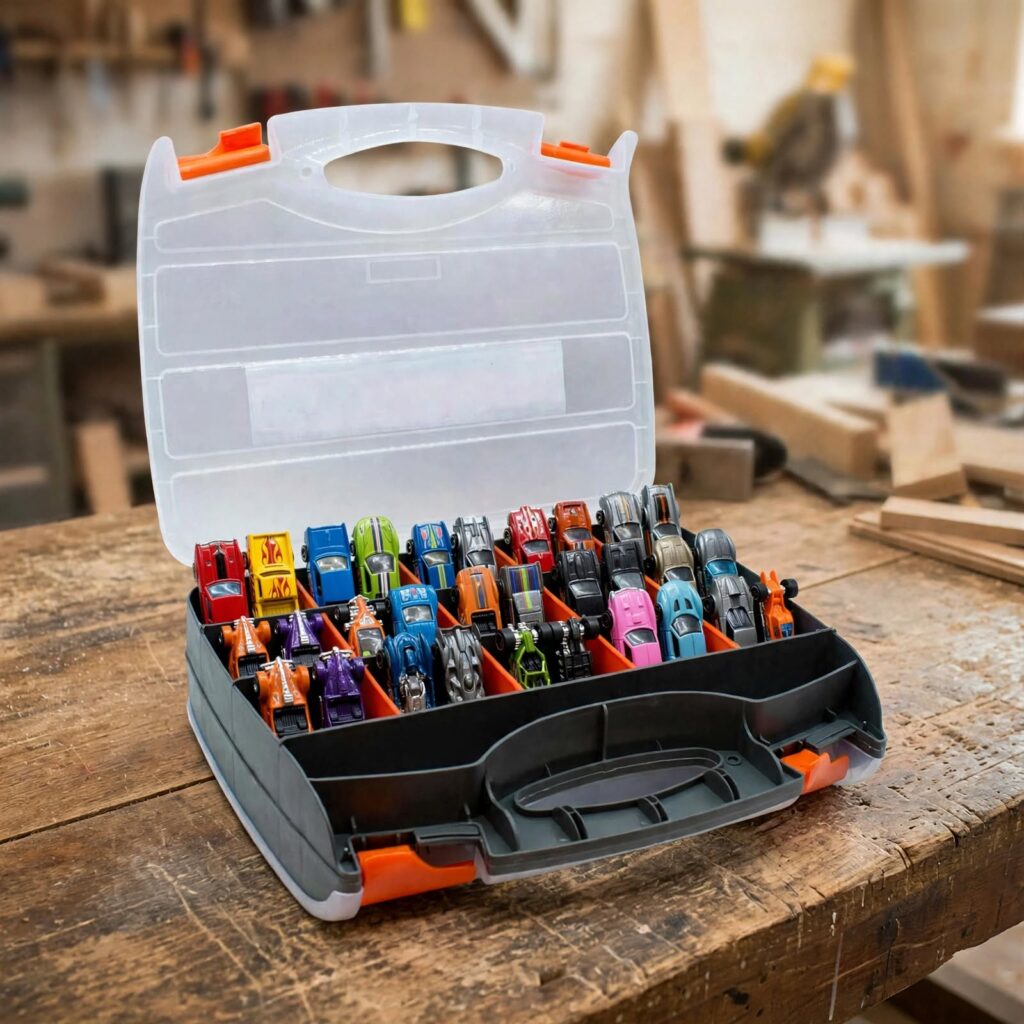
This is the decision the storage guides skip, and it is the one that matters.
Most diecast cars are fine sharing a section with neighbours. They are metal, they are solid, and a bit of contact does nothing.
The exceptions are the ones with something sticking out:
- Tall rear wings. A Superbird or any GT racing car with uprights above the deck
- Thin chrome windscreen frames, which is every convertible
- Separate front splitters on modern performance cars
- Translucent plastic parts, which scratch and haze from rubbing against other cars
On the organiser boxes the dividers do not reach the lid, so a box tipped on its side lets things move between sections. For most cars that is harmless. For the list above it is how damage happens.
Cardboard boxes and wrapped cars
The third layer, for deep storage rather than access.
Cars wrapped individually in paper, packed into a cardboard box. No compartments, no dividers, nothing touching metal to metal.
This is the right solution for the part of a collection you are not going to touch for months. It protects well, it costs nothing, and it is slow to get into, which is exactly the trade you want for things you are not using.
What it does not do is let you find anything quickly, which brings us to the real problem.
Organise by subject, size the box to the group
The system is one criterion per box, with the box sized to the group rather than the other way round.
Brand is the main axis. All the Fords together, all the Chevrolets. When a brand does not fill a box, another American marque goes in beside it rather than leaving the space empty.
Themes get their own boxes: film cars, racing liveries, trucks. Those groups are usually smaller, so they go in smaller boxes.
That last part is the bit people get wrong. Buying ten identical boxes leaves you with some overflowing and some half empty. Match the box to the group.
Label the outside, always
The lids on these cases are semi-transparent, which is worse than either extreme. You can see that there are cars in there and you cannot tell which.
So the label on the outside is not optional. It is the thing that turns a stack of boxes into a collection you can use.
Without labels, finding one specific car means opening everything, and once you have done that twice you stop photographing your own collection because it is too much effort. The labels are what keep it accessible.
[IMAGEN: las etiquetas en el exterior de las cajas apilaas]
Storage against display
Worth being honest about: a stored collection is not a displayed one.
With a few hundred cars you cannot display everything, and anyone telling you otherwise is selling shelving. The practical approach is a small rotating display of whatever you are currently interested in, with everything else boxed.
That also protects the bulk of the collection from the two things that damage stored diecast quietly: dust settling into open cabins, and light fading paint and yellowing translucent parts over years.
If you build scenes rather than shelves, our diorama guide covers that side.
Frequently asked questions
What size box do I need for 1:64 diecast cars?
At least 9 cm of internal depth so cars can stand on end. Anything shallower wastes most of the space.
Are official Hot Wheels cases worth buying?
For vulnerable cars, yes, because individual compartments prevent contact. For bulk storage they are expensive relative to what they hold.
Can I store diecast cars touching each other?
Most of them, yes. Cars with tall wings, thin chrome frames, separate splitters or translucent parts should be separated.
Is cardboard storage bad for diecast?
No, provided the cars are wrapped individually and the box stays dry. It is a good deep-storage solution and a poor access solution.
How should I organise a large diecast collection?
Pick one criterion per box, usually brand or theme, size the box to the group, and label the outside. The label matters more than the system.