Opening parts on a small scale car usually annoy me. A hood that lifts to show a lump of plastic, doors that swing out on visible pins and leave gaps in the bodywork, a tailgate that never closes flush again. They cost accuracy and they buy very little.
This one is the exception, and the reason is simple. The doors on a 300 SL are the entire point of the car. Making them open is not a toy feature bolted onto a model. It is the single most important thing about the vehicle being reproduced.
Why the Siku 300 SL opens the way it does
The real car had a tubular frame so deep along the sides that a conventional door would have left you climbing over a wall. Hinging the doors at the roof was the fix, and it turned an engineering compromise into the most recognizable silhouette of the fifties.
Siku’s casting hinges them the same way, and they lift cleanly on my example with no sag and no scraping against the roof panel. Closed, the shut lines sit where they should and the roof reads as one continuous surface. That is the harder half of the job. Plenty of opening door castings look wrong when shut, which defeats the purpose.
What Siku’s basic line gets right
This is the cheap end of the German brand’s range, and it behaves like a European toy rather than an American one. The emphasis is on the thing being a correct little car instead of a stylized one.
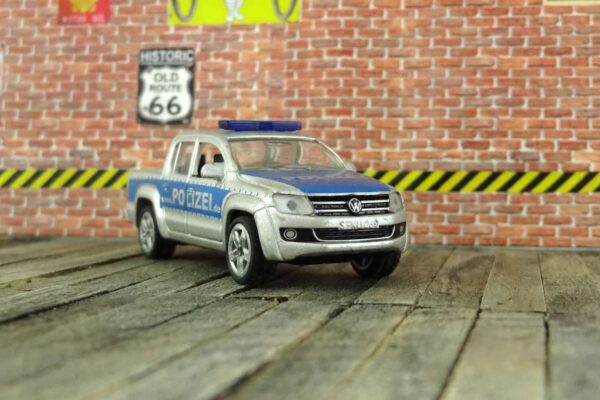
So the proportions are sober, the ride height is realistic, and nobody has stretched the arches or dropped the body. If you have only ever bought from the big two, the whole approach feels slightly foreign. My notes on the diecast car brands page cover where Siku sits against everybody else, and my review of the Siku VW Amarok in police livery shows the same philosophy on a modern vehicle.
The Mercedes 300 SL front end up close
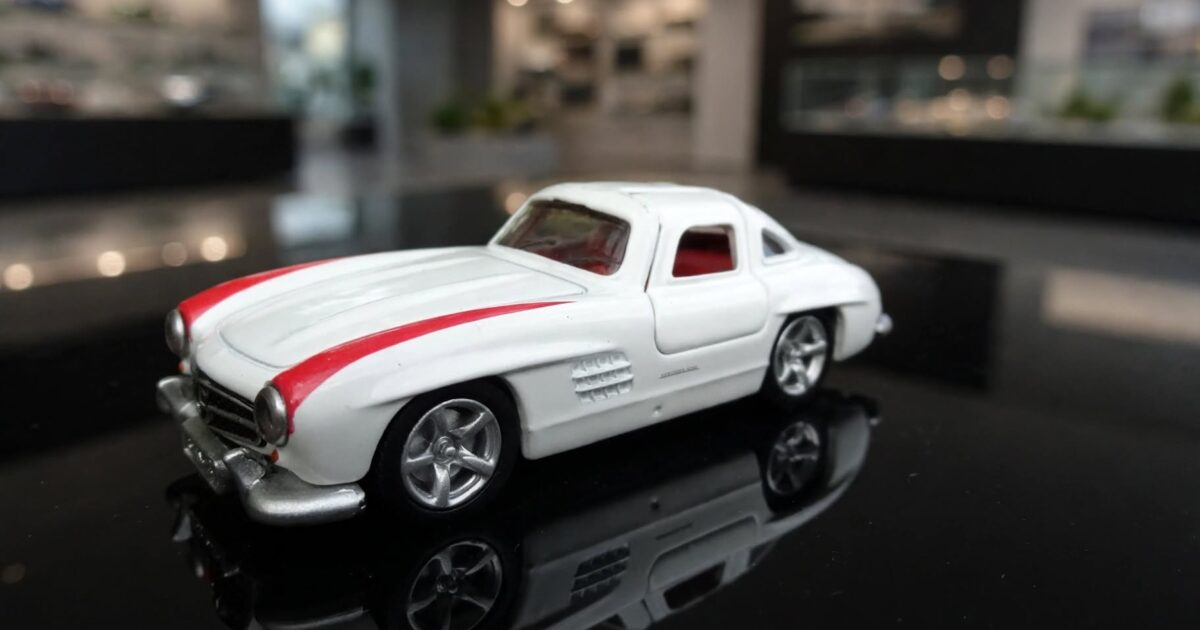
The best detail on the model is the headlights. They are separate clear pieces set into deep round housings, and they reflect light the way actual glass does. Next to a casting with a dab of silver paint for a lamp there is no comparison.
Below them the chrome bumper wraps the nose with two small overriders, and between those sits a molded number plate with a Stuttgart style registration on it. The grille carries a large three pointed star, proportionally a little bigger than it should be, which I suspect is deliberate. At this size a correctly scaled badge would vanish, and the star is how a child or a customer in a shop identifies the brand in half a second.
The red stripes are not a factory scheme
White body, with a red stripe running from the nose back over each front wing. It looks sharp and it photographs well, and as far as I know no road car left the factory wearing it.
What it evokes is the racing version, the cars that ran long distance events in period with national colors and competition numbers. Siku has taken that idea and applied a cleaned up version of it, which is a reasonable thing for a toy to do. I would still rather have it in plain silver, because silver is what this car is supposed to be, but the stripes give a white body something to break it up.
Behind the front wheel there are molded vents in the flank, and on mine the paint has stayed out of the recesses, so they still read as openings instead of filled in lines.
Red interior and what you can see of it
Open the doors and the cabin is red plastic with molded seats and a dashboard shape. Closed, you catch it through the side glass and the windscreen, and the contrast against the white body does a lot for the model from any angle.
This is one of the few cases where an opening door earns its place twice. You get the gullwing gesture, and you get a reason to have detailed the interior at all. On a sealed casting that red would be wasted.
Siku sits bigger than the rest of the shelf
Here is the thing to know before buying. Siku’s basic cars are not built to the same scale as a mainline Hot Wheels or Matchbox. They are noticeably larger, which is what happens when a manufacturer sizes each casting to a standard box instead of to a fixed ratio.
Stand this next to a 1:64 Porsche and the Mercedes looks like it ate well. On a mixed shelf that bothers some collectors enormously and others not at all. I put the Siku cars together in their own group, which solves it, and I would suggest the same to anybody starting with this brand.
Wheels that belong to a different decade
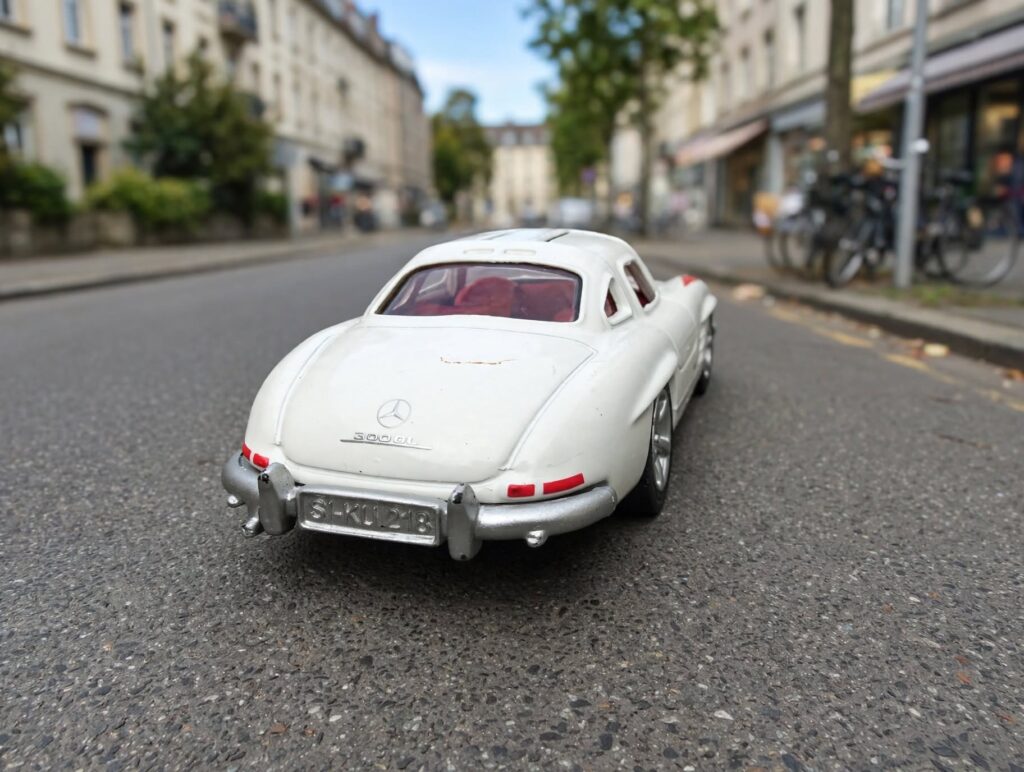
My one real complaint. The wheels are silver five spoke alloys, and they are a modern design on a car from 1954. The real thing wore steel wheels with hubcaps or wire wheels, and neither looks anything like this.
It is a cost decision. Brands reuse wheel tooling across a whole range, and the classics get whatever is already in the parts bin. On a casting this careful about the doors and the headlights, it stands out as the one place somebody stopped paying attention.
Where the Siku Mercedes earns its place
It stays, and not because it is perfect. It stays because it is the best argument I own for buying outside the two brands everybody starts with.
A German company made a careful little model of a German car, sized it for a box, gave it a feature that happens to be the most famous thing about the original, and sold it cheap. Hold it next to anything from the usual peg and the difference in intent is obvious within about two seconds.