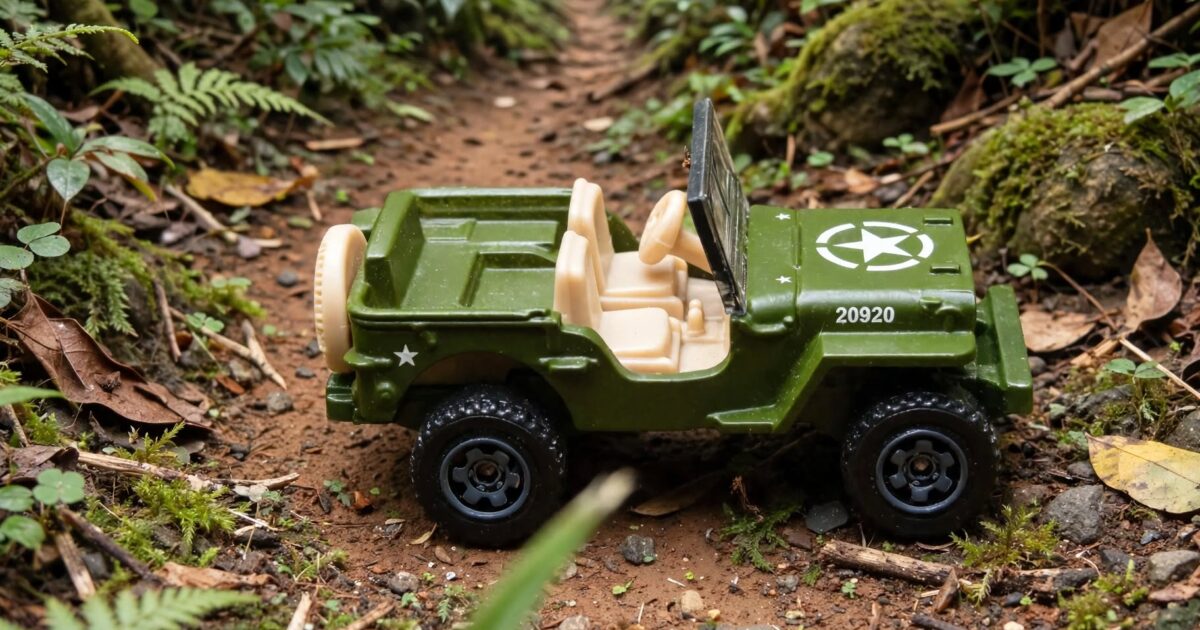
Look through any mainline range and count the military vehicles. You will find jeeps, trucks, ambulances, maybe a half track. What you will not find is anything with a gun on it. The brands settled on that line decades ago and they have not moved from it since: transport yes, weapons no.
That makes the Willys Jeep MB the acceptable face of military diecast, and it is why this olive Matchbox casting sits on toy pegs next to sports cars without anybody raising an eyebrow.
What the Matchbox Willys Jeep MB actually is
A small open vehicle with four wheels, a folding windscreen, two rows of seats and a spare on the back. No doors, no roof, no trunk, and nothing that does not earn its place. It was designed by engineers working to a military specification, with no stylist anywhere in the process, and it shows in every single line.
The casting respects that. The body is a simple tub with the fenders running forward as flat shelves, a flat hood between them, and a grille that is a plain slotted panel. The rear panel carries a spare wheel mounted flat up against it.
Reading the markings on the hood and body
There is a white star in a circle on the hood, white stars on the body sides and a white serial number printed on the front panel. None of this is decoration. The star was a recognition marking, the number was a registration, and every vehicle carried its own.
What that means for a collector is that this model represents one specific vehicle, not a model line. It also means the printing has to be sharp, because an off center star on a flat olive hood is the first thing anybody sees. On mine the star sits dead straight and the number is still legible under a magnifier.
Olive paint and the flat finish
The green is a flat olive with no metallic in it and no gloss. That is correct, since shine was the enemy on a vehicle meant to disappear into a hedgerow, and it gives the casting a different texture from everything around it on the shelf.
The trade is practical. Flat paint picks up marks and holds fingerprints, and it cannot be polished out the way a gloss finish can. Handle this one by the wheels and keep it out of warm hands.
The cream interior and the folded windscreen
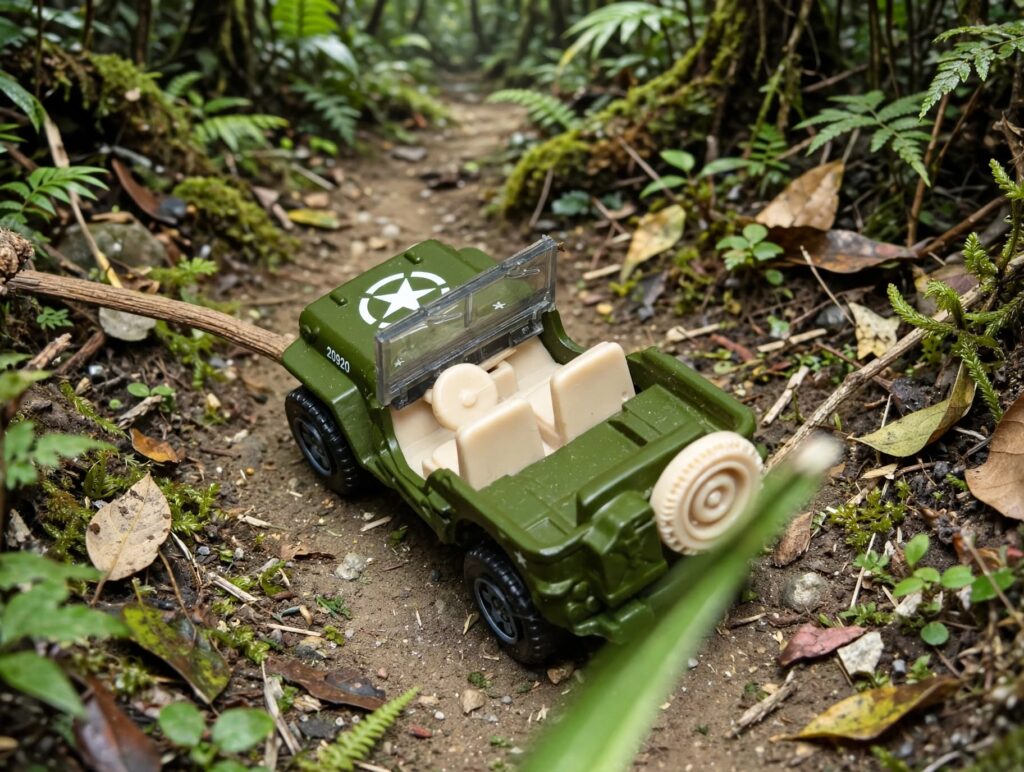
The interior is a separate piece in a pale cream, and because there is no roof you see all of it: two front seats, a rear bench, a steering wheel on a long column and a shifter. The spare wheel on the back panel is the same cream plastic.
The color choice is the only thing I would argue with. Real vehicles had canvas seats in a drab shade close to the body, and this cream is much lighter. It makes the interior pop in photos, which I suspect was the point, but it is a decision about toys and not about accuracy.
The windscreen frame is a separate dark piece standing upright with clear glass in it. On the real vehicle that frame folded flat onto the hood, and the casting shows it in the raised position.
I would have preferred it folded. The raised frame is the tallest thing on the vehicle and it is thin, so it is the part that will bend in a pocket or a box. Folded flat it would also have looked more like a vehicle in use.
Wheels and tires on a small military casting
The wheels are grey with a simple hub design, and the tires are chunky with a deep tread pattern molded all the way around the shoulder. They look like they would actually bite into something, which is more than most tires at this size manage.
The vehicle sits high, with real daylight under the body and visible suspension detail between the wheels. A lowered jeep would be absurd, and nobody has tried, which tells you something about where even the most custom minded brands draw their own lines.
The axles are visible front and rear, cast with a simple differential bulge, and there is a hint of chassis rail above them. At this price you rarely see anything under a model, so getting even a suggestion of running gear is a point in its favor.
Why Matchbox makes these and Hot Wheels mostly does not
It comes down to what each brand is for. One builds factory accurate versions of working vehicles, and jeeps, ambulances and fire engines are exactly that. The other lowers everything, adds flames and invents cars that never existed.
A military jeep makes no sense at all inside the second range. I went through the split in detail in Matchbox versus Hot Wheels, and this casting is a clean example of it.
Using a jeep in a 1:64 scene
It is the easiest subject I own for this. A patch of soil, some dry leaves, a piece of weathered wood behind it, and the vehicle immediately looks like it is somewhere real. Open bodywork helps, because the cream interior gives the scene a second color to work with.
Shoot it low and let a stem cross the frame up front. For backgrounds and surfaces, my diorama guide covers what works at this size.
What the jeep adds to a shelf of cars
Contrast, mostly. Every other vehicle I own exists to be looked at. Somebody chose its color, drew its creases and argued about its wheels. This one exists to carry four people and a jerrycan across a field, and every shape on it answers a question about doing that.
Having one on the shelf changes how the others read. Next to a jeep, the styling on a sports car stops being invisible and starts looking like what it is, which is a long series of decisions somebody made in order to sell you something.