Cover the badge on a modern Volvo and you still know what it is, because of two shapes. A T on its side inside each headlight, and a pair of tall narrow lamps standing up either side of the tailgate. Those two signatures now do the work that grilles, fins and badges used to do for everybody else.
Which creates a problem for anybody making a small copy of the car. A grille can be cast. A crease can be pressed into metal. A light signature is a thin graphic, and at this size it has to be printed, which means the whole identity of this blue Welly Volvo XC90 rests on how well a machine lined up some ink.
How the Welly Volvo XC90 handles the light signatures
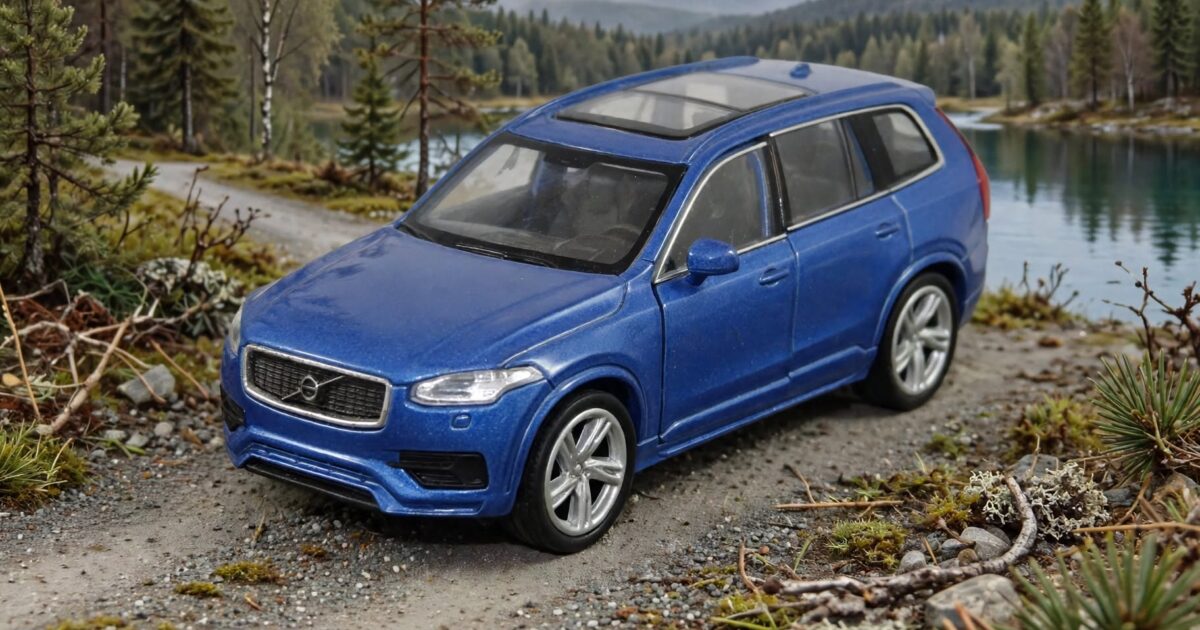
Better than I expected. The front lamps are printed as clear units with a dark horizontal bar running through them, and the shape reads correctly from a foot away. They sit either side of a chrome framed grille with the diagonal slash and the iron mark in the middle.
The rear is the stronger end. The tall lamps run up the sides of the hatch in red, with the upper section continuing onto the roof pillars, and the printing follows that bend around the corner without breaking or thinning out. On a cheap model that corner is exactly where the ink usually goes wrong.
Blue metallic and chrome window trim
The paint is a rich metallic blue with a visible flake, bright in sun and deep in shade. Coverage on mine is even across the long roof and the flat door panels, which on a vehicle this size is a lot of surface to keep consistent.
Running around every window there is a bright chrome strip, cast separately and fitted into the body. It follows the glass line from the windscreen pillar all the way around to the tailgate, and it is the single detail that makes the model look like a premium vehicle instead of a generic SUV.
The glass roof and what it shows
The roof is one long tinted panel stretching from the windscreen almost to the back of the cabin. Through it you can see the interior: front seats, a center console, a dashboard with a vertical screen shape, a steering wheel.
It is unpainted dark plastic, so what you get is shapes and not real detail. At this scale I would have liked some contrast on the seats, because the roof panel invites you to look inside and then there is not a great deal to find.
A note on scale before you buy
This one is marked at a scale between the common small castings and the larger display models. In practice it is noticeably bigger than a mainline car and noticeably smaller than the 1:32 models, which means it matches almost nothing.
That is the trap with odd scales. Buy a single one and it sits on its own forever. Buy several from the same range and they work together, because the brand is consistent with itself even when the number on the base is unusual. If you are picking a scale to commit to, my starter guide is the place I would begin.
Wheels and the way it sits
The wheels are silver five spoke alloys with a concave face, a fair copy of what these came with, and they are the right diameter. The arches are properly filled without the tires touching the lips.
Ride height is factory correct, which matters on an SUV. Lower it and you get a crossover pretending to be something sporty. Raise it and you get a toy. The casting leaves it alone, and the body sits level with a believable amount of daylight underneath.
The lower body trim is picked out in dark grey along the sills and around the arches, which is how the real vehicle was finished. Painting it body color would have been cheaper and would have made the thing look like a tall estate car.
The driver door opens, and that is the only one
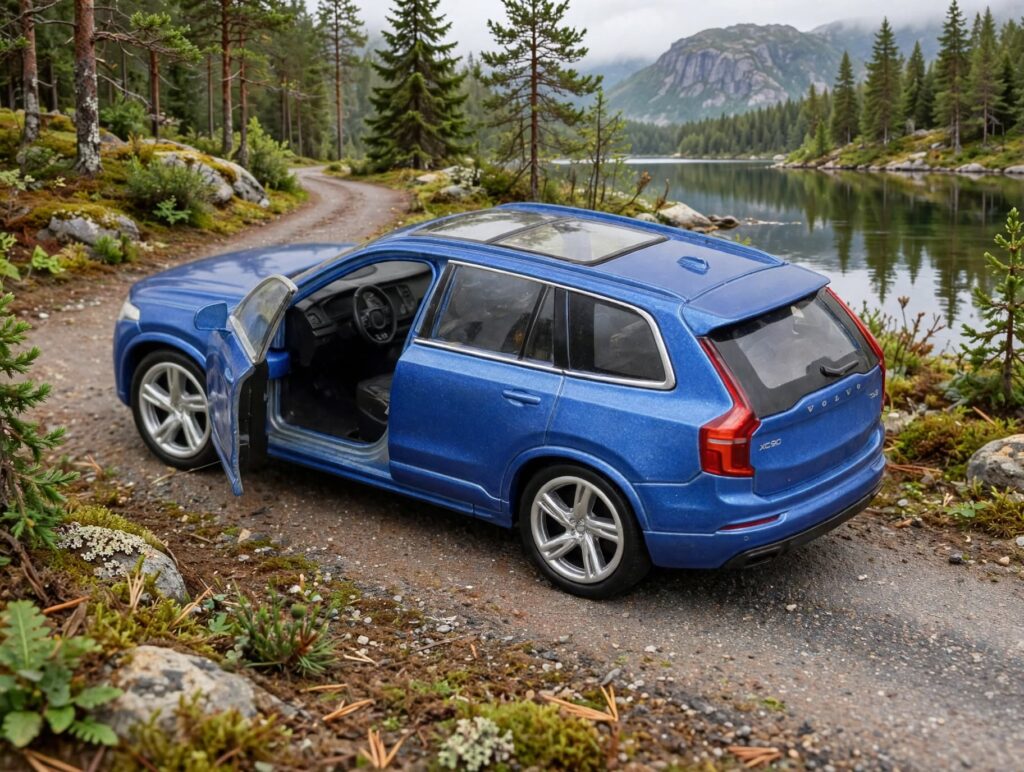
One door opens on this model. It swings on a visible hinge and reveals a dash and a front seat, and the door card itself is a flat panel with no detail printed on it.
I understand the economics. One opening door costs less to tool than four, and it gives the vehicle a play feature on the shelf. What it does in practice is draw your eye to the one side of the car with a wider shut line than the other.
The hinge itself is visible when the door is open, a chunky plastic arm in a color that does not match anything around it. Shut the door and it disappears, so this is a flaw you only meet when you go looking for the feature.
Modern SUVs as castings
They are hard subjects. A modern SUV is a large smooth box with very few hard edges anywhere on it, so there is almost nothing for a casting to grip onto. What saves this one is the chrome trim, the printed lamps and the glass roof, which break up a shape that would otherwise be a solid lump of blue.
Brands that specialize in factory accurate models handle vehicles like this better than the brands that lower and widen everything, and I set out that difference in Matchbox versus Hot Wheels.
Where the XC90 ends up
On the shelf with the other large scale models, alone, because nothing else I own is its size. That is a real cost and I would think about it before buying another in this scale.
What keeps it there is the front three quarter view. From that angle the printed lamps, the chrome grille frame and the window trim all line up, and for a second the model looks like a photograph of the real vehicle. Not many castings at any price or any scale manage that trick.