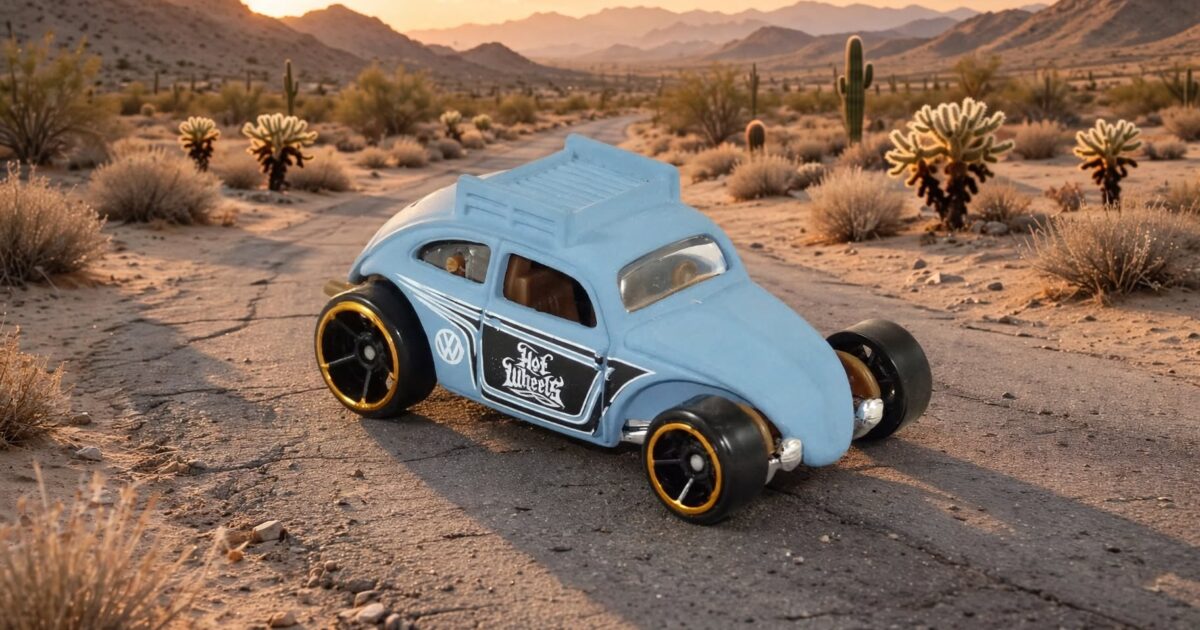
Somebody took a Beetle, dropped the roof, slammed the body onto the ground, pulled the front wheels out past the bodywork on exposed arms, bolted a louvered panel over the back and painted the whole thing pale blue. Every single one of those changes fights the original design.
And you still know what it is from across the room, instantly, before you can name a single detail. That is the thing about this shape, and this casting is a decent test of how far it stretches.
What the Hot Wheels Custom Volkswagen Beetle changes
The list is long. The roof is chopped, so the side glass is now a slot and the rear window is a letterbox. The body sits on the deck with no visible gap under the sills. The front suspension is exposed, with a beam and brown radius arms running forward out of the body to the wheels, which gives it the look of a sand car built for a dry lake.
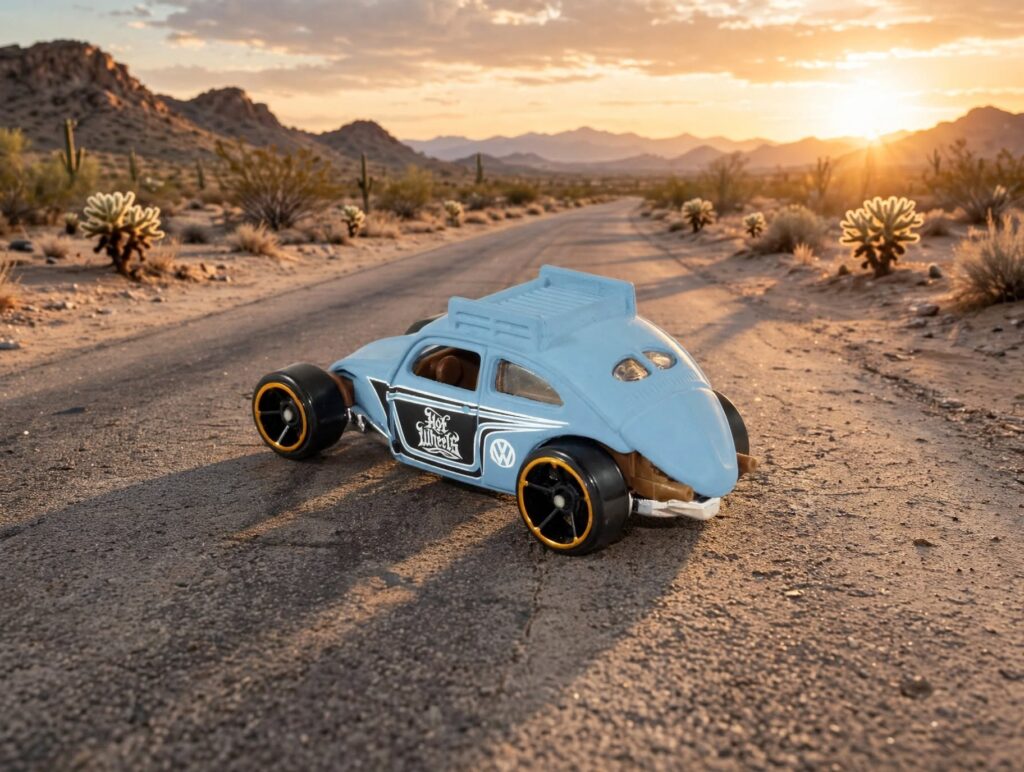
Over the engine deck there is a large louvered panel that stands proud of the body, stepped like a cooling scoop. The front bumper is a thin chrome blade hanging below the nose. The headlights are small clear inserts sunk deep into the fenders.
Why the Beetle silhouette survives all of it
Here is my theory. The identity of this car lives in one line, the arc that starts at the front bumper, rises over the hood, crosses the roof and drops to the tail. It is a single continuous curve, and almost nothing else on the car carries meaning.
Chop the roof and you lower that arc, but you do not break it. Slam it and the arc comes closer to the ground. Add wheels and panels and the arc still reads. Compare that to a modern car, where the identity sits in the grille, the lights and the creases, and cutting any of those produces a shape nobody recognizes.
Pale blue with black and white pinstripe graphics
The body color is a soft powder blue with a flat finish. It is not glossy, and that choice matters: a satin pastel reads as a shop build that has been shot with one coat and driven, not as a showroom car.
On the door there is a black panel outlined in a white pinstripe, with Hot Wheels written inside it in an old fashioned script. Ahead of that sits a small white VW roundel. That is the whole graphics package, and it is restrained for a casting this aggressive.
Gold rimmed wheels and the stance
The wheels are black with a gold outer ring and fine spokes, and the rears are noticeably fatter than the fronts. Classic drag proportion, borrowed straight from the dry lakes and the quarter mile strip.
The gold is the part people will argue about. On a pale blue body it is warm and it stands out, and I think it works, because the car needs some contrast somewhere and the graphics are too small to provide it. If the rims were plain black the whole lower half would disappear into shadow in any photo.
The louvered deck panel is the signature detail
That stepped panel over the engine is what separates this casting from every other custom Beetle. It is cast with individual slats, not printed, so it catches light and throws a row of hard shadows across the back of the car.
Functionally it would feed air to an engine that is working hard. Visually it does something better: it breaks the back of that long curve and gives the rear of the car a flat plane to end on. Without it the tail would just taper away.
The inside of the panel is painted the same blue as the body, which was the right call. Picking it out in black would have made it look bolted on instead of built in.
Where this one sits among other Volkswagens
I have a few Beetles. A convertible, a Super Beetle, a couple of stock ones. They are all recognizably the same car, which is a strange thing to say about a group of models this different from one another.
The full history of why this shape ended up everywhere is on my Beetle page. The short version is that the car stayed in production almost unchanged for decades, so there is no single correct year to copy, and that freedom is why every brand ends up customizing it in a different direction.
What I would check before buying one
The exposed front suspension is the weak point. Those arms stick out ahead of the body with nothing protecting them, and on a loose car they are the first thing to bend or snap. Look at the car from directly above and check that both front wheels still sit square.
The second thing is the flat paint. Satin finishes mark more easily than gloss, and fingerprints sit on the surface instead of wiping off clean. Mine needs a dry cloth after every handling session.
Also look at the louvers. Printed slats on a flat panel would be a different and cheaper casting, so make sure yours are actually cast in. If you want to work out which wave your example shipped in, the card tells you, and I explained how to read it in Hot Wheels case codes.
What the blue Beetle does that my other ones cannot
It makes every stock one on the shelf look better. Park this next to a factory correct Beetle and the stock car suddenly looks tall, narrow and upright, qualities you stop noticing when it is on its own.
That is the real argument for owning an extreme custom of a common shape. It is not that the custom is better. It is that having both of them on the same shelf tells you exactly what the designers changed, and a chopped pale blue Beetle makes that lesson very easy to see.