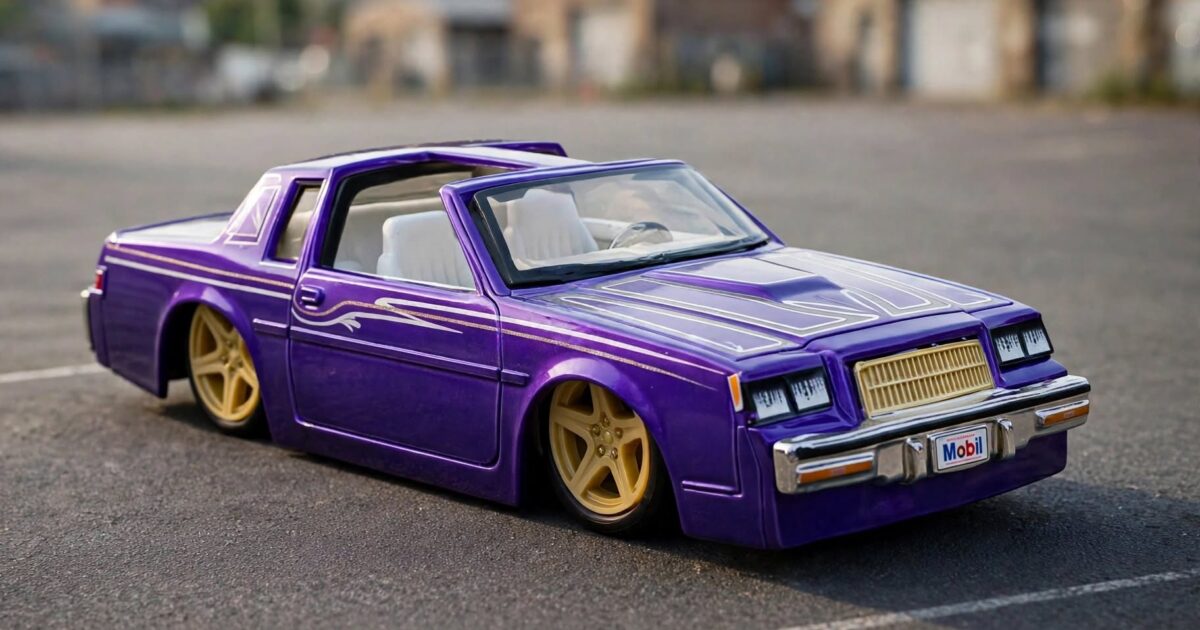
Purple paint, gold wheels, gold pinstriping, T-tops removed and a body slammed to the floor. If you asked somebody to design a car that could only have come from one decade, they would produce something close to this.
What a T-Type was
The Regal T-Type was Buick’s performance version of a car that was otherwise aimed at comfortable middle class buyers. Turbocharged, rear wheel drive, and quick in a way that surprised people who assumed Buick only made cruisers.
It sits alongside the Grand National in the same family, and the two get confused constantly. The short version is that they share the underlying car and differ in trim and equipment, with the Grand National being the version everyone remembers because it was black and because the name stuck.
Either way, the T-Type belongs to a brief moment when American manufacturers rediscovered performance through turbocharging instead of displacement.
T-tops and why they matter on a casting
T-tops are removable glass panels either side of a central roof bar, and they were everywhere in the eighties before manufacturers decided they leaked too much.
On this model the panels are out, which leaves an open roof with the central bar spanning it. That single feature transforms the casting, because a closed coupe shows you nothing and an open one shows you a whole interior.
You can see a white interior through the gap, with seats and a console. The contrast between purple paint and a pale interior is the sort of period combination that manufacturers today would never sign off.
The pinstriping is the detail to notice
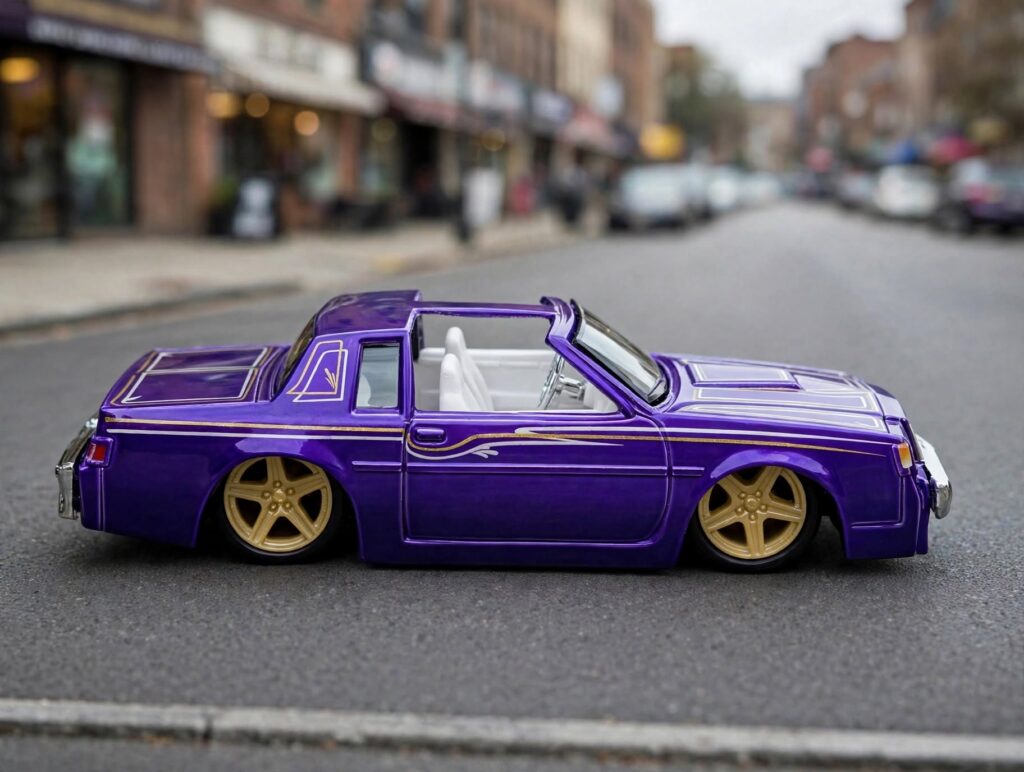
Thin gold lines run the full length of the body, along the shoulder, around the wheel arches and across the boot. There is a scrolled flourish behind the front wheel, the kind a sign painter would have brushed on by hand.
Pinstriping at this scale is genuinely difficult. The lines have to be fine enough to look like pinstripes instead of stripes, and they have to follow body contours without wandering.
Maisto got it. Look closely at where the line crosses the door shut and it stays true.
The gold wheels tie into it, which is a period correct pairing rather than a modern one. In 1987 gold wheels on a dark body was a look people paid extra for.
Lowered, and what that costs
The car sits on the floor with almost no gap above the tyres. It reads as a street custom rather than a stock T-Type, and on this body it works, because the Regal was already a long flat car with a formal roof.
The cost is underside clearance. Anything this low picks up damage on the base and rocker panels from ordinary handling, let alone from being pushed along a surface.
It also means the car photographs badly from above. Get the camera down to bumper height or the stance disappears entirely.
Where Maisto helps a collection
This is the second Maisto I have looked at and the pattern is consistent: unusual subjects, careful bodywork, ordinary accessories.
The strength is the choice of car. Hot Wheels would make a Grand National because the name sells. A T-Type with T-tops out and gold pinstriping is a narrower, stranger thing to produce, and that is exactly what makes it worth owning.
Where they fall short is the usual: plastic tyres and wheels chosen from a parts bin. Here the gold wheels happen to suit the car, which is more luck than policy based on what I have seen elsewhere in the range.
What T-tops were and why they vanished
Removable roof panels either side of a central bar, so you get most of a convertible without losing the structure a fixed roof provides.
They were everywhere through the seventies and eighties, on everything from Corvettes to Firebirds to this Regal, and then they disappeared almost completely.
The reasons were practical. Seals leaked, the panels had to be stored somewhere when removed, and improving convertible engineering made the compromise unnecessary. Modern structural requirements finished the job.
For a diecast collector they are a gift, because an open roof reveals an interior that would otherwise be hidden. If you like castings where you can see inside, T-top cars from this era are an easy and cheap category to hunt.
Buying a loose Regal
The pinstriping is fine printing running the whole length of the body at handling height. That is the worst possible combination, so check both flanks under angled light before anything else. A broken pinstripe is very visible.
Then the open roof. Look straight down into the cabin for dust and scratching on the white interior, and check the central roof bar, which is a thin span and the weakest structural point on the body.
Then turn it over for scraping, since the car sits so low. And check the gold wheel faces, which scuff and show it.
Eighties American cars as a theme
This is territory almost nobody collects, which makes it cheap and interesting in equal measure.
The cars from this decade have a specific visual language: square bodies, formal rooflines, pinstripes, wire or gold wheels, and colours that no manufacturer would approve now. Collected together they look deliberate. Collected singly they look like oddities.
The Regal is a good anchor for that shelf because it has the performance credentials to justify itself alongside the muscle cars, while looking nothing like them.
My recommendation
An unusual subject with genuinely impressive pinstriping, open T-tops that show off an interior, and gold wheels that suit the period instead of fighting it. The low stance costs you clearance and buys you attitude. Check the pinstripes and the roof bar before you pay.