Camaro collectors mostly want two things: the first generation and the current one. The second generation, which ran from 1970 well into the eighties, gets treated as the awkward middle that nobody asks for.
Which is a shame, because by 1981 it had turned into one of the most distinctive shapes Chevrolet ever built.
Why the 1981 car looks like that
The second generation started in 1970 as a clean fastback with a rounded nose. Over the following decade it accumulated changes, mostly forced by safety and emissions regulation, and by the early eighties the front and rear had been reshaped around impact bumper requirements.
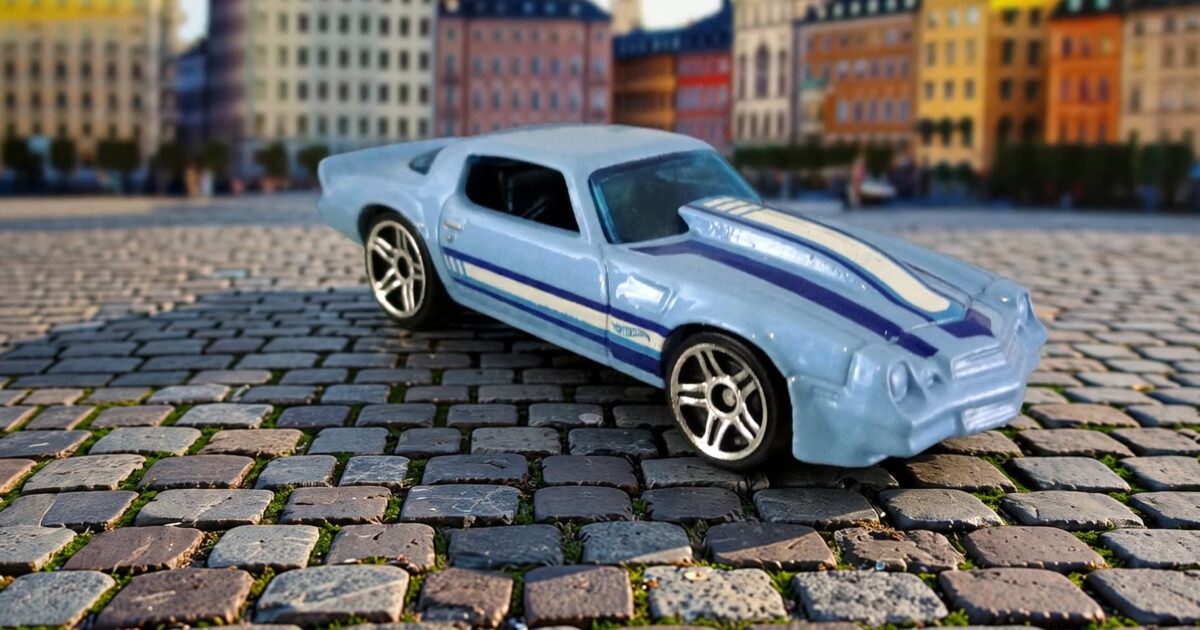
The result is a long nose with a wide, low grille opening split into segments, quad headlights set into square housings, and a rear that sits high and flat. It looks nothing like the 1970 car.
Purists call it the compromised version. I think it has more character than the early cars precisely because the regulations forced it somewhere nobody would have gone voluntarily.
The scoop and the Pro Stock treatment
The casting is not stock. It carries a large forward facing hood scoop, oversized relative to anything Chevrolet fitted, sitting on a raised bonnet section.
That is drag racing language. Pro Stock cars ran enormous scoops because the engines underneath needed the air, and the visual has been borrowed here to signal what the car is for.
It works because the 1981 body was already long and flat across the bonnet. There was room for it. Try the same thing on a short nosed car and it looks like a hat.
Light blue with a blue and white stripe package
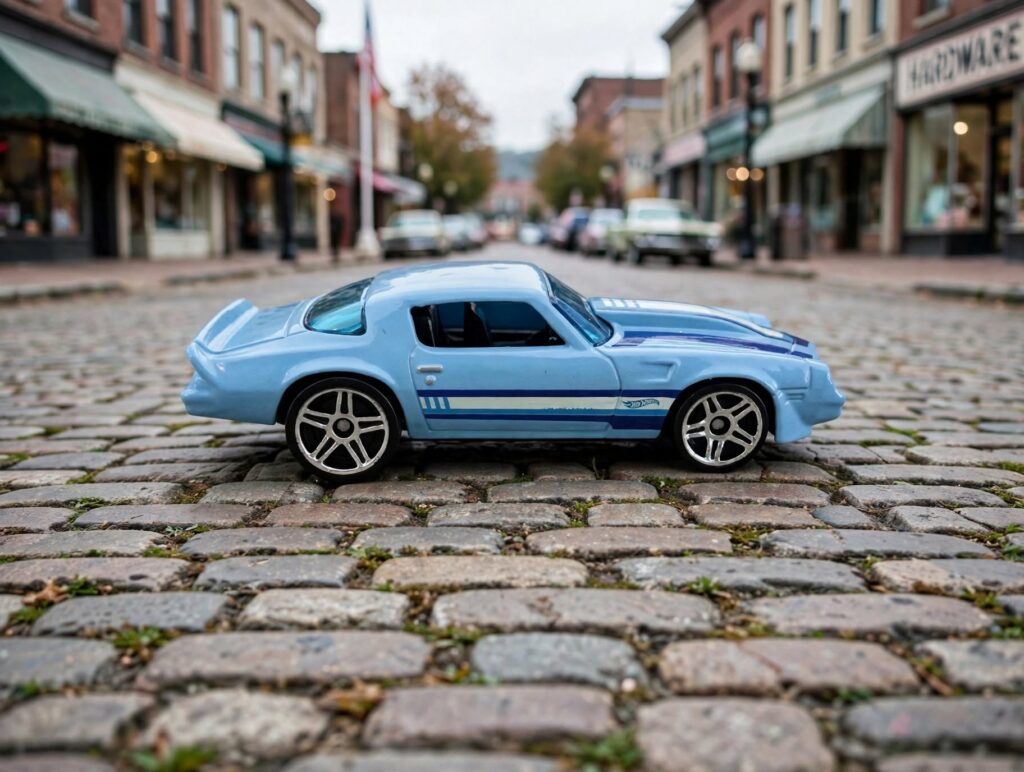
The deco is period correct in a way I appreciate. A wide white stripe bordered in dark blue runs over the bonnet and along the flanks, tapering as it goes, with additional hash marks behind the front wheel arch.
Stripe packages on Z28s in this era were exactly this: bold, geometric and applied over a pale body colour. It reads as a factory option rather than an invention.
The pale blue underneath is doing quiet work. A dark colour would have swallowed the stripe and a bright one would have fought it. This lets the graphic sit on top without competing.
Why second generation castings are cheap
Simple supply and demand. Fewer people want them, so fewer get made, and the ones that exist sit on shelves instead of getting cleared by collectors.
For a buyer that is an opportunity. You can assemble a run of second generation F-body cars for a fraction of what an equivalent group of first generation Camaros would cost, and the shapes are more varied because the design changed so much across the decade.
The catch is availability rather than price. Cheap and rarely produced is a frustrating combination, because you cannot simply go and buy one when you decide you want it.
The Camaro and Firebird problem
These two get confused constantly and they are close cousins rather than the same car. Both were F-body vehicles built on shared underpinnings, and from a distance the profiles match.
The front ends separate them immediately. A second generation Camaro has a wide low grille opening below a body coloured bar. A Firebird of the same years has a split nose with two openings either side of a central point, and usually a large decal across the bonnet.
The rear lights differ too, and so do the badges, though badges are the least reliable check on a small casting.
If you are building an F-body shelf, having both is worthwhile precisely because the comparison shows how General Motors differentiated two cars that shared most of their structure.
Buying a loose ’81 Z28
The scoop first. It stands proud at the highest point of the bonnet and it is the first thing to take a knock. Check it is straight and that the leading edge is not chipped.
Then the stripe where it crosses the bonnet crown, since that is where handling wear concentrates on any car with graphics over the nose.
The front bumper on this generation is a wide low piece that sits ahead of the wheels, so it scrapes. Look at it straight on.
Pale blue shows dirt more than damage, so a grubby looking car in photos is often fine once cleaned. Ask for a photo under decent light rather than assuming the worst.
Where it goes on the shelf
Put it with the other awkward American cars from the late seventies and early eighties rather than with the muscle era. Grouped with its contemporaries it reads as a moment in design history. Next to a ’69 Camaro it just looks like the one that went wrong.
That grouping is one of the cheapest interesting shelves you can build, because almost nobody else is building it.
Verdict on the second gen
A distinctive shape most collectors ignore, wearing a period correct stripe package and an oversized scoop that suits the long bonnet. Cheap when you find one, and you will have to find it rather than buy it on demand. Check the scoop before you pay.