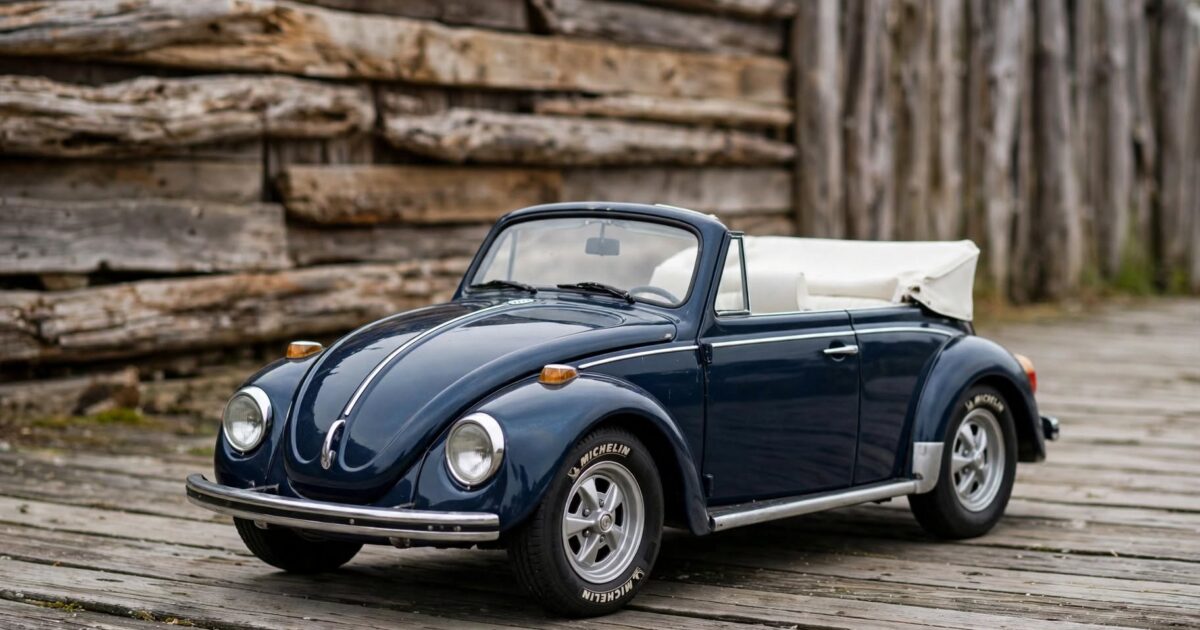
The first thing I noticed was the wheels. Not because they are flashy, but because they are correct: narrow chrome rims with the right diameter for a 1970s Volkswagen, instead of the oversized alloys that most brands bolt onto everything.
That single decision tells you what Johnny Lightning is for.
What makes a Super Beetle different
The Super Beetle was Volkswagen’s attempt to modernise a car that was already decades old. The main change was the front suspension, which moved to MacPherson struts and freed up space under the bonnet, and that in turn gave the nose a slightly different profile.
You can see this change in the casting. The bonnet is a little longer and flatter than on an earlier Beetle, and the front wings sit differently around it. Put it next to a classic Beetle and the difference is subtle and real.
For a collector, this matters because most manufacturers make one generic Beetle and call it done. Choosing the Super and then modelling the nose correctly is the sort of thing that separates a serious brand from a casual one.
The cabriolet body and the folded top
Beetle convertibles were built by Karmann, and the folded top is the detail everybody recognises. When it comes down it does not disappear; it stacks up behind the rear seats in a thick roll that sits proud of the body line.
This casting reproduces that in cream coloured plastic, and getting the height right matters. A folded top that sits too low looks like a mistake, and one that sits too high turns the car into a hunchback.
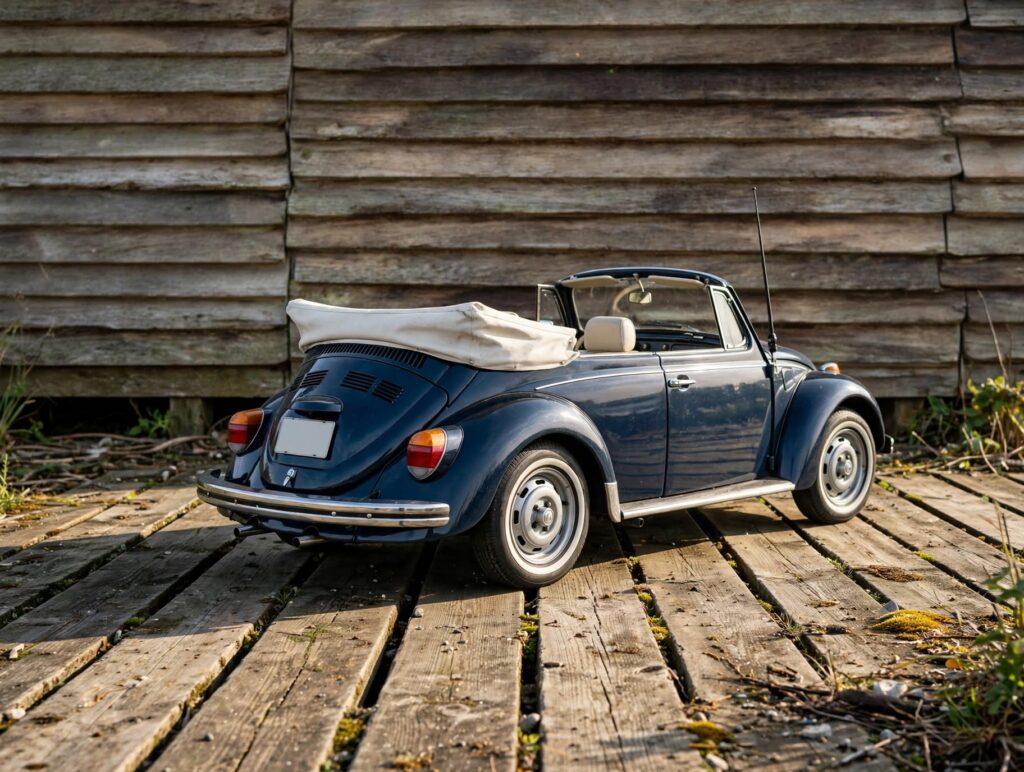
Behind it you can see the interior in the same cream, with seats and a dashboard visible. Open cars give you this and closed ones do not, which is why a cabriolet is worth having even when the coupe is the more famous body.
Chrome that behaves like chrome
Dark blue paint with chrome bumpers, chrome window surrounds, chrome running board trim and a chrome strip down the bonnet. That is a lot of brightwork on a small car and it is the hardest thing to execute at this scale.
What Johnny Lightning did right is keep the chrome thin. Real trim on a Beetle is delicate, and the common mistake is to mould it thick enough to survive production, which makes the car look clumsy. Here the bonnet strip is a fine raised line and the window surrounds are barely there.
The headlights are separate clear pieces set into the wings rather than painted circles, and the indicators on the front wings are picked out in amber.
Where Johnny Lightning sits
The brand occupies the detailed end of the market, closer to Greenlight than to a supermarket mainline. The emphasis is on realistic subjects, accurate proportions and period correct wheels rather than on fantasy customs.
That makes it a natural fit for anyone whose shelf leans toward real cars. It also makes it a poor fit if you want the exaggerated stances and loud graphics that Hot Wheels does well.
Availability is the honest limitation. These are not supermarket cars and the range is narrower, so you buy them deliberately rather than stumbling across them.
Beetles across brands
The Beetle is made by almost everybody, which makes it a useful car for comparing manufacturers directly. Buy three Beetles from three brands and you learn more about each brand than any review can tell you.
The things to compare are the nose profile, the wheel choice and the thickness of the chrome. Those three reveal how much research went into the casting, because they are the details that are easy to approximate and hard to get right.
If you want the background on the real car, our piece on the Beetle covers it.
Which Beetle variant are you actually buying?
Listings treat every Beetle as interchangeable and they are not. There are four things to separate before you agree a price.
Standard or Super, which is the suspension change and shows in the bonnet profile. Coupe or cabriolet, which changes the whole rear of the car. Split or oval rear window, which dates the very early cars and commands far more money. And decade, because bumpers, indicators and engine lids all changed repeatedly across forty years of production.
A seller writing “classic VW Beetle” has told you almost nothing. Ask for a photo of the rear three quarter, which shows the window, the engine lid and the bumper shape in one frame.
The practical consequence is that you can own five Beetles without repeating yourself, which is not true of most subjects.
Buying a loose Super Beetle
The chrome is thin, which is why it looks good and also why it damages. Check the bonnet strip and the window surrounds under a light, since a bent or rubbed trim piece is very visible against dark paint.
Then the folded top. It is a separate piece sitting at the highest point behind the cabin and it can be knocked loose or scuffed.
Then look down into the cabin. Open cars collect dust and scratches that closed ones hide behind glass, and on a cream interior every mark shows.
Dark blue hides fine scratches and shows chips, so check the wing edges and the bumper corners rather than the flat panels.
My honest take
A carefully researched casting of a specific Beetle variant, with correct wheels, restrained chrome and a folded top that sits at the right height. It costs more than a mainline and it shows you exactly where the money went. If your collection is drifting toward realism, this is the kind of car that pushes it further.