Say Bburago to most collectors and they picture a shelf model. Something the size of a shoe, with doors that open and a hood you can prop up, bought from a toy shop and displayed on a bookcase. That is the business this brand built its name on.
So a Bburago in 1:64 is a different proposition. It is a company whose instincts formed at a scale where almost everything is possible, now working at a size where almost nothing is. This matte black Audi R8 is a good test of what survives that change.
What the Bburago Audi R8 keeps from the real car
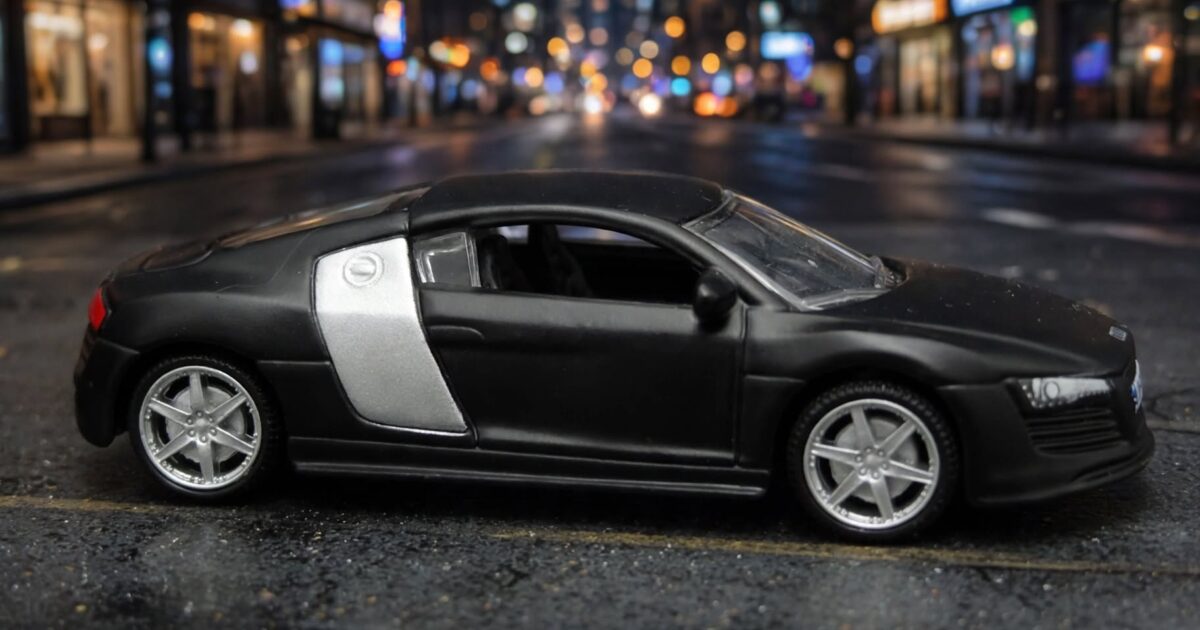
The proportions, first. The R8 is a mid engine car with a cabin pushed forward, a long flat deck behind it and a nose that drops away early, and the casting holds all three. It is not a generic wedge with an Audi grille stuck on the front.
The front is a single wide opening with the four rings in the middle, flanked by two intakes in the lower bumper. The headlights sweep back along the fenders. At the rear the deck is flat and wide, with the engine cover shapes suggested in the casting.
The sideblade and why it carries the whole car
The R8 had one design feature that made it instantly recognizable, a large panel behind the door, finished in a contrasting color, covering the air intake for the engine. On the real car it was a styling decision people either loved immediately or complained about for years.
On this model it is silver against matte black, and it does more work than any other element. Without it the car would be a dark shape with wheels. With it there is a clear break halfway down the body that tells you where the engine sits and which way the car is pointing.
Matte black at 1:64
Flat paint on a small casting is a trade. It kills reflections, which means the body shows its own shape instead of throwing back whatever is above it, and on a car with surfaces this subtle that helps.
The cost is handling. Matte finishes hold marks, and a fingerprint that would wipe off gloss will sit on this surface until you work at it. It also changes how the car behaves under artificial light. A gloss body throws back every lamp around it. This one absorbs them, so in a dim setting it reads as a dark silhouette with a silver stripe down the side.
What a small Bburago gives up
Everything the brand is known for. No opening doors, no hinged engine cover, no steerable wheels, no separately applied metal badges. At this size none of that is possible without pushing the price somewhere a peg will never support.
What remains is a body, a glass insert, an interior tub, a base and four wheels. That is the recipe every brand uses at this scale, and it is the honest answer to anybody expecting a shrunken version of the big models.
The interior and the glass
Through the windscreen and the side glass there is a dark interior with two seats, a center console and a steering wheel. Unpainted, as expected, and visible mostly from a high front angle because the glass is raked hard.
The rear window is small and the engine deck behind it is long, so the car reads correctly from the side: a short cabin sitting well forward of the back axle. That silhouette is the quickest way to tell a mid engine car from a front engine one, and it survives at this size.
The glass is a single clear piece covering the windscreen and both side windows. That means the pillars are transparent where the real car has body color, and on a black car it shows up less than it would on a light one.
The rear end is where the detail went
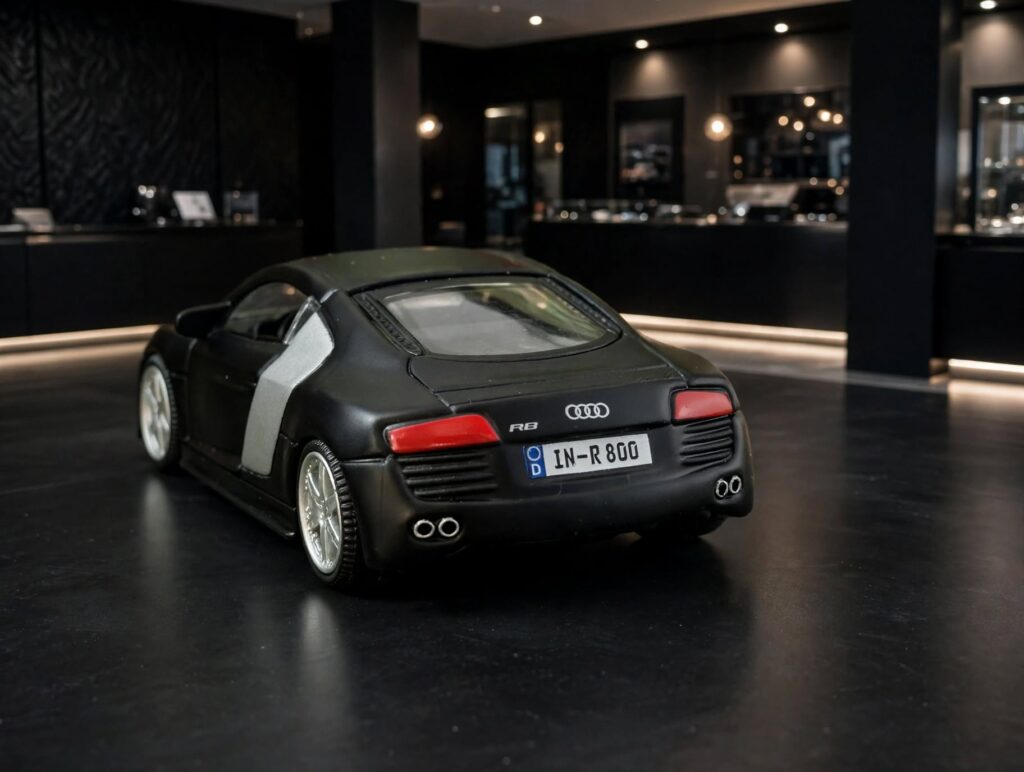
Walk around the back and the model stops being plain. The four rings and the R8 lettering are both printed on the tail panel, the lamps are solid red blocks set into the bodywork, and the valance below carries four exhaust tips in two pairs, one at each corner.
There is even a German plate, white with a blue strip, printed with a registration that references the car itself. That is the kind of detail I associate with much larger models, and finding it here says something about where this brand’s habits come from.
The wheels are six spoke silver designs that fill the arches and sit flush with the bodywork. The car is low and level, with no rake and very little gap over the tires, which is how a modern supercar should sit.
Is a budget supercar casting a good starting point
For somebody building a first shelf, yes. Supercars are the easiest category to buy badly, because the expensive looking ones tempt you into paying more than a small model will ever return. My guide to starting a collection covers how to spend a small budget well.
A matte finish and a premium nameplate also make a casting look more special than it is. If you want to know what actually separates a common release from a scarce one, I went through it in Treasure Hunt versus Super Treasure Hunt.
What the R8 proves about scale and brands
That a brand’s reputation does not transfer down. Everything that makes a large Bburago appealing lives in features this size cannot carry, so the small car has to compete on exactly the same terms as everybody else: shape, paint, stance, wheels.
On those terms it does fine. The silhouette is right, the sideblade is well executed and the matte black suits the body. It is not a small version of a big Bburago. It is a decent small car that happens to carry that name on its base, and it has to earn its place the same way the rest of them do.