Go looking for a Corsa in the mainline ranges of the two biggest diecast brands and you will be looking for a long time. Muscle cars, pickups, supercars and Japanese tuners, all of those, yes. A small European hatchback that sold in enormous numbers across an entire continent, no.
That absence has nothing to do with the car and everything to do with who the toy is for. This red Welly Opel Corsa D exists because a different company sells into different markets, and it is a useful reminder of how much of what we collect was decided by a sales department.
Why the Welly Opel Corsa D exists at all
The big American brands build for the pegs in American stores, and those pegs are stocked with what sells there. A European supermini is a shape most of that audience has never seen on a road, so it never makes the cut.
Brands with European roots work the other way around. They fill their ranges with hatchbacks, city cars, vans and the compact models that actually fill the streets their customers walk down. The same logic is why a French brand makes castings an American one never would, something I went into in my notes on collecting Majorette.
What the Opel Corsa casting gets right
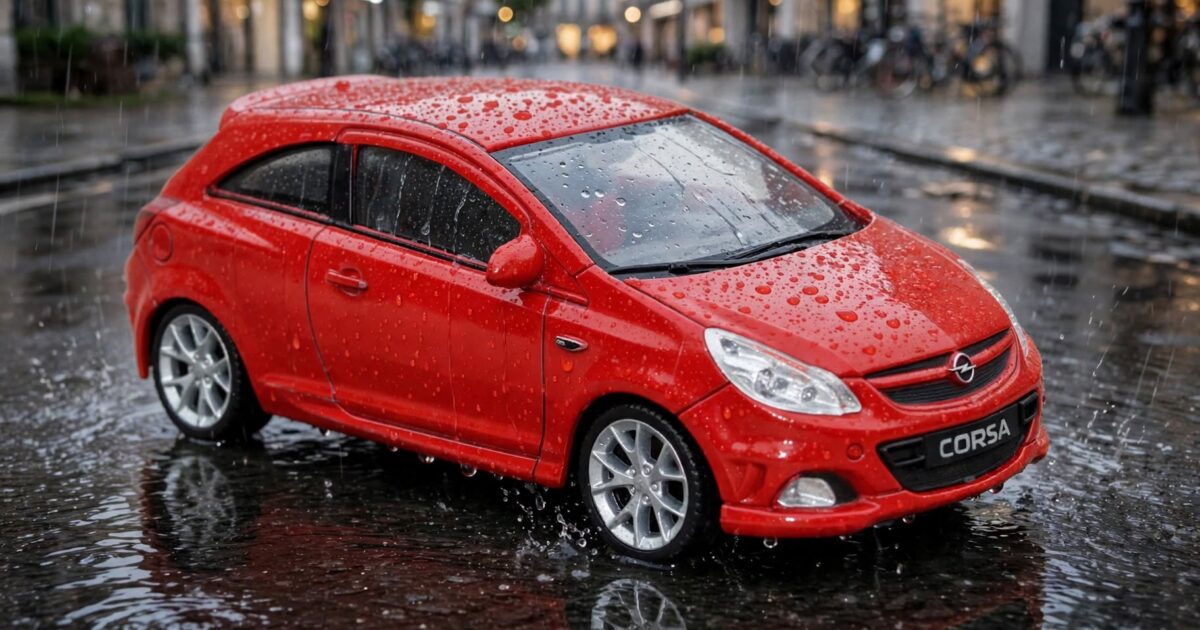
The proportions, which is the hard part on a car this plain. The Corsa D had a high waistline, a steeply raked windscreen and a roof that drops away toward a short tail, and all of that is here.
The rising crease along the lower doors is cast in, not printed, so it catches light the way the real pressing did. The rear quarter panel swells out over the wheel, the roof spoiler is a separate shape at the top of the hatch, and the window surrounds are picked out in gloss black against the red.
Red paint on a small casting
The red is bright and properly glossy, with no orange in it. Coverage on mine is even across the roof and the hood, and the gloss level is high enough that the body reflects whatever is above it.
That gloss is a double edged thing. It makes the car look expensive on a table under good light. It also hides shape, because a highly reflective surface throws back light instead of showing the shadows that define a crease. Photograph this car badly and it turns into a red blob with wheels. Side light, late in the day, is the only way I have found to get the creases to show up properly.
Wheels, arches and the stance
The wheels are silver multi spoke alloys with a fine spoke count, and they are a fair copy of what the sportier versions of this car wore. They fill the arches without stretching them, and the tires are plain black with a low profile that suits the body.
The stance is slightly lower than a standard road car, which is a choice I like here. A supermini at factory ride height looks tall and slightly apologetic. Dropping it a millimeter gives the casting some intent without turning it into a custom.
Badges, lettering and the small print
The grille carries the Opel lightning bolt in a chrome surround, and the same badge appears again on the hatch. Both the front and rear number plates simply read CORSA, which is a convention these brands use instead of inventing a registration.
It is a sensible shortcut. A made up registration would tie the model to one country, and these get sold across a lot of them.
Along the lower rear there is a thin chrome strip and a CORSA script in small lettering. The lights are printed: clear with an amber section at the front, red with a darker inner section at the rear. Printed lamps are the honest limit of what this price point allows, and at this larger scale they are more visible than they would be on a small casting.
Where the detail runs out
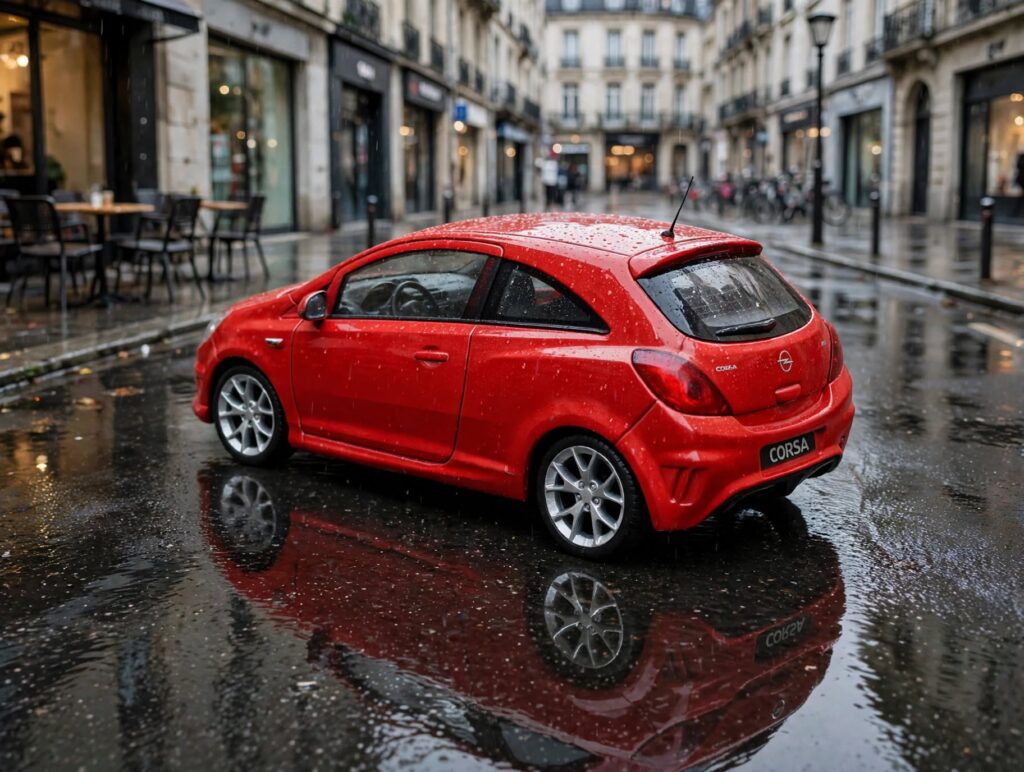
Two places. The interior is a single color with seats, a dash and a wheel, all unpainted, and the glass is large enough that you look at it constantly. The second is the underside, which is a plain plate with the axles visible and no attempt at exhaust or suspension detail.
The doors on mine do not open either, which I count as a fair trade. A sealed body at this size means the shut lines stay tight and the flanks stay clean, and on a small hatchback those flanks are most of what you see.
Neither is a surprise at this price. I mention them because larger scale models invite closer inspection, and the things you forgive on a three inch casting start to look like omissions when the model is twice that long.
Collecting cars that the mainlines ignore
This is the real argument for brands outside the big two. Their ranges hold vehicles the mainstream lines will never touch: superminis, European vans, small diesel hatchbacks, estate cars, the stuff that fills an actual supermarket car park on a Saturday.
If you only ever buy from the mainline pegs, your collection ends up looking like a motor show instead of a street. For context on what those mainline ranges are built to be, I wrote about it in what a Hot Wheels car actually is.
Who the red Corsa is for
Not for someone chasing value, and not for someone building a 1:64 display, since this is a larger scale model and will tower over small castings.
It is for the collector who wants the cars of one particular place and time. If you grew up anywhere these were everywhere, this small red hatchback does something no Camaro can do: it looks like the car your neighbour owned. That is a narrow appeal, and it is also the entire reason this particular model sits on my desk instead of in a drawer with the overflow.