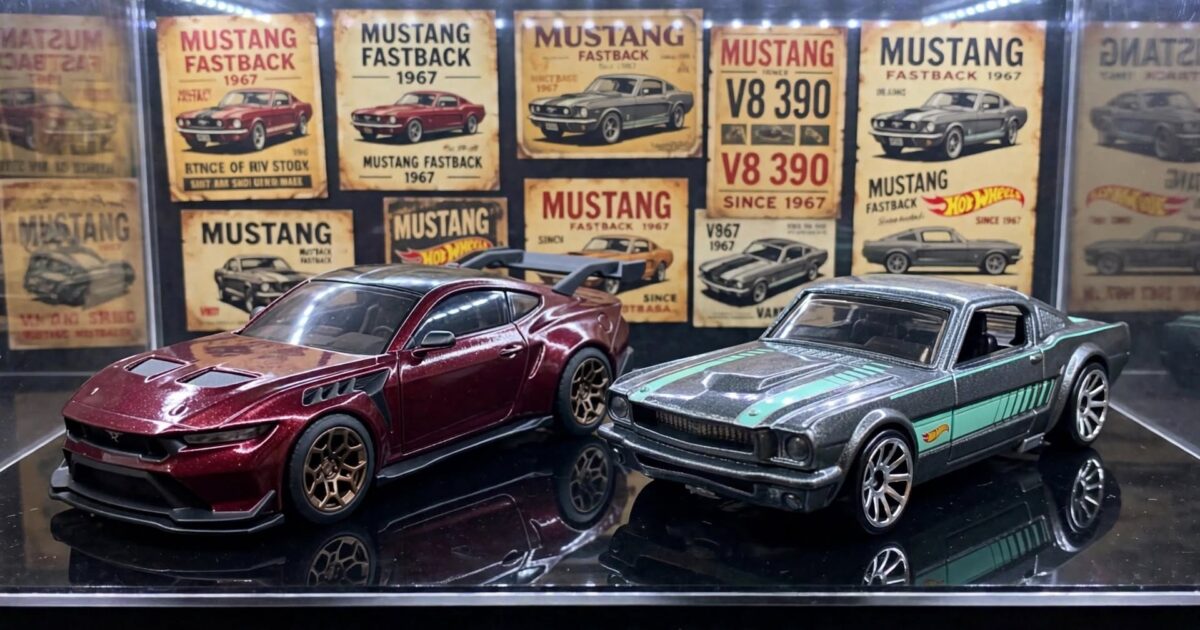
No car in this hobby is easier to buy and harder to collect well. Manufacturers produce Mustangs constantly, in every generation and every colour, and it is entirely possible to end up with fifteen of them and no idea why you have any of them.
So this is less a history lesson and more a way of deciding which ones belong on your shelf.
Where the Mustang came from
Ford needed a cheap, small, sporty car for buyers who did not exist as a category yet: young, first-time, not wealthy. The Thunderbird had drifted upmarket and left a gap underneath it.
The solution was to build something new on parts that already existed. The Falcon donated most of the mechanical hardware, which kept the price low, and the body on top was entirely new.
It launched in 1964 and sold in numbers that caught even Ford by surprise. Every pony car that followed, the Camaro included, exists because of what happened next.
Carroll Shelby and what he actually did
Worth clearing up, because this gets repeated wrong constantly.
Shelby did not design the Mustang. He took finished Mustangs and modified them, producing the GT350 and later the GT500 as separate, more aggressive versions sold through a different operation.
That distinction matters when you are buying castings. A Mustang and a Shelby Mustang are not the same car, they do not look the same, and sellers use the names interchangeably when they should not.
Check the stripes, the bonnet and the badges in any listing photo before agreeing that something is a Shelby.
First generation, 1964 to 1973
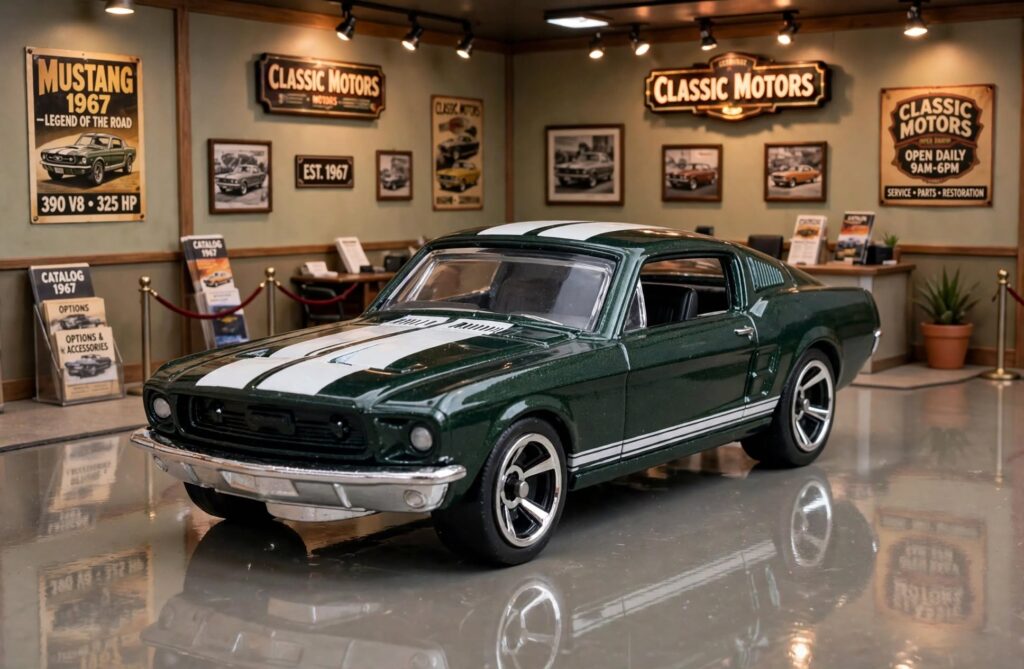
The famous one, and the longest. It also changed enormously across those years.
A 1965 Mustang is small, light and almost delicate. A 1973 Mustang is a much bigger, heavier car with impact bumpers and a wider stance. Same generation, completely different vehicles.
Most castings reproduce the 1965 to 1969 window, with the fastback being the favourite shape. Our review of the Hot Wheels ’65 Mustang Convertible covers the open version.
If you buy one first-generation Mustang, make it an early one. The late cars are interesting precisely because nobody makes them.
Second generation, 1974 to 1978
The Mustang II, and the one everybody leaves out.
The oil crisis hit, fuel economy suddenly mattered more than power, and Ford responded by making the Mustang dramatically smaller. It was built on the Pinto platform and it worked commercially, selling well in a market where big engines had become a liability.
Enthusiasts have never forgiven it. That is exactly why it is worth owning: it is the generation that shows what external pressure does to a product, and almost nobody collects it.
Finding a casting is the hard part. Manufacturers make what sells and the Mustang II has never sold.
Third generation, 1979 to 1993
The Fox body, named after the platform underneath, and the longest-running Mustang of all.
It arrived angular and boxy, and it stayed in production for fourteen years with constant updates. Convertibles returned in 1983, and by the mid eighties fuel injection had replaced carburettors on the V8, which enthusiasts disliked until they drove the result.
Fox bodies have become genuinely collectible in the real market over the last decade. The diecast side is starting to follow, which makes this a good moment to buy castings before prices move.
Fourth generation, 1994 to 2004
Rounder, smoother, with the sharp edges of the Fox body sanded away. The side scoops and the three-element tail lights are the giveaways.
It is also the generation that outlasted its rival. Chevrolet stopped building the Camaro in 2002 and the Mustang carried on alone for seven years, which is a detail worth knowing if you are building both shelves.
Like the fourth-generation Camaro, this one is underrepresented in 1:64 because it falls between the classic era and the modern one.
Fifth and sixth generations, 2005 to 2023
The fifth generation went retro, pulling the 1960s proportions back into a modern car years before Chevrolet did the same with the Camaro. That head start is part of why it worked.
The sixth, known internally as the S550, arrived for the 2015 model year with independent rear suspension and a shape aimed at markets outside the United States, which is the first time a Mustang was designed with Europe genuinely in mind.
Both are well covered in 1:64 and both are cheap. If you want a modern Mustang, buy whichever shape you prefer, because availability is not the constraint.
Seventh generation, 2024 onward

Ford revealed the seventh generation at the Detroit Auto Show in September 2022, codenamed S650, and it reached buyers as a 2024 model.
It is an evolution rather than a clean sheet. Ford kept the familiar profile of the S550 underneath and concentrated the changes on a heavily revised front end, a reworked rear deck and angular triple LED tail lights.
One detail worth knowing if you are checking a casting against the real car: on the previous generation the only way to tell an EcoBoost from a V8 GT was the badge on the boot lid, and Ford changed that for the seventh so the two are distinguishable from the outside.
As I write this in 2026 the S650 is the current car. There will be an eighth eventually, which is worth remembering before you decide your shelf is finished.
Building a Mustang shelf that says something
One per generation, which means seven cars as things stand in 2026. That is the discipline that keeps this from turning into a pile, and it is a project that grows rather than one you finish.
The useful comparison is to put the Mustang shelf next to a Camaro shelf, generation for generation. The two companies were answering the same question in the same years with different assumptions, and the differences are legible in the metal.
If you collect Ford more broadly, our Ford Motors guide covers the wider group.
Frequently asked questions
How many Ford Mustang generations are there?
Seven as of 2026, from 1964 onward, with no break in production. The seventh, codenamed S650, arrived as a 2024 model.
Is a Shelby Mustang the same as a Mustang?
No. Shelby versions were modified from standard Mustangs and sold as separate, higher-performance models with their own styling.
What is a Fox body Mustang?
The third generation, built from 1979 to 1993 on Ford’s Fox platform. It is the longest-running Mustang generation.
Which Mustang generation is hardest to find in 1:64?
The second, the Mustang II, followed by the fourth. Manufacturers rarely produce either because demand has always been low.
Which Mustang should a collector buy first?
A mid-sixties fastback is the obvious starting point. A Mustang II is the more interesting one, if you can find it.